
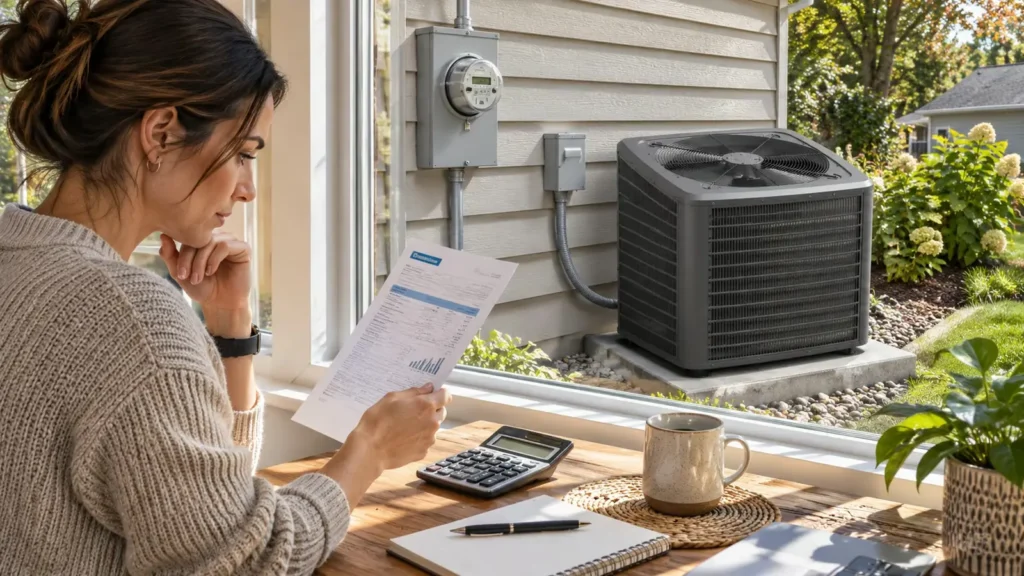
Heat pump electricity usage for a whole home is typically 2,000 to 8,000 kWh a year, according to PICKHVAC, or about 170 to 670 kWh a month on average. At the U.S. average residential price of 18.16 cents per kWh in August 2026, reported by the EIA, that works out to roughly $360 to $1,450 a year.
Of course, your own usage depends on your climate, your home’s insulation and the size and efficiency of your system. Below, we show typical heat pump electricity usage by climate and size, explain how to estimate your own and list the biggest ways to cut it. Information checked on November 3, 2026.
Heat pump electricity usage by climate
Climate is the biggest factor, because it decides how many hours your heat pump runs each year. For example, PICKHVAC gives these annual ranges for whole-home heating and cooling:
| Climate | Annual usage (PICKHVAC) | Monthly average | Annual cost at 18.16¢/kWh |
|---|---|---|---|
| Mild (Pacific Coast) | 1,500–3,000 kWh | 125–250 kWh | $270–$545 |
| Mixed (Mid-Atlantic) | 2,500–5,000 kWh | 210–420 kWh | $455–$910 |
| Hot-humid (Southeast) | 3,000–6,000 kWh | 250–500 kWh | $545–$1,090 |
| Hot-dry (Southwest) | 2,500–5,000 kWh | 210–420 kWh | $455–$910 |
| Cold (Upper Midwest) | 4,000–9,000+ kWh | 335–750+ kWh | $725–$1,635+ |
Keep in mind that usage isn’t spread evenly. In fact, most of it falls in winter in cold regions and in summer in hot ones, so your bills will swing from month to month.
How much power a heat pump draws while running
While it’s actively heating or cooling, a whole-home air-source heat pump often draws about 2–6 kW, according to PICKHVAC. The figures also vary by system type:
| System | Typical running power | Typical daily use |
|---|---|---|
| 1-ton ductless mini-split | 0.6–1.2 kW | 5–20 kWh heating; 3–10 kWh cooling |
| 2–3-ton central air-source | 1.5–3.5 kW | 15–60 kWh heating; 10–40 kWh cooling |
| 3–4-ton cold climate air-source | 1.8–4.5 kW | — |
| 3–4-ton geothermal | 1.2–2.5 kW | 15–45 kWh heating; 8–30 kWh cooling |
| Electric backup heat strips | 5–20 kW extra | — |
Also, notice the last row. Backup heat strips can draw several times more power than the heat pump itself, so how often they run has a big effect on your bill.
How to estimate your own heat pump electricity usage
You can get a rough figure with the formula PICKHVAC uses: power in kW equals the heating or cooling output in BTU per hour divided by the COP times 3,412. For example, a 3-ton (36,000 BTU) heat pump running at a COP of 3 draws about 3.5 kW. On a very cold day, however, its COP might fall to 1.75, which is the ENERGY STAR cold climate minimum at 5°F. At that point, the same output needs about 6 kW.
Similarly, for a seasonal estimate, divide the heat your home needs over the season by the system’s rating:
- Heating: kWh ≈ seasonal heating BTU ÷ (HSPF2 × 1,000)
- Cooling: kWh ≈ seasonal cooling BTU ÷ (SEER2 × 1,000)
Your contractor’s Manual J load calculation gives the seasonal BTU numbers for your home. After that, multiply the kWh by the price on your utility bill.
What raises your heat pump electricity usage
- Leaky ducts: ENERGY STAR says about 20% to 30% of the air moving through a typical duct system is lost to leaks and poor connections.
- Backup heat: as mentioned, resistance strips use far more power than the heat pump, as the table above shows.
- Wrong sizing: an oversized unit short-cycles, while an undersized one runs nonstop and leans on backup heat. See our guide to heat pump sizing.
- Poor insulation and air leaks: because the more heat your home loses, the longer the system runs.
- Skipped maintenance: finally, dirty filters and coils make the system work harder.
How to lower your heat pump electricity usage
- Seal and insulate first. The Department of Energy recommends pairing a heat pump with weatherization measures such as insulation to save more.
- Then seal your ducts, especially if they run through an attic, crawlspace or garage.
- Avoid big thermostat setbacks in winter, since recovering from a deep setback can trigger backup heat strips.
- Change filters every 1–3 months and schedule service each year, as Carrier and Trane recommend.
- Choose a higher HSPF2 and SEER2 when you replace your system. In addition, a cold climate model keeps efficiency higher on frigid days.
Related guides: For the bigger picture, start with our guide on heat pump cost. To compare that with a furnace, use our heat pump vs furnace cost calculator.
Frequently asked questions
How many kWh does a heat pump use per day?
Generally, a 2–3-ton central heat pump uses 15–60 kWh a day when heating and 10–40 kWh when cooling, according to PICKHVAC.
Does a heat pump use more electricity than a furnace?
It uses more electricity than a gas furnace, which mostly burns gas. Compared with electric furnaces and baseboard heaters, however, the Department of Energy says modern air-source heat pumps can cut electricity use by 50%.
Why is my electric bill so high with a heat pump?
Frequent use of backup heat strips is a common cause, along with leaky ducts and poor insulation. For a full checklist, see our guide to heat pump pros and cons.
How much does it cost to run a heat pump per month?
Using PICKHVAC’s annual ranges and the EIA’s August 2026 average price of 18.16 cents per kWh, a typical home pays roughly $30 to $120 a month on average across the year. However, your peak months will be higher.
Sources and review
Sources: PICKHVAC, how much electricity does a heat pump use (September 18, 2025); U.S. Energy Information Administration, Electric Power Monthly, Table 5.6.A (August 2026 data, preliminary); ENERGY STAR Version 6.2 heat pump specification; ENERGY STAR, duct sealing; U.S. Department of Energy, Pump Up Your Savings with Heat Pumps (May 30, 2023); Carrier, how long do heat pumps last (September 15, 2026). All checked on November 3, 2026.
Written by: HVAC Switch. Last updated: November 3, 2026. Read our editorial policy to learn how we research prices, or contact us if you spot an error.