
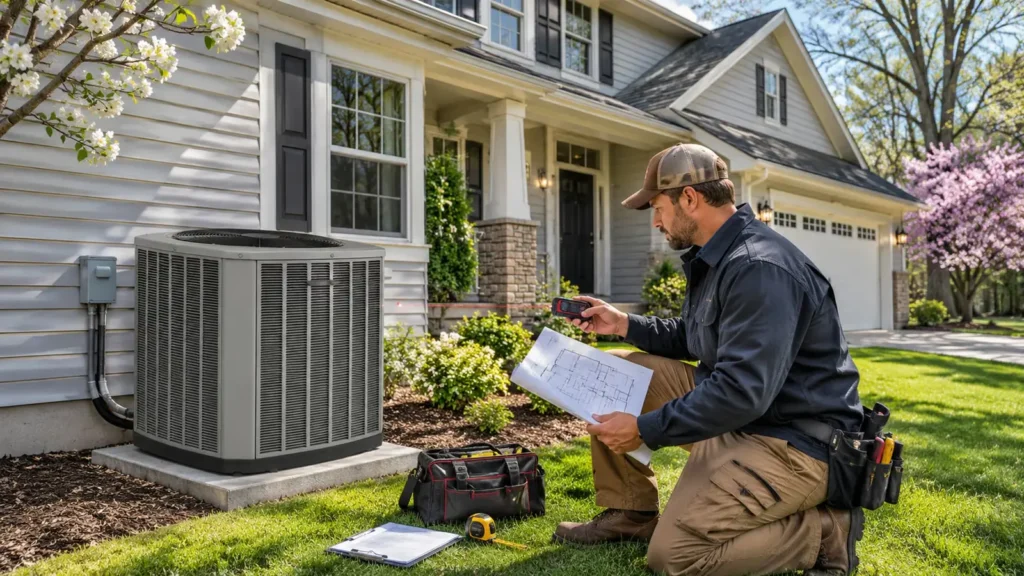
Most 2,000 sq ft homes need a 3- to 4-ton heat pump, or about 36,000 to 48,000 BTU, according to Carrier. Still, the right heat pump size for a 2,000 sq ft house can range from 3 to 4.5 tons depending on your climate, insulation and windows, so a Manual J load calculation should make the final call.
Below, we compare the sizing rules of major manufacturers and HVAC guides, show how climate changes the answer and explain why a unit that’s too big causes as many problems as one that’s too small. Information checked on November 3, 2026.
Heat pump size for 2,000 sq ft: what the rules of thumb say
Heat pumps are sized in tons, and one ton equals about 12,000 BTU per hour. For example, here’s what six sources recommend for a 2,000 sq ft home:
| Source | Rule used | Size for 2,000 sq ft |
|---|---|---|
| Carrier | 1,500–2,000 sq ft = 36,000–48,000 BTU | 3–4 tons |
| Fixr | Typical size by home size | 3–4 tons |
| EnergySage | About 1 ton per 600 sq ft | About 3.3 tons |
| The Furnace Outlet | 1,800–2,200 sq ft row | 3.5 tons |
| PICKHVAC | Detailed sizing chart | 4 tons (48,000 BTU) |
| This Old House | Typical range for 2,000 sq ft | 3–5 tons |
As you can see, most sources land on 3 to 4 tons. However, the spread shows why square footage alone isn’t enough to size a system.
How climate changes the heat pump size for a 2,000 sq ft home
Your climate has a big effect, because a heat pump must handle both summer cooling and winter heating. In hot regions, cooling needs tend to drive the size. In cold regions, on the other hand, heating needs usually do.
| Climate | PICKHVAC example for 2,000 sq ft | Our estimate from The Furnace Outlet’s BTU rates |
|---|---|---|
| Hot | 52,000 BTU (4.5 tons) | — |
| Warm | 44,000 BTU (4 tons) | 18 BTU/sq ft = 36,000 BTU (3 tons) |
| Moderate | — | 22 BTU/sq ft = 44,000 BTU (about 3.7 tons) |
| Cool or cold | 38,000 BTU (3.5 tons) | 25+ BTU/sq ft = 50,000+ BTU (about 4.2 tons or more) |
The two sources treat climates differently, so their numbers don’t always match. That’s exactly why contractors use a load calculation instead. If you live somewhere with harsh winters, also read our guide to cold climate heat pumps. PICKHVAC goes further and suggests a gas furnace in the coldest U.S. climate zones, while a dual fuel system is another option.
Other factors that change the size you need
Even so, two houses of the same size can need very different equipment. According to Carrier, insulation levels, window orientation, window efficiency, air leakage and ceiling height all change the load. The Furnace Outlet adds two practical adjustments:
- Tight, well-insulated homes may use 10–15% less capacity.
- Older, poorly insulated homes may need an extra half ton or more.
PICKHVAC also notes that older windows may push you toward a larger system. As a result, an energy upgrade before you replace your heat pump can sometimes let you buy a smaller, cheaper unit.
Why the wrong heat pump size costs you money
It’s tempting to buy a bigger unit “just in case.” But an oversized heat pump can short-cycle, which means it turns on and off too often. According to Carrier, that can reduce humidity control and wear out components faster. PICKHVAC and AC Direct also warn that short cycles keep the system from dehumidifying your home properly.
Meanwhile, an undersized heat pump has the opposite problem. Carrier says it may run constantly and still struggle to keep your home comfortable in extreme weather. Similarly, The Furnace Outlet notes that constant running can shorten the compressor’s life.
How contractors find the right heat pump size
A professional load calculation is the most accurate method, according to Carrier. Good contractors follow two industry standards from ACCA:
- Manual J calculates how much heating and cooling your home needs, room by room, using your local design temperatures, insulation, windows and air leakage.
- Manual S then selects equipment whose real capacity matches that load.
So if a contractor quotes a size after a quick look at your square footage, ask for the load calculation in writing. It protects you from paying for capacity you don’t need.
Cost of the right heat pump size for 2,000 sq ft
Size drives price, so getting it right also protects your budget. For a 2,000 sq ft home, Fixr puts a ducted air-source heat pump at $8,000–$20,000 installed. Meanwhile, PICKHVAC lists replacement prices of $9,000–$13,000 for a 3-ton unit and $10,000–$14,000 for a 4-ton unit, using existing ducts. For more detail, see our guide to heat pump cost by home size.
Related guides: See also our guide on ducted vs ductless heat pumps.
Frequently asked questions
Is 3 tons the right heat pump size for 2,000 sq ft?
It can be, especially in a well-insulated home in a moderate climate. Carrier’s table puts 1,500–2,000 sq ft at 3 to 4 tons. However, an older home in a hot or cold climate may need 3.5 to 4 tons or more.
How many BTU do I need for a 2,000 sq ft house?
Generally, about 36,000 to 48,000 BTU, according to Carrier. That equals 3 to 4 tons.
Can a heat pump be too big?
Yes. An oversized unit short-cycles, controls humidity poorly and can wear out sooner, as Carrier and PICKHVAC both explain.
Do I really need a Manual J calculation?
Yes, if you want the right size. Rules of thumb for a 2,000 sq ft home range from 3 to 5 tons, and only a load calculation based on your home narrows that down.
Sources and review
Sources: Carrier, what size heat pump do I need (September 15, 2026); PICKHVAC, heat pump sizing (June 3, 2025); AC Direct, system sizing; The Furnace Outlet, what size heat pump do I need; Fixr, heat pump installation cost (updated January 22, 2026); EnergySage, air-source heat pump costs (updated March 19, 2026); This Old House, heat pump cost (updated October 14, 2026); PICKHVAC, heat pump replacement cost (June 27, 2025); ACCA technical manuals. All checked on November 3, 2026.
Written by: HVAC Switch. Last updated: November 3, 2026. Read our editorial policy to learn how we research prices, or contact us if you spot an error.