
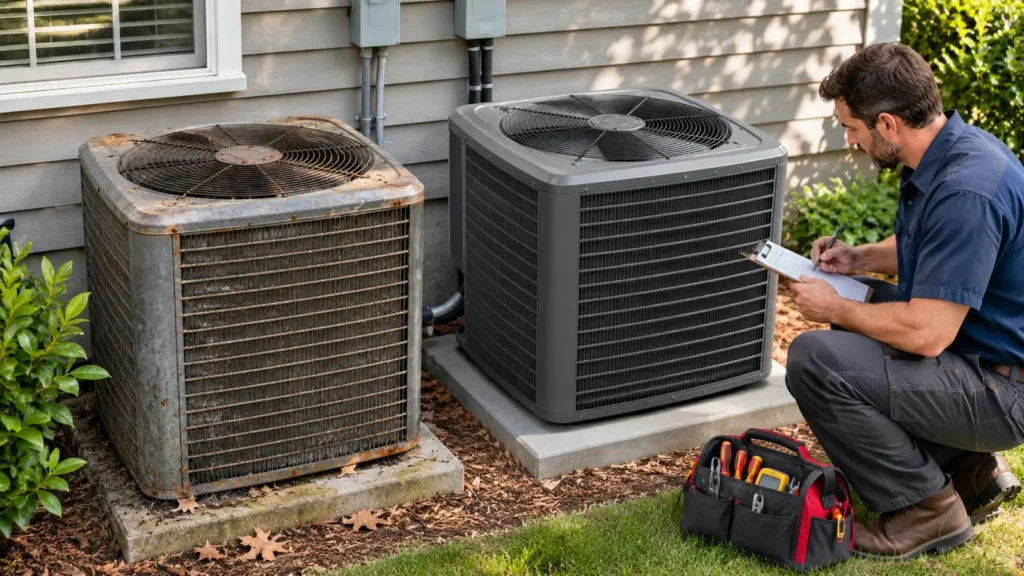
The typical heat pump lifespan is 10 to 15 years, according to Carrier, Trane and Fixr, and well-maintained units often reach 15 to 20 years. However, installation quality, climate and maintenance can shorten that to 8 years or stretch it past 20.
This guide compares lifespan estimates from major manufacturers, explains what wears a heat pump out and shows when replacing it makes more financial sense than repairing it. Information checked on November 3, 2026.
Heat pump lifespan: what manufacturers say
| Source | Typical lifespan | With good maintenance |
|---|---|---|
| Carrier (2026) | 10–15 years | Up to 20 years for high-quality systems |
| Trane | 10–15 years on average | Some Trane units have lasted 25 years |
| Bryant | About 15 years | 15–20 years |
| Fixr (2026) | 10–15 years | 20–25 years possible |
| PICKHVAC (2025) | 12–16 years | More than 20 years |
By type, Carrier says air-source heat pumps generally last 10–15 years, while geothermal systems can exceed 20. Trane, meanwhile, gives ductless mini-split heat pumps a range of 10 to 30 years.
What shortens or extends heat pump lifespan
Because so many factors are involved, two identical units can wear out years apart. According to Carrier, maintenance is “the single biggest variable under your control.” Here’s what matters most:
- Installation and sizing: Carrier says an oversized or undersized unit can cut lifespan to 8–10 years. Similarly, Bryant explains that poor sizing causes short cycling, which wears out the compressor and fan motor early.
- Equipment quality: according to Carrier, high-quality models often last 15–20 years, whereas low-quality models typically last 8–12.
- Climate: extreme heat and long, cold winters add strain, as Carrier and Trane both note. In addition, Bryant says coastal salt spray speeds up corrosion. PICKHVAC, for example, expects units in Florida to land closer to the low end of their range.
- Maintenance: regular service and clean filters keep the system from working harder than it should.
How to extend your heat pump lifespan
- Change the filter often. Carrier and Trane recommend every 1–3 months, depending on the filter.
- Schedule professional service. Bryant recommends service at least once, and ideally twice, a year. Trane suggests every fall and every spring, because the system works in both seasons.
- Keep the outdoor unit clear. Leave 2–3 feet of space around it, according to Carrier, so it can move air freely.
- Fix small problems early. For example, strange noises or longer run times are worth a service call before they turn into a failed compressor.
- Register your warranty. Bryant, for instance, covers internal parts such as the compressor for up to 10 years upon registration.
Signs your heat pump is near the end of its lifespan
Age alone doesn’t mean your heat pump lifespan is over. Still, manufacturers point to a few clear warning signs:
- The unit is more than 13–15 years old (Trane and Carrier).
- Your energy bills keep rising even though your usage hasn’t changed.
- Repairs are becoming frequent or expensive. PICKHVAC treats more than two repairs in a year as a red flag.
- Some rooms stay too hot or too cold, or the system struggles to reach the thermostat setting.
- You hear grinding, rattling or squealing noises.
Trane adds that if performance is dropping, breakdowns are frequent and bills are climbing all at once, it’s time to plan a replacement.
Repair or replace? Two quick rules
- The $5,000 rule: multiply the unit’s age by the repair cost. If the result is over $5,000, replacement usually makes more sense (Fixr and PICKHVAC).
- The 50% rule: if a repair costs half the price of a new system or more, replace it (Carrier and Fixr).
For example, a $700 repair on a 12-year-old heat pump gives $8,400, which points to replacement. To budget for a new system, see our guides to heat pump replacement cost and heat pump cost by home size.
Related guides: See also our guide on heat pump pros and cons.
Frequently asked questions
Can a heat pump lifespan reach 20 years?
Yes, but it isn’t typical. Carrier says high-quality systems can reach 20 years, and Trane has seen its units last 25 years with proper maintenance.
Do heat pumps last as long as air conditioners?
Not quite. Bryant says the heat pump lifespan is a little shorter. It puts heat pumps at about 15 years and traditional air conditioners at 15 to 20, because a heat pump runs in both summer and winter.
Is it worth repairing a 10-year-old heat pump?
Often, yes, if the repair is small. However, Trane notes that a heat pump over 10 years old is usually out of warranty, so a major repair at that age deserves a second look.
How long do ductless mini-splits last?
Trane puts ductless mini-split heat pumps at 10 to 30 years. As with ducted systems, though, installation and maintenance make the biggest difference.
Sources and review
Sources: Carrier, how long do heat pumps last (September 15, 2026); Trane, how long do heat pumps last (updated June 30, 2025); Bryant, how long do heat pumps last; PICKHVAC, heat pump life expectancy (June 3, 2025); Fixr, heat pump repair cost (updated January 21, 2026). All checked on November 3, 2026.
Written by: HVAC Switch. Last updated: November 3, 2026. Read our editorial policy to learn how we research prices, or contact us if you spot an error.