
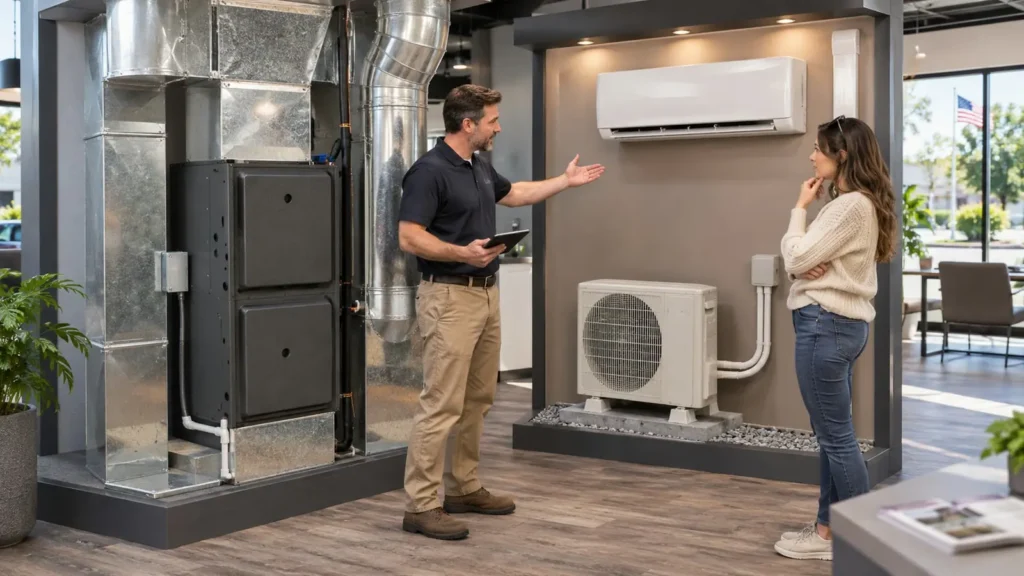
In the ducted vs ductless heat pump decision, ducted usually wins on price when your home already has ducts in good shape, while ductless wins when it doesn’t. EnergySage’s 2026 data shows an average of $3,790 per ton for ducted systems versus $9,163 per ton for ductless ones. On the other hand, ductless systems avoid duct leaks, which waste 20% to 30% of the air in a typical house, according to ENERGY STAR.
This guide compares both options on cost, efficiency and fit, so you can choose with confidence. Information checked on November 3, 2026.
Ducted vs ductless heat pump at a glance
| Ducted heat pump | Ductless (mini-split) heat pump | |
|---|---|---|
| How it works | One indoor air handler sends air through ducts to every room | One or more indoor heads, mounted on walls or ceilings, are linked to an outdoor unit by refrigerant lines |
| Best for | Homes with existing forced-air ducts | Homes, additions or rooms without ducts |
| Average cost per ton (EnergySage, 2026) | $3,790 | $9,163 |
| Typical installed price | $6,500–$12,000 (Modernize) | Single zone: $2,000–$6,000; multi-zone: $8,000–$15,000 (Modernize) |
| Duct losses | About 20%–30% of air in a typical house (ENERGY STAR) | None, because there are no ducts |
| Zoning | Usually one or a few zones | Each indoor head is its own zone |
Ducted vs ductless heat pump cost
For a single room, ductless is clearly cheaper. Modernize puts a single-zone mini-split at $2,000–$6,000 installed, while HomeGuide lists $1,200–$4,000 for one zone. However, the price climbs with every indoor head you add. Modernize prices multi-zone systems at $8,000–$15,000, and EnergySage’s 2026 average for ductless installations was $25,957 before incentives.
In contrast, a whole-home ducted system typically costs $6,500–$12,000, according to Modernize, and EnergySage’s ducted average was $14,529. So if your ducts are usable, a ducted heat pump usually costs less to heat and cool the entire house. If you need new ducts, though, HomeGuide adds $2,400–$6,600 to the bill, which narrows the gap.
For a detailed price breakdown by home size, see our guide to heat pump cost.
Ducted vs ductless heat pump efficiency
A ducted and a ductless heat pump use the same basic technology, so the real difference is often the ducts. According to ENERGY STAR, about 20% to 30% of the air moving through a typical duct system is lost through leaks, holes and poor connections. Ducts in an attic, crawlspace or garage are a common warning sign.
Because a ductless system delivers heat straight to each room, it avoids those losses. Still, a well-sealed ducted system in conditioned space can perform very well. Meanwhile, ENERGY STAR says its certified mini-splits use up to 60% less energy than standard electric radiators, which is why they’re popular in homes with baseboard heat.
For cold climates, ENERGY STAR’s cold climate certification sets a minimum heating efficiency of 8.1 HSPF2 for ducted split systems and 8.5 HSPF2 for ductless ones. Learn more in our guide to cold climate heat pumps.
When a ducted heat pump is the better choice
ENERGY STAR notes that if your home already has ductwork, a ducted air-source heat pump may be the right system, because it connects to the forced-air ducts found in most American homes. A ducted system is also a good fit if:
- You’re replacing a central AC or a furnace and the ducts are sealed and correctly sized.
- You want hidden equipment with no indoor heads on the walls.
- You want one thermostat to control the whole house.
When a ductless heat pump is the better choice
According to ENERGY STAR, mini-splits are increasingly used in these situations:
- Homes with costly electric heat, such as baseboard heaters or wall heaters, that would also benefit from cooling.
- Older homes with radiators or baseboard heat and no ductwork.
- Homes with high fuel costs, such as propane or oil.
- Additions, garages and outbuildings where extending ducts is difficult.
- Rooms next to unconditioned spaces, such as a bedroom above a garage.
- New, high-efficiency homes.
Can you combine ducted and ductless?
Yes. The ducted vs ductless heat pump choice doesn’t have to apply to the whole house. ENERGY STAR points out that mini-splits can heat and cool a whole home, but they also work well to supplement an existing system. For example, many homeowners keep a ducted heat pump for the main floor and add a single-zone mini-split for a hard-to-heat addition or a finished attic.
Related guides: See also our guide on mini-split cost per zone.
Frequently asked questions
Is a ductless heat pump cheaper than a ducted one?
For one or two rooms, yes. For a whole house, usually not: EnergySage’s average cost per ton is more than twice as high for ductless systems ($9,163) as for ducted ones ($3,790).
Do ductless heat pumps work in old houses?
Yes. In fact, ENERGY STAR lists older homes with radiators or baseboard heat and no ducts as one of the most common uses for mini-splits.
Should I replace my ducts or go ductless?
It depends on their condition. If your ducts leak badly or sit in an unconditioned attic, sealing or replacing them costs money, and HomeGuide puts new ductwork at $2,400–$6,600. Therefore, compare that cost with a multi-zone ductless quote before you decide.
Which lasts longer, ducted or ductless?
Our sources don’t show a clear difference between a ducted and a ductless heat pump. Fixr puts the average heat pump lifespan at 10–15 years, and regular maintenance helps either type last longer.
Sources and review
Sources: ENERGY STAR, ductless heating and cooling; ENERGY STAR, duct sealing; ENERGY STAR Version 6.2 heat pump specification; EnergySage, air-source heat pump costs (updated March 19, 2026); Modernize, heat pump cost guide (updated August 12, 2026); HomeGuide, heat pump cost (2026); Fixr, heat pump repair cost (updated January 21, 2026). All checked on November 3, 2026.
Written by: HVAC Switch. Last updated: November 3, 2026. Read our editorial policy to learn how we research prices, or contact us if you spot an error.