
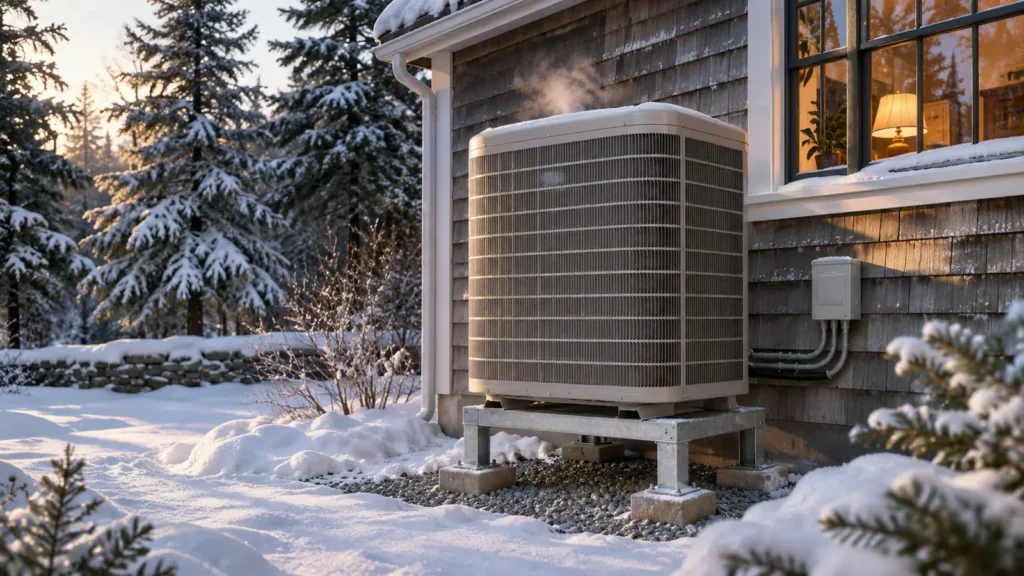
Yes. A cold climate heat pump is built to keep heating in subzero weather. In the U.S. Department of Energy’s Cold Climate Heat Pump Challenge, Carrier’s test units ran at 100% capacity at 0°F and kept working down to −13°F in real homes. Mitsubishi also advertises guaranteed heating down to −13°F for its Hyper-Heat models.
However, every heat pump loses some efficiency as it gets colder, so sizing and backup heat still matter. Below, we explain what the cold climate label actually requires, what tests show about performance below 0°F and what to ask your contractor. Information checked on November 3, 2026.
What makes a heat pump a cold climate heat pump
A cold climate heat pump is designed to keep most of its heating capacity, and a good share of its efficiency, when the outdoor temperature drops. The clearest benchmark is ENERGY STAR’s Cold Climate certification. Under Version 6.2 of the ENERGY STAR specification, a certified cold climate model must meet two low-temperature tests:
- Efficiency: a coefficient of performance (COP) of at least 1.75 at 5°F.
- Capacity: at 5°F, it must deliver at least 70% of the heating capacity it delivers at 47°F.
A COP of 1.75 means the heat pump moves 1.75 units of heat into your home for every unit of electricity it uses. For comparison, electric resistance heat, such as baseboard heaters or backup heat strips, has a COP of 1. In addition, manufacturers must confirm these results with the unit’s own controls, and certified models must report their capacity and COP at 5°F.
| ENERGY STAR requirement | Standard heat pump (split system) | Cold climate heat pump |
|---|---|---|
| SEER2 (cooling) | 15.2 or higher | 15.2 or higher |
| HSPF2 (heating) | 7.8 or higher | 8.1 or higher (ducted); 8.5 or higher (ductless) |
| COP at 5°F | Not required | 1.75 or higher |
| Capacity at 5°F | Not required | At least 70% of capacity at 47°F |
How a cold climate heat pump performs below 0°F
Ratings are useful, but real homes are the true test. That’s why the Department of Energy launched its Cold Climate Heat Pump Challenge in 2021 with eight manufacturers: Bosch, Carrier, Daikin, Johnson Controls, Lennox, Midea, Rheem and Trane.
The Challenge set a higher bar than ENERGY STAR. According to ACHR News, a heat pump of 4 tons or less had to deliver 100% of its nominal capacity at 5°F with a COP of 2.4. It also had to pass a mandatory lab test at −20°F. Field validation in occupied homes then ran from 2022 to 2024, as summarized in a January 2025 report by Pacific Northwest National Laboratory.
Here is what manufacturers reported:
- Carrier: three units installed in Syracuse, New York, homes ran at 100% capacity at 0°F and operated reliably down to −13°F in the field. Carrier also demonstrated operation down to −23°F in its labs.
- Trane: its prototype reached −23°F in lab tests at Oak Ridge National Laboratory, beating the −20°F requirement.
- Mitsubishi: its Hyper-Heat outdoor units are sold with guaranteed heating down to −13°F.
By contrast, a standard heat pump struggles more as it gets colder. As ACHR News explains, traditional models deliver less heating capacity at low temperatures, so they have to run longer. Even so, many current models heat effectively at 5°F and keep working below 0°F, just less efficiently.
Do you still need backup heat with a cold climate heat pump?
Often, yes, but you’ll use it far less. The key question is whether the heat pump’s capacity at your coldest expected temperature covers your home’s heat loss on that day. A room-by-room load calculation, known as ACCA Manual J, answers that question.
If the heat pump falls short on the coldest days, you have two common options:
- Electric backup heat strips inside the air handler. They’re simple, but because their COP is 1, they cost more to run per unit of heat.
- A dual fuel setup that keeps or adds a gas or propane furnace for the coldest hours. EnergySage’s 2026 average for hybrid systems was $14,353 before incentives.
Cold climate heat pump cost
Cold climate models usually cost more than standard ones. In fact, EnergySage notes that they tend to carry a premium, although it doesn’t publish a separate average. For context, its 2026 average for a ducted heat pump of any type was $14,529 before incentives.
Meanwhile, incentives have shrunk. Until December 31, 2025, ENERGY STAR Cold Climate models were one route to the federal 30% tax credit, worth up to $2,000. That credit has now ended, according to the IRS. Federal Home Energy Rebates are only available in select states, so check your state energy office and your utility. For a full price breakdown, see our guide to heat pump cost by home size.
How to choose a cold climate heat pump
- Look for the ENERGY STAR Cold Climate label as a minimum, then compare models that go beyond it.
- Check the spec sheet for capacity and COP at 5°F. Certified models must report both, so you can compare them side by side.
- Ask for the minimum operating temperature and how much capacity the unit keeps at your area’s design temperature.
- Insist on a Manual J load calculation so the system is sized for your home and climate, not just its square footage.
- Decide on backup heat up front, whether that’s heat strips or a furnace, and ask how the controls switch between them.
Related guides: See also our guides on heat pump size for a 2,000 sq ft house and ducted vs ductless heat pumps.
Frequently asked questions
Do heat pumps work at −20°F?
Some can. Trane and Carrier prototypes ran at −23°F in lab tests, and the DOE Challenge required a lab test at −20°F. In real homes, Carrier reported reliable operation down to −13°F. At those temperatures, however, capacity and efficiency are lower, so backup heat is common.
What is a good COP at 5°F?
ENERGY STAR’s Cold Climate minimum is 1.75. The DOE Challenge target was higher, at 2.4 for units of 4 tons or less, so a COP above 2 at 5°F is a strong result.
Is a cold climate heat pump more expensive than a regular one?
Usually, yes. EnergySage notes that cold climate models tend to carry a premium. Still, they can reduce how often you rely on costly backup heat.
What’s the difference between a cold climate heat pump and a regular one?
The main difference is performance at low temperatures. A cold climate model must keep at least 70% of its capacity and a COP of 1.75 or more at 5°F, while a standard ENERGY STAR heat pump has no low-temperature requirement.
Sources and review
Sources: ENERGY STAR Version 6.2 Central Air Conditioner and Heat Pump specification; U.S. Department of Energy, Residential Cold Climate Heat Pump Challenge; PNNL, Performance Results from DOE Cold Climate Heat Pump Challenge Field Validation (January 21, 2025); ACHR News, Trane set to start field tests of cold climate heat pumps (November 8, 2022); Carrier, completion of the DOE Cold Climate Heat Pump Challenge (September 12, 2024); Ferguson, Mitsubishi Hyper-Heat outdoor unit SUZ-AK48NLHZ; ACHR News, the 9 types of heat pumps (February 14, 2023); EnergySage, air-source heat pump costs (updated March 19, 2026); ENERGY STAR, air-source heat pump tax credit; IRS, Energy Efficient Home Improvement Credit. All checked on November 3, 2026.
Written by: HVAC Switch. Last updated: November 3, 2026. Read our editorial policy to learn how we research prices, or contact us if you spot an error.