
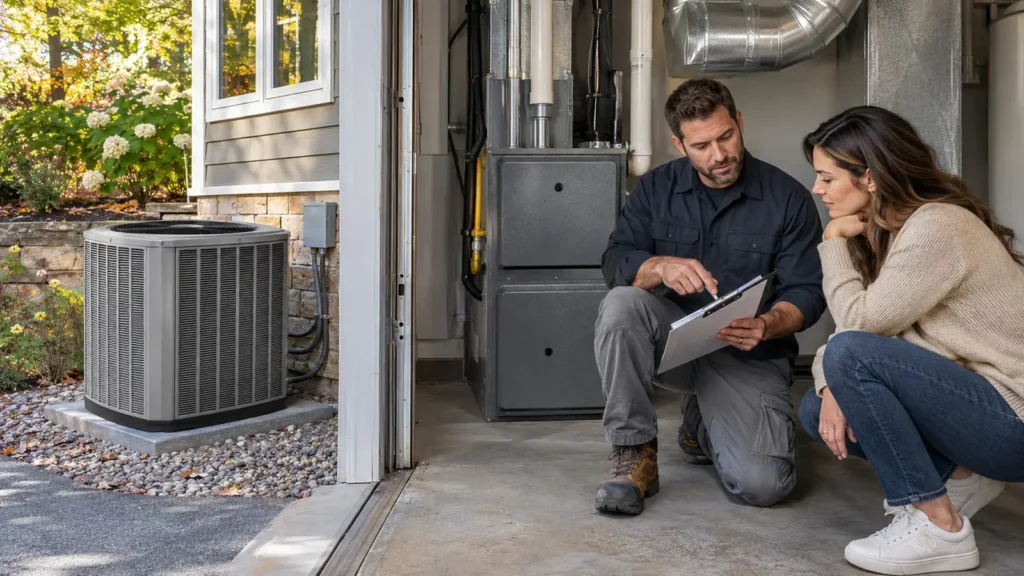
Dual fuel vs heat pump: a dual-fuel (hybrid) system pairs a heat pump with a gas or propane furnace and switches to the furnace when that’s cheaper or the weather is very cold, while a heat-pump-only system relies on the heat pump plus electric backup heat. At current U.S. average prices, a heat pump beats a 95% gas furnace only when it runs at a coefficient of performance (COP) above about 3.9, so dual fuel usually saves money where natural gas is cheap. By contrast, heat pump only tends to win where electricity is cheap or the alternative is propane.
Below, we compare upfront costs, show the break-even point for each U.S. region and explain which setup fits which climate. Information checked on November 4, 2026.
Dual fuel vs heat pump at a glance
| Dual fuel (hybrid) | Heat pump only | |
|---|---|---|
| Equipment | Heat pump plus gas or propane furnace | Heat pump plus electric backup strips |
| Average installed cost (EnergySage) | $14,353 for a hybrid system | $14,529 for a ducted heat pump |
| Average cost (This Old House survey) | $7,905 | $8,007 (air-source heat pump) |
| Fuel needed | Electricity and gas or propane | Electricity only |
| Best fit | Cold climates with cheap gas | Mild climates, cheap power, or no gas line |
In other words, the two setups cost about the same up front, according to both sources. As a result, the real difference shows up in your energy bills.
How a dual-fuel system decides which heat to use
In short, a dual-fuel system uses the heat pump until the outdoor temperature drops to a set switchover point, then hands off to the furnace. The right switchover point depends on comfort and on cost: ideally, it’s the temperature at which the heat pump’s efficiency falls low enough that gas becomes cheaper per unit of heat.
To find that point, we therefore calculated the break-even COP: the efficiency a heat pump must beat to be cheaper than a gas furnace with your local prices. Above that COP, run the heat pump; below it, however, gas is cheaper.
Dual fuel vs heat pump: break-even COP by region
| Region | Break-even COP vs 95% gas furnace | Break-even COP vs 80% gas furnace |
|---|---|---|
| New England | 5.1 | 4.3 |
| Middle Atlantic | 4.5 | 3.8 |
| East North Central | 5.4 | 4.6 |
| West North Central | 4.4 | 3.7 |
| South Atlantic | 3.3 | 2.8 |
| West South Central | 3.1 | 2.6 |
| Mountain | 2.8 | 2.4 |
| Pacific (contiguous) | 4.9 | 4.1 |
| U.S. average | 3.9 | 3.3 |
For context, ENERGY STAR’s cold-climate certification requires a COP of at least 1.75 at 5°F, and heat pumps run more efficiently in milder weather. Therefore, in regions with a break-even COP of 4 or more, gas is often cheaper on most winter days, which favors dual fuel. In the South and Mountain West, on the other hand, a good heat pump can stay cheaper through much of the season.
Keep in mind that electricity prices also change with the season, so plug in the rates from your own winter bills before setting a switchover point.
What if your backup fuel is propane?
Propane, however, changes the answer. At the EIA’s late-October 2026 average of $2.73 a gallon, propane in a 95% furnace costs about $31 per million BTU, so the break-even COP at U.S. average power prices is only about 1.7. In other words, a heat pump beats propane in almost all weather, which makes heat pump only, or dual fuel with a low switchover point, the better choice.
When dual fuel makes sense
- First of all, you have natural gas service and gas is cheap compared with electricity, as in much of the Midwest and Northeast.
- Also, your winters are long and very cold.
- You already have a good furnace and only need to replace the AC; in that case, a heat pump can replace the AC and share the furnace.
- You want a fuel-burning backup if the power goes out, although most furnaces still need electricity to run their blower.
Dual fuel vs heat pump only: when to skip the furnace
- To begin with, electricity is relatively cheap, as in the Mountain and South Central regions.
- Similarly, you don’t have a gas line, or you heat with propane, oil or electric baseboard.
- Your climate is mild, so electric backup strips rarely run; see do you need backup heat strips.
- Finally, you want to drop a fuel-burning appliance, along with its carbon monoxide risk and annual combustion inspection.
For a full comparison of costs, read heat pump vs furnace, and for colder regions see our guide to cold climate heat pumps. Installed prices are in our heat pump cost guide.
Related guides: See also our guides on heat pump vs central AC and mini-split vs central air. For the furnace side of a dual fuel setup, see our guide on furnace replacement cost.
Dual fuel vs heat pump FAQ
What temperature should a dual-fuel system switch to gas?
There’s no single number. Instead, set it where your heat pump’s COP drops below the break-even COP for your local prices, and adjust for comfort. Also ask your installer for the heat pump’s performance data at different outdoor temperatures.
Is dual fuel more expensive to install?
Not necessarily, because EnergySage’s averages are $14,353 for hybrid systems and $14,529 for ducted heat pumps, and This Old House’s survey shows a similar gap.
Do I still get rebates for a dual-fuel system?
Federal tax credits ended for equipment installed after December 31, 2025, the IRS says. However, utility programs and, in some states, HOMES rebates may still apply. Since May 29, 2026, federal HEEHR rebates (formerly HEAR) cover a heat pump only when it replaces electric equipment, so check your state program and the ENERGY STAR rebate finder.
Sources and review
Sources: EnergySage, heat pump costs (March 19, 2026); This Old House, HVAC replacement cost (September 2, 2026); EIA, Electric Power Monthly, Table 5.6.A (August 2026 data, preliminary); EIA, Winter Fuels Outlook 2026–27 (October 6, 2026); EIA, Heating Oil and Propane Update (October 28, 2026); EIA, British thermal units; ENERGY STAR, central AC and heat pump specification, version 6.2; IRS, Energy Efficient Home Improvement Credit; ENERGY STAR rebate finder. All checked on November 4, 2026.
Written by: HVAC Switch. Last updated: November 4, 2026. Read our editorial policy to learn how we research prices, or contact us if you spot an error.