
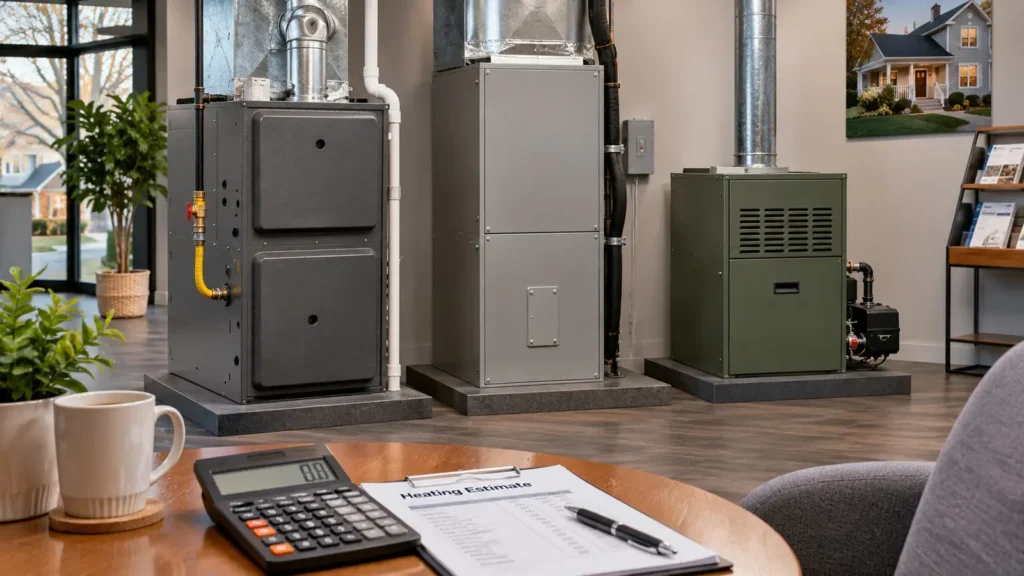
The average furnace replacement cost is about $4,800, and most homeowners pay $2,800 to $7,500 installed, according to Fixr’s 2026 data. HomeGuide, similarly, puts a standard-efficiency furnace at $3,500 to $7,500 or more, and up to $11,500 for a high-efficiency model. Fuel type matters most: electric furnaces usually cost the least to install, while oil and propane cost the most.
Below, we compare furnace replacement cost by fuel type, home size, efficiency and brand, explain the 2028 efficiency rule and the end of the federal tax credit, and show how to get a fair quote. Prices checked on November 4, 2026.
Furnace replacement cost at a glance
| Source | Typical installed range | Average or note |
|---|---|---|
| Fixr (Jan. 28, 2026) | $2,800–$7,500 | $4,800 average; $1,200 low end, $11,500 high end |
| HomeGuide (Dec. 31, 2025) | $3,500–$7,500+ | Standard efficiency; up to $11,500 for high efficiency |
| Angi (2026 data) | $2,800–$6,900 | $4,800 average |
Furnace replacement cost by fuel type
| Fuel type | Fixr (installed) | HomeGuide (installed) |
|---|---|---|
| Natural gas | $3,800–$10,000 | $3,000–$10,000+ |
| Electric | $1,800–$7,300 | $2,500–$7,000+ |
| Oil | $6,700–$10,000 | $4,000–$10,000+ |
| Propane | $3,700–$14,200 | $3,000–$12,000+ |
Gas furnaces remain the most popular heating system in the U.S., HomeGuide says, and they usually cost less to run than electric furnaces in cold regions. However, switching fuels adds cost: HomeGuide says changing fuel types typically adds $500 to $2,000 or more, and a new gas line alone often adds $350 to $2,000 or more.
Electric furnaces, on the other hand, are the cheapest to install but can cost much more to run in cold climates. Oil furnaces, meanwhile, remain common in the Northeast where natural gas isn’t available.
Furnace replacement cost by home size
| Home size | Average cost installed |
|---|---|
| 1,000–1,500 sq ft | $2,000–$4,500 |
| 1,500–2,500 sq ft | $3,000–$6,500 |
| 2,500–3,500 sq ft | $4,000–$9,500 |
| 3,500+ sq ft | $5,500–$10,000+ |
In general, larger homes need more heating capacity, which raises the price. Still, size should come from a load calculation rather than square footage alone, because climate and insulation change the answer.
Furnace replacement cost by efficiency and brand
Standard-efficiency furnaces are rated at 80% to 89% AFUE, while high-efficiency models reach 90% to 98% AFUE, according to HomeGuide. In addition, HomeGuide says high-efficiency models can cut heating costs by 15% or more, although they cost more up front.
| Trane line | 80% AFUE furnace | 96% AFUE furnace |
|---|---|---|
| Premier (two-stage variable) | $6,000–$6,386 | $7,569–$8,390 |
| Priority (two-stage) | $5,530–$5,934 | $6,851–$7,412 |
| Choice (single-stage) | $5,093–$5,481 | $6,630–$6,946 |
In Trane’s lineup, the step from 80% to 96% AFUE adds roughly $1,500 to $2,000. For a full comparison, see our guide to 80% vs 96% AFUE furnaces.
Labor and other costs
- Labor: Fixr puts installation labor at $300 to $1,800, with most replacements taking 4 to 10 hours at $75 to $150 an hour. HomeGuide, by contrast, estimates labor at $1,500 to $3,500 or more.
- Removal: disposal of the old furnace costs $50 to $200 or more, according to HomeGuide.
- Permits: local permits also typically cost $50 to $300.
- Access: cramped crawl spaces or attics can raise costs by 25% to 50%, HomeGuide says.
- Ducts: leaky ducts can reduce efficiency by up to 30%, and repairing minor leaks costs $200 to $700 on average.
The 2028 efficiency rule for gas furnaces
Under a 2023 DOE rule, non-weatherized gas furnaces manufactured on or after December 18, 2028 must reach at least 95% AFUE. Because non-condensing furnaces top out at 80%, the rule effectively requires condensing technology, according to the Appliance Standards Awareness Project. Importantly, the rule is based on the date of manufacture, with no sell-through or installation deadline, HARDI told ACHR News.
The rule’s future is uncertain, however. On June 8, 2026, the Supreme Court vacated a D.C. Circuit decision that had upheld it and sent the case back for reconsideration; meanwhile, the rule remains in effect. DOE has also asked for comments on a petition to delay compliance to at least January 1, 2030. As of the latest reports we found (July 2026), no final decision had been announced.
Tax credits and rebates in 2026
- Federal tax credit: ended. The IRS says the Energy Efficient Home Improvement Credit applies only to improvements made through December 31, 2025, so a furnace installed in 2026 doesn’t qualify.
- HEEHR rebates (formerly HEAR): the federal High-Efficiency Electric Home Rebates cover only electric upgrades, not gas furnaces. Since May 29, 2026, they also no longer pay to replace a gas furnace with a heat pump.
- Utility rebates: many gas utilities still offer rebates on high-efficiency furnaces, so check the ENERGY STAR rebate finder.
If you’re open to switching, compare a furnace with a heat pump first; our heat pump cost guide shows installed prices by home size. And if your AC is also aging, read whether to replace your AC and furnace at the same time.
When to replace your furnace
ENERGY STAR suggests considering a replacement once a furnace is more than 15 years old, noting that an ENERGY STAR furnace is 15% more efficient than a conventional one. Likewise, HomeGuide recommends replacing a furnace that is over 15 years old and needs frequent fixing, or when a repair costs more than half of a new unit. Other warning signs include:
- Rising energy bills, as well as rooms that heat unevenly.
- Frequent cycling or loud noises.
- Soot buildup or a yellow flame instead of a blue one on a gas furnace.
- A smell of gas. In that case, leave the house and call your gas utility from outside.
How to get a fair furnace replacement quote
- First, get at least three written quotes from licensed, insured contractors.
- Then ask each contractor for a load calculation instead of matching the old furnace’s size.
- Compare the same fuel type, AFUE rating, number of stages and warranty.
- Check that each quote includes removal, permits, venting changes and any duct repairs.
- Finally, ask about utility rebates and financing before you sign.
Related guides: Before you collect quotes, also read our guide on how to compare HVAC quotes. You can also get a personalized estimate with our HVAC replacement cost calculator. To size the new unit first, use our furnace BTU calculator.
More in this section:
- What size furnace you need
- How long furnaces last
- Two-stage vs single-stage furnaces
- Electric furnace cost
- Replacing an oil furnace
- Cracked heat exchangers
- Attic vs basement furnace installation
- Furnace tune-up cost
Furnace replacement cost FAQ
How long does a furnace replacement take?
Most replacements take 4 to 10 hours, according to Fixr, and HomeGuide says most installations can be completed within a day.
How long do furnaces last?
Angi says a modern furnace lasts 15 to 20 years, while HomeGuide gives a wider range of 15 to 30 years.
Can I still buy an 80% AFUE gas furnace?
Yes. The 95% rule applies only to furnaces manufactured from December 18, 2028, and it is still under review.
Is a higher-efficiency furnace worth it?
Usually in cold climates with high fuel prices, HomeGuide says, because the savings add up over long heating seasons. In mild climates, the payback takes longer.
Sources and review
Sources: Fixr, furnace replacement cost (January 28, 2026); HomeGuide, new furnace cost (December 31, 2025); Angi, new furnace and AC cost (2026 data); Trane, 2026 HVAC replacement cost guide; Appliance Standards Awareness Project, furnaces; ACHR News, furnace efficiency standard (November 7, 2025); Contracting Business, Supreme Court vacates ruling on 95% furnace standard (June 9, 2026); ACCA, DOE weighs delaying furnace rule (May 22, 2026); IRS, Energy Efficient Home Improvement Credit; ENERGY STAR, when is it time to replace?; ENERGY STAR rebate finder. All checked on November 4, 2026.
Written by: HVAC Switch. Last updated: November 4, 2026. Read our editorial policy to learn how we research prices, or contact us if you spot an error.