
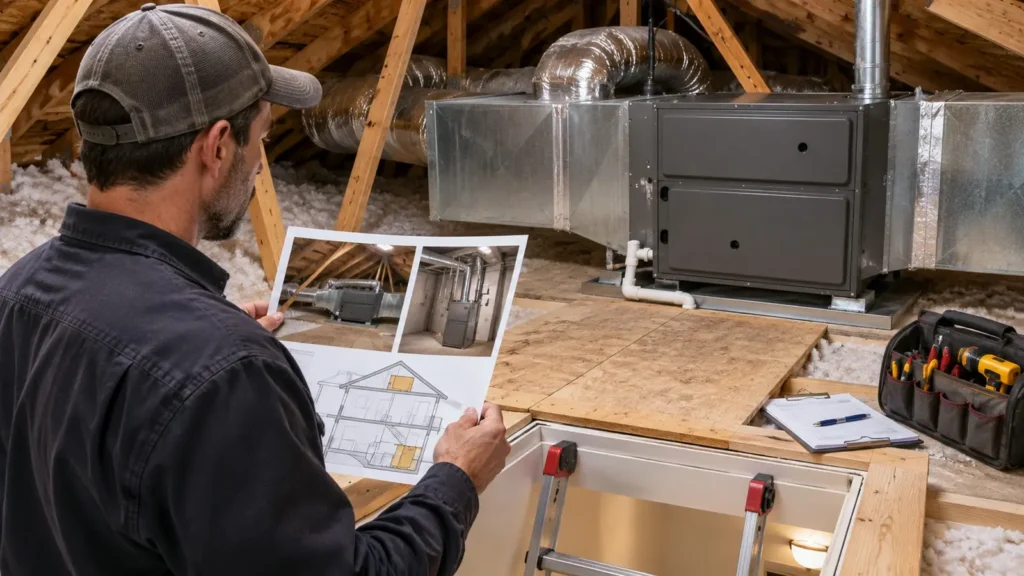
Furnace installation cost in an attic usually runs higher than in a basement, because tight access, extra protection against condensate leaks and freezing, and longer duct and vent runs all add labor. HomeGuide says hard-to-reach spots, such as attics with poor access, can raise costs by 25% to 50%; applied to Fixr’s $4,800 average replacement, that works out to roughly $6,000 to $7,200. A basement furnace, by contrast, is usually the simplest to install and service.
Below, we compare attic, basement, closet and crawl space installations, explain what drives the extra cost and list what to ask your contractor. Information checked on November 4, 2026.
Furnace installation cost in an attic vs a basement
| Location | What affects the price | Typical effect on cost |
|---|---|---|
| Basement | Easy access, room to work, existing venting | Baseline; Fixr’s average replacement is $4,800 ($2,800–$7,500) |
| Closet or utility room | Limited space to work and service the unit | Varies with access |
| Attic | Tight access, summer heat, freeze risk, ducts in unconditioned space | Up to 25%–50% more where access is poor (HomeGuide) |
| Crawl space | Cramped access and moisture | Up to 25%–50% more where access is poor (HomeGuide) |
In other words, an attic with a good ladder, a clear walkway and room around the unit may cost little more than a basement job. However, a cramped attic with low clearance can push the price toward the top of that range.
Why attic installs cost more
- Labor and access: HomeGuide says labor costs more in hard-to-reach areas such as rooftops, tight crawl spaces and attics. Moreover, technicians charge about $75 to $150 an hour, and a typical replacement already takes 4 to 10 hours, according to Fixr.
- Freezing and condensate: Trane lists “Is it in a conditioned area, or will there be freezing?” among the questions that affect installation complexity. In addition, condensing furnaces need a condensate drain line.
- Venting: a condensing furnace vents through PVC intake and exhaust pipes that exit through a wall or the roof above the snow line, Trane notes.
- Electrical: a gas furnace also needs a dedicated circuit breaker and a safety disconnect switch, according to Trane.
- Ducts: finally, ducts in a hot or cold attic waste more energy. ENERGY STAR says typical duct systems lose 20% to 30% of the air moving through them, so sealing and insulating attic ducts matters.
Attic vs basement furnace: pros and cons
| Attic | Basement | |
|---|---|---|
| Floor space | Saves living space in homes without a basement | Uses basement space |
| Installation | Harder access, so more labor | Easier access, so less labor |
| Service and filters | Harder to reach for monthly filter checks | Easy to reach |
| Temperature exposure | Exposed to summer heat and winter cold | More protected |
Should you move a furnace from the attic to the basement?
Sometimes it makes sense, but relocation turns a replacement into a partial new installation. HomeGuide notes that first-time installations generally cost more because of the extra work on connections, ductwork and venting. For example, interior gas piping alone costs $15 to $50 or more per linear foot, or about $350 to $2,000 for a typical run, according to HomeGuide. As a result, moving the furnace usually pays off only when the attic is very hard to work in or the ducts already need replacing.
What to ask before an attic furnace installation
- To begin with, how will the crew get the furnace into the attic, and is there enough room around it for service?
- How will the condensate drain be routed, and how will it be protected from freezing?
- Does local code require a secondary drain pan or an overflow shutoff switch for attic equipment?
- Will the ducts be sealed and insulated as part of the job?
- Finally, how will I reach the filter for monthly checks, as ENERGY STAR recommends?
For full price ranges, see our furnace replacement cost guide. Then check what size furnace you need and whether an 80% or 96% AFUE furnace fits your attic.
Furnace installation cost in an attic: FAQ
How much more does furnace installation cost in an attic?
It depends on access. HomeGuide says difficult locations can raise costs by 25% to 50%, whereas an easy-to-reach attic may add little.
Can a high-efficiency furnace go in an attic?
Often, yes. Still, ask how the condensate drain will be protected from freezing, since Trane lists freezing as a question to settle before installation.
How long does an attic furnace installation take?
Fixr says most furnace replacements take 4 to 10 hours, while Carrier puts a full installation at 10 to 15 hours. Consequently, a hard-to-reach attic may land at the long end.
Sources and review
Sources: HomeGuide, new furnace cost (December 31, 2025); HomeGuide, new HVAC system cost (August 27, 2025); HomeGuide, oil-to-gas conversion cost (gas piping) (December 30, 2025); Fixr, furnace replacement cost (January 28, 2026); Trane, top 8 furnace replacement cost factors (February 3, 2026); Carrier, new gas furnace cost (October 13, 2026); ENERGY STAR, duct sealing; ENERGY STAR, maintenance checklist. All checked on November 4, 2026.
Written by: HVAC Switch. Last updated: November 4, 2026. Read our editorial policy to learn how we research prices, or contact us if you spot an error.