
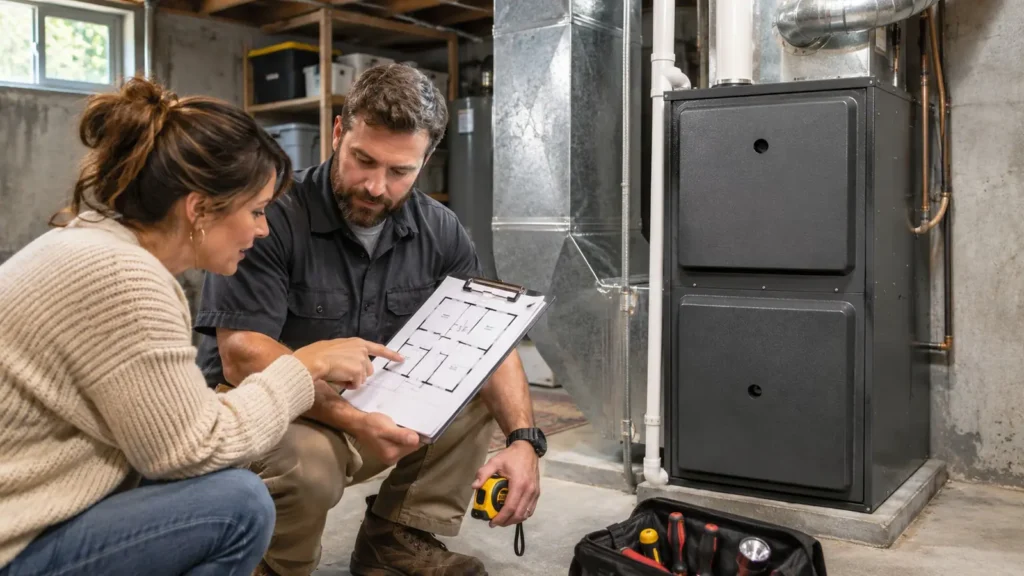
What size furnace do I need? As a rule of thumb, most homes need about 30 to 60 BTU of heating per square foot, depending on climate, so a 2,000-square-foot house typically needs somewhere between 60,000 and 120,000 BTU, based on Fixr’s figures. Because that range is so wide, the right size comes from a Manual J load calculation, which accounts for your climate zone, insulation and windows.
Below, you’ll first find furnace sizes by climate zone and square footage, the difference between input and output BTU, and what to ask your contractor. Information checked on November 4, 2026.
What size furnace do I need by climate zone?
| Climate zone | BTU per sq ft (Fixr) | 2,000 sq ft home (our math) |
|---|---|---|
| 1 (hottest) | 30–35 | 60,000–70,000 BTU |
| 2 | 35–40 | 70,000–80,000 BTU |
| 3 | 35–45 | 70,000–90,000 BTU |
| 4 | 45–50 | 90,000–100,000 BTU |
| 5 | 50–60 | 100,000–120,000 BTU |
| 6 | 55+ | 110,000+ BTU |
| 7 (coldest) | 60+ | 120,000+ BTU |
In other words, climate is the biggest factor. For example, a home in a cold northern zone can need about twice the heating capacity of the same home in the far South.
Furnace size chart by square footage
| Home size | Mild climate (zone 1) | Moderate climate (zone 4) |
|---|---|---|
| 1,000 sq ft | 30,000–35,000 BTU | 45,000–50,000 BTU |
| 1,500 sq ft | 45,000–52,500 BTU | 67,500–75,000 BTU |
| 2,000 sq ft | 60,000–70,000 BTU | 90,000–100,000 BTU |
| 2,500 sq ft | 75,000–87,500 BTU | 112,500–125,000 BTU |
| 3,000 sq ft | 90,000–105,000 BTU | 135,000–150,000 BTU |
Input vs output BTU
Also, when you compare models, check whether the BTU figure is input (gas burned) or output (heat delivered). Since AFUE is the share of fuel that becomes heat, output is roughly input times AFUE. For example, an 80,000-BTU furnace at 80% AFUE delivers about 64,000 BTU of heat, while the same input at 96% AFUE delivers about 76,800 BTU. That’s also why a high-efficiency model can often have a smaller input rating.
Why rules of thumb often oversize furnaces
To begin with, the U.S. Department of Energy says rules of thumb too often lead to excessively oversized systems, which cost more, waste energy and cycle on and off too often. DOE also notes that in the U.S. the cooling load is often larger than the heating load, and that loads in energy-efficient homes can be so small they fall below manufacturers’ smallest sizes.
Still, sizing errors cut both ways. According to Fixr, a furnace that’s too large cycles on and off rapidly, which hurts efficiency and can lead to premature breakdowns. On the other hand, a furnace that’s too small works overtime, which shortens its lifespan and raises maintenance costs.
What size furnace do I need for my house? Ask for a Manual J
In general, ACCA’s Manual J is the industry method for calculating heating and cooling loads, and DOE recommends selecting equipment from those loads. According to HomeGuide, a proper calculation considers:
- Your climate zone, as well as humidity.
- Square footage, layout and the number of stories.
- Ceiling height, too.
- Insulation amount and quality.
- Basement, slab or crawl space conditions.
- The number, type and placement of windows, as well as sun exposure.
- The number of people in the home and heat-generating appliances.
As for cost, HomeGuide also says a professional HVAC evaluation costs $150 to $500, although some contractors credit it toward the installation.
How to get the right furnace size
- To begin with, ask each contractor whether the quote is based on a Manual J calculation, and request a copy.
- Also, don’t simply match the old furnace’s size, since it may have been oversized.
- Next, mention upgrades such as new windows or attic insulation, because they lower the heating load.
- Then compare quotes using output BTU, not just input BTU.
- Finally, if your load falls between sizes, ask about a two-stage or modulating furnace, which can run at lower output most of the time.
Once you know the size, compare installed prices in our furnace replacement cost guide and decide between 80% and 96% AFUE. If you’re sizing a new AC at the same time, see what size AC you need.
Related guides: See also our guide on how long furnaces last. To get a quick estimate for your home, try our furnace BTU calculator.
What size furnace do I need? FAQ
What size furnace do I need for 1,500 square feet?
In general, roughly 67,500 to 75,000 BTU in a moderate climate (zone 4), using Fixr’s per-square-foot ranges. However, a Manual J calculation for a well-insulated home may come in lower.
How many BTU per square foot does a furnace need?
For instance, Fixr gives about 30 to 35 BTU per square foot in the warmest zone and 60 or more in the coldest. Similarly, HomeGuide says most homes need 30 to 60 BTU per square foot.
Is a bigger furnace better?
No, because an oversized furnace short-cycles, wastes energy and can wear out sooner, according to DOE and Fixr.
Does a high-efficiency furnace need fewer BTUs?
It needs the same heat output; however, because it wastes less fuel, it can reach that output with a lower input rating.
Sources and review
Sources: Fixr, furnace replacement cost and sizing (January 28, 2026); HomeGuide, new furnace cost (December 31, 2025); HomeGuide, new HVAC system cost (August 27, 2025); U.S. Department of Energy, proper sizing of HVAC systems; PNNL, IECC 2021 climate zone map; Carrier, high-efficiency gas furnaces (October 13, 2026). All checked on November 4, 2026.
Written by: HVAC Switch. Last updated: November 4, 2026. Read our editorial policy to learn how we research prices, or contact us if you spot an error.