
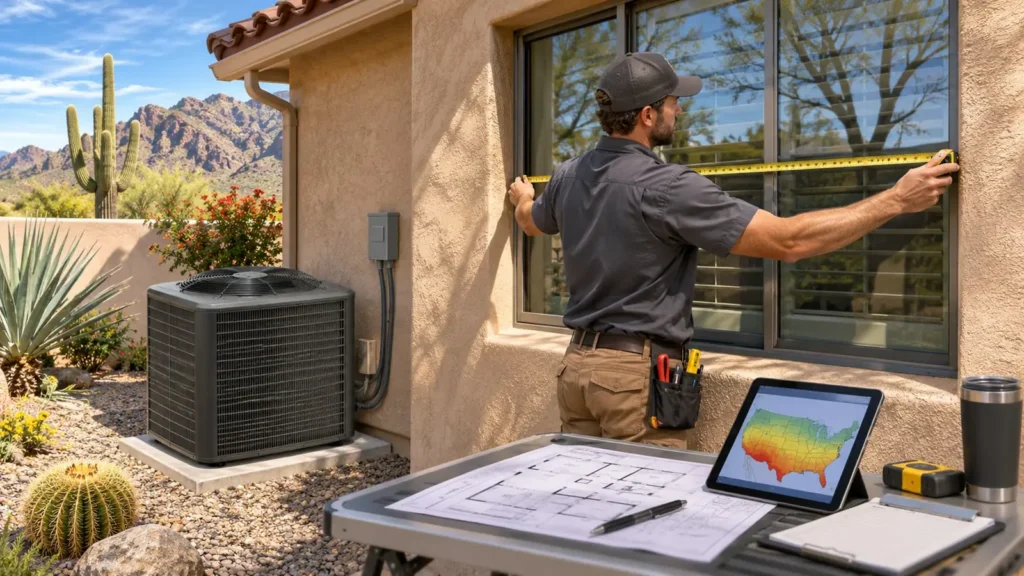
What size AC do I need? As a rule of thumb, most homes need about 1 ton of cooling (12,000 BTU per hour) for every 500 to 600 square feet, so a 1,500-square-foot house usually lands near 2.5 tons in a moderate climate. Still, the right answer comes from a Manual J load calculation, because climate, insulation, windows and sun exposure can move the size by half a ton or more.
Below, you’ll first find an AC size chart by square footage, the factors that push the size up or down and what to ask your contractor. Information checked on November 4, 2026.
AC size you need by square footage
The chart below assumes a moderate climate (climate zones 3 to 4), 8-foot ceilings, average insulation and a standard amount of window area, according to SupplyHouse.
| Home size | AC size | Cooling capacity |
|---|---|---|
| 600–900 sq ft | 1.5 tons | 18,000 BTU/h |
| 900–1,200 sq ft | 2 tons | 24,000 BTU/h |
| 1,200–1,500 sq ft | 2.5 tons | 30,000 BTU/h |
| 1,500–1,800 sq ft | 3 tons | 36,000 BTU/h |
| 1,800–2,100 sq ft | 3.5 tons | 42,000 BTU/h |
| 2,100–2,400 sq ft | 4 tons | 48,000 BTU/h |
| 2,400–3,000 sq ft | 5 tons | 60,000 BTU/h |
However, other charts differ slightly. HVAC.com, for example, pairs 1,600 to 1,900 square feet with 3 tons, while HomeGuide says one ton cools roughly 500 to 600 square feet. In other words, treat any chart as a starting point, not a final answer.
How climate changes the AC size you need
In general, climate is the biggest adjustment. According to SupplyHouse, a 1,500-square-foot home that needs about 2.5 tons in a moderate climate may need closer to 3 tons in a hot, humid climate or in a poorly insulated older house. On the other hand, 2 tons may be enough for a well-insulated, newer home in a cooler climate.
| Factor | Size down if… | Size up if… |
|---|---|---|
| Climate | Cool northern climate | Hot, humid South or Southwest |
| Insulation | Well insulated, newer home | Poor insulation, pre-1980 home |
| Windows | Double-pane, small window area | Single-pane, large or many windows |
| Ceiling height | Standard 8 ft | 10 to 12+ ft ceilings |
| Sun exposure | Well shaded or north-facing | Full afternoon sun, south- or west-facing |
| Stories | Two-story home | Single-story home with a large roof area |
| Occupancy | Few occupants | Many occupants, busy kitchen |
For ceilings, SupplyHouse adds roughly 10% to the BTU requirement for each foot above 8 feet.
Why rules of thumb often oversize your AC
The 500-square-feet-per-ton rule is simple, but it’s often wrong. For example, building scientist Allison Bailes reviewed 40 Manual J calculations, mostly in hot and mixed climates, and found an average of 1,431 square feet per ton, according to the ACCA blog. Moreover, only eight of those homes came in below 1,000 square feet per ton.
That gap matters because the U.S. Department of Energy says rules of thumb too often lead to oversized systems, which cost more, waste energy and cycle on and off too often. In addition, an oversized AC cools the air faster than it can remove humidity, so the house can feel cool but clammy.
An undersized unit, by contrast, runs constantly, struggles on the hottest days and drives up your electric bill.
What size AC do I need for my house? Ask for a Manual J
Manual J, from the Air Conditioning Contractors of America (ACCA), is the industry method for calculating heating and cooling loads. DOE recommends sizing equipment, including ducts, from those loads instead of rules of thumb. Likewise, ENERGY STAR tells homeowners to make sure the contractor uses the actual characteristics of the home rather than a rule of thumb.
For this reason, a proper load calculation looks at:
- Your local climate and design temperatures.
- Insulation levels and how airtight the house is.
- Window size, type and orientation.
- Ceiling height and the number of stories.
- The number of occupants and heat-producing appliances.
- Basement, slab or crawl space conditions.
As for cost, HVAC.com puts a stand-alone Manual J inspection at $200 to $300. Fixr, however, notes that many contractors waive the fee if you buy the system from them.
How to make sure you get the right size
- First, ask every contractor whether the quote is based on a Manual J load calculation, and ask for a copy.
- Also, be wary of a quote that simply matches your old unit’s tonnage.
- Mention recent upgrades, such as new windows or attic insulation, because they can lower the load.
- Then compare quotes at the same tonnage and SEER2 rating.
- Finally, if your load falls between sizes, ask about a two-stage or variable-speed system, which can run at lower capacity most of the time.
Once you know the size, see our AC replacement cost guide for installed prices by tonnage. If you’re weighing a heat pump instead, our guide to heat pump size for a 2,000 sq ft house walks through the same math.
Related guides: See also our guides on replacing your AC and furnace at the same time and AC coil replacement cost.
What size AC do I need? FAQ
What size AC do I need for a 2,000 sq ft house?
About 3.5 tons in a moderate climate, if you go by the SupplyHouse chart (1,800 to 2,100 square feet). Even so, a Manual J calculation for an efficient home may come in lower.
How many square feet does a 3-ton AC cool?
Roughly 1,500 to 1,800 square feet in a moderate climate, according to SupplyHouse. Similarly, HVAC.com lists 1,600 to 1,900 square feet.
Is it better to oversize an AC?
No. An oversized AC short-cycles, removes less humidity and wastes energy, according to DOE and ENERGY STAR guidance.
How many BTUs per square foot do I need?
HVAC.com uses about 20 BTU per square foot as a general rule, while HomeGuide gives a wider range of 16 to 30 BTU. As a result, the right number depends on your climate and how your home is built.
Can I use the same size as my old AC?
Not automatically, since your old unit may have been oversized, or your home may have changed since it was installed. That’s why HVAC.com recommends a Manual J inspection rather than simply replacing the old unit with the same size.
Sources and review
Sources: SupplyHouse, AC tonnage guide; HVAC.com, AC size guide (August 1, 2023); HomeGuide, AC replacement cost (July 25, 2025); ACCA blog, Manual J load calculations vs rules of thumb (October 20, 2016); U.S. Department of Energy, proper sizing of HVAC systems; ENERGY STAR, HVAC quality installation; Fixr, AC installation cost (January 28, 2026). All checked on November 4, 2026.
Written by: HVAC Switch. Last updated: November 4, 2026. Read our editorial policy to learn how we research prices, or contact us if you spot an error.