
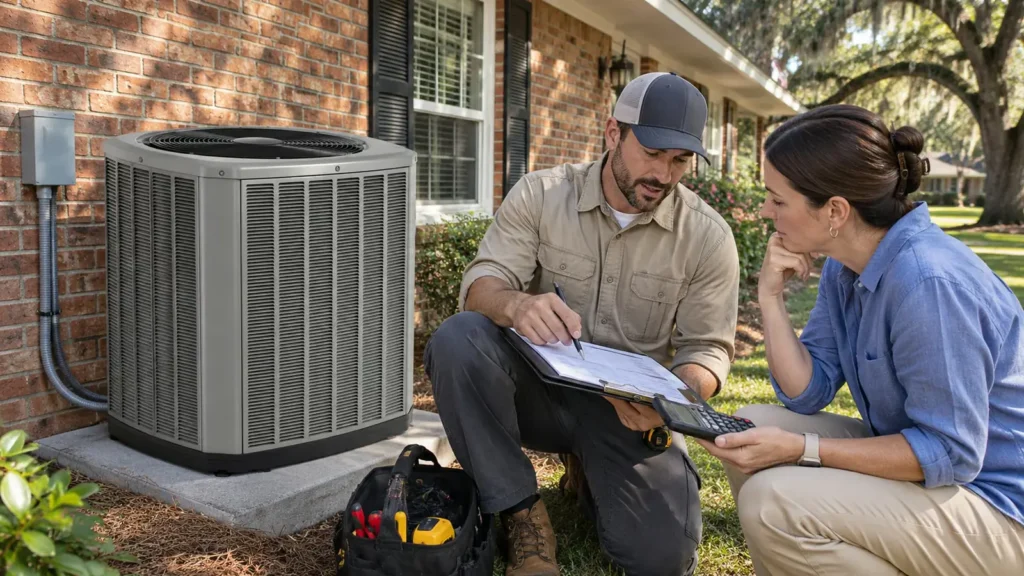
The average AC replacement cost is about $6,000 for a 3-ton central air conditioner, and most homeowners pay $5,000 to $12,000 installed, according to Fixr’s 2026 data. A basic, standard-efficiency system usually lands between $5,000 and $8,300, while high-efficiency variable-speed models can top $14,000.
Below, we break down the AC replacement cost by tonnage and SEER2 rating, explain the refrigerant rule change behind many 2026 quotes and show you how to compare bids. Prices checked on November 3, 2026.
AC replacement cost at a glance
| Source | Typical range | Average or note |
|---|---|---|
| Fixr (Jan. 28, 2026) | $5,000–$12,000 | $6,000 average for a 3-ton central AC |
| Angi (2026 data) | $3,911–$8,067 | $5,989 average, with existing ducts and wiring |
| HomeGuide (July 25, 2025) | $5,000–$8,300 | Standard efficiency, 2,000 sq ft home, no duct work |
In other words, a like-for-like swap in a typical home often costs $5,000 to $8,000. However, the price climbs quickly once you add higher efficiency, a variable-speed compressor or duct work.
AC replacement cost by tonnage
Air conditioner size is measured in tons, and one ton equals 12,000 BTU per hour of cooling. As a rough guide, HomeGuide says one ton cools about 500 to 600 square feet. Still, insulation, windows, ceiling height and climate all change the answer.
| Size | Cooling capacity | Unit only | Installed |
|---|---|---|---|
| 1.5 tons | 18,000 BTU/h | $2,200–$3,500 | $4,700–$6,500 |
| 2 tons | 24,000 BTU/h | $2,500–$3,800 | $5,000–$6,800 |
| 2.5 tons | 30,000 BTU/h | $2,900–$4,200 | $5,400–$7,200 |
| 3 tons | 36,000 BTU/h | $3,300–$4,800 | $5,800–$7,800 |
| 3.5 tons | 42,000 BTU/h | $3,700–$5,300 | $6,200–$8,300 |
| 4 tons | 48,000 BTU/h | $4,000–$5,800 | $6,500–$8,800 |
| 5 tons | 60,000 BTU/h | $4,500–$6,500 | $7,000–$9,500+ |
Also, size matters for more than price. Because an oversized unit short-cycles and an undersized one runs nonstop, your contractor should size the new system with a Manual J load calculation instead of simply copying the old unit’s tonnage.
AC replacement cost by SEER2 rating
SEER2 measures cooling efficiency under the test procedure that took effect on January 1, 2023. A higher rating means lower electric bills; on the other hand, the equipment also costs more.
| SEER (old scale) | SEER2 | Efficiency tier | Installed cost |
|---|---|---|---|
| 13–14 | Up to 13.4 | Standard | $5,300–$7,900 |
| 15–16 | 14.0–14.7 | High | $6,700–$9,300 |
| 17–18 | 15.0–17.2 | High | $7,500–$10,600 |
| 19–21 | 16.5–18.5 | Very high | $9,100–$12,200 |
| 22–26 | Up to 25.8 | Maximum | $11,400–$17,300+ |
Federal minimum SEER2 by region
In addition, your location sets the floor. According to AHRI, a split central AC in the North must reach at least 13.4 SEER2. In the Southeast and Southwest, however, the minimum is 14.3 SEER2 for systems under 45,000 Btu/h and 13.8 SEER2 for larger ones. The Southwest also adds an EER2 requirement, and in both southern regions the rule applies by installation date.
As a result, a higher SEER2 rating generally pays back faster in hot climates with long cooling seasons than in northern homes that run the AC for only a few months a year.
What an AC replacement quote should include
A standard replacement usually covers the items below, although every contractor words its quote a little differently:
- The outdoor condenser and a matching indoor evaporator coil.
- Refrigerant lines, as well as the refrigerant charge.
- Wiring and the condensate drain line.
- Removal of the old unit, which Angi lists at $25 to $200 when it’s billed separately.
- Permit and inspection fees, when your city requires them.
- Labor, startup and testing; Fixr puts labor at $500 to $2,500 for a standard central AC, or $75 to $250 an hour.
What else raises the AC replacement cost?
- Ductwork: minor sealing and repairs cost $300 to $1,500, while replacing damaged ducts costs $1,400 to $5,600 or more, per HomeGuide.
- Permits: HomeGuide puts replacement permits at $100 to $250. Fixr, by contrast, reports $50 to $1,500, depending on your building department.
- Compressor type: two-stage and variable-speed models cost more than single-stage units; in return, they run more evenly and control humidity better.
- Brand: premium brands such as Carrier, Trane and Lennox generally cost more, HomeGuide notes.
- Access: attic installs, tight closets and long line runs also add labor time.
- Timing: emergency installs in peak summer often cost more. Late fall and early spring, meanwhile, tend to bring off-season discounts.
How the 2026 refrigerant rules affect AC replacement cost
Since January 1, 2025, manufacturers can no longer make or import new residential split AC systems that use refrigerants with a global warming potential above 700, such as R-410A. Consequently, most new equipment now uses lower-GWP refrigerants such as R-454B or R-32.
EPA originally barred contractors from installing leftover R-410A systems after January 1, 2026. However, on May 21, 2026, EPA finalized a rule that removes that installation deadline, so equipment made or imported before 2025 can still be installed until existing supplies run out. NAHB reports that the change took effect on July 27, 2026. New York is the exception: its state rules keep the original deadline, so R-410A systems can’t be installed there.
For your quote, this matters in two ways. First, HomeGuide notes that if your old system uses R-22 or R-410A, you typically can’t replace just the outdoor unit and will need a full system upgrade. Second, ask every contractor which refrigerant the proposed system uses, so you compare bids on equal terms.
Tax credits and rebates in 2026
- Federal tax credit: ended. The IRS says the Energy Efficient Home Improvement Credit covers only improvements made through December 31, 2025, so a central AC installed in 2026 doesn’t qualify.
- HEEHR rebates (formerly HEAR): the federal High-Efficiency Electric Home Rebates cover heat pumps, not standard central air conditioners. They pay up to $8,000 for a heat pump for income-qualified households, but only in states that have launched them and, since May 29, 2026, only when replacing existing electric equipment.
- Utility rebates: many utilities still offer rebates on high-efficiency cooling equipment, so check the ENERGY STAR rebate finder before you sign.
Because a heat pump cools like an AC and also heats your home, it’s worth pricing one at the same time. See our heat pump cost guide for installed prices by home size, or our guide to heat pump replacement cost.
Should you repair or replace your AC?
HomeGuide puts typical AC repairs at $150 to $650. Even so, it recommends replacement when the system is more than 10 to 12 years old, when a repair would cost at least 50% of a new unit, or when breakdowns and bills keep rising. In addition, new units run 20% to 40% more efficiently than 10-year-old models, according to HomeGuide.
How to get a fair AC replacement quote
- First, get at least three written quotes from licensed, insured contractors.
- Ask each one for a Manual J load calculation instead of a tonnage guess.
- Compare the same tonnage, SEER2 rating, compressor type and refrigerant.
- Check that each quote lists the indoor coil, line set, permit, disposal and labor warranty.
- Don’t pay in full before the installation starts.
- Finally, if you can wait, schedule the job for late fall or early spring.
Related guides: Before you collect quotes, also read our guide on SEER2, EER2 and HSPF2. You can also get a personalized estimate with our HVAC replacement cost calculator.
More in this section:
- What size AC you need
- Replacing your AC and furnace at the same time
- AC coil replacement cost
- 14 vs 16 SEER2
- How long a central AC lasts
- Central air without ductwork
- The best time to replace your AC
- Variable-speed vs single-stage AC
- What happens on AC installation day
AC replacement cost FAQ
How much does a 3-ton AC replacement cost?
Fixr puts the national average at about $6,000 for a 3-ton central AC. Similarly, HomeGuide lists $5,800 to $7,800 for a basic 3-ton installation.
How long does an AC replacement take?
Swapping only the outdoor unit takes 4 to 8 hours, and replacing both the outdoor and indoor units takes 8 to 14 hours, according to HomeGuide. A full install with duct changes, by contrast, can take 2 to 3 days.
Is it cheaper to replace the AC and furnace together?
Doing both costs more up front, but it can make sense when both systems are aging. For instance, HomeGuide lists $10,500 to $18,500 for a combined furnace and AC system, compared with $5,300 to $10,500 for central AC alone.
Can I still buy an R-410A air conditioner?
In most states, yes, while leftover inventory lasts. Under EPA’s May 2026 rule, R-410A equipment made or imported before January 1, 2025 can still be installed, except in New York.
How long does a new central AC last?
HomeGuide says new AC systems last 15 to 20 years on average. Of course, installation quality, maintenance and usage all affect the real number.
Sources and review
Sources: Fixr, AC installation cost (January 28, 2026); Angi, AC replacement cost (2026 data); HomeGuide, AC replacement cost (July 25, 2025); AHRI, 2023 energy efficiency standards; ACHR News, EPA removes R-410A installation deadline (May 21, 2026); NAHB, EPA final rule on R-410A installations (May 26, 2026); IRS, Energy Efficient Home Improvement Credit; DOE Program Notice 26-2 (HEEHR) (effective May 29, 2026); ENERGY STAR rebate finder. All checked on November 3, 2026.
Written by: HVAC Switch. Last updated: November 3, 2026. Read our editorial policy to learn how we research prices, or contact us if you spot an error.