
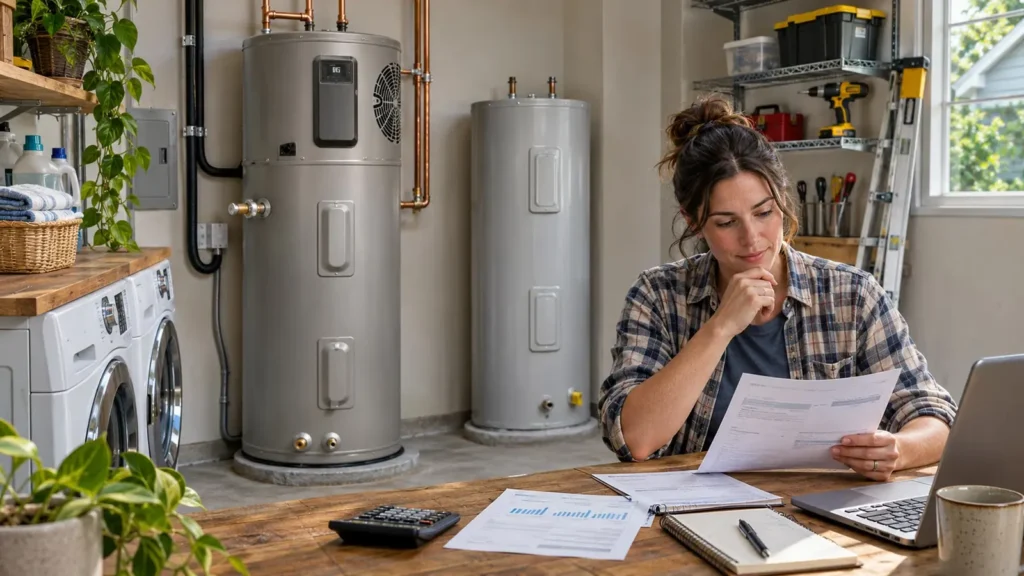
A heat pump water heater cost is typically $1,500 to $3,000 for the unit plus $1,000 to $3,000 for installation, according to ENERGY STAR. In return, an ENERGY STAR certified model saves a household of four about 3,760 kWh a year compared with a standard electric tank, or roughly $680 a year at the August 2026 U.S. average electricity price.
Below, we break down the heat pump water heater cost, compare it with an electric tank, calculate payback by household size and list the installation issues that can raise the price. Information checked on November 3, 2026.
Heat pump water heater cost: unit and installation
| Cost item | Typical range (ENERGY STAR) |
|---|---|
| Heat pump water heater unit | $1,500–$3,000 |
| Installation labor and materials | $1,000–$3,000 |
| Typical total | $2,500–$6,000 |
| Split-system models (for tight spaces) | Several times more than a standard unit |
First, tank size is one of the biggest price factors. Heat pump water heaters range from 40 to 80 gallons, and larger tanks usually cost more, according to ENERGY STAR. In general, installation can cost roughly as much as the water heater itself.
Heat pump water heater vs electric tank: savings and payback
Because it moves heat from the surrounding air instead of creating it, a certified heat pump water heater is typically 3 to 4 times more efficient than standard electric and gas models, ENERGY STAR says. So here’s what that means for your bill:
| Household size | Annual kWh saved | Savings at 14.6¢/kWh (ENERGY STAR) | Savings at 18.16¢/kWh (Aug. 2026 U.S. average) | Payback at 18.16¢ |
|---|---|---|---|---|
| 2 people | 1,880 kWh | $270 | About $340 | About 4.4 years |
| 3 people | 2,820 kWh | $410 | About $510 | About 2.9 years |
| 4 people | 3,760 kWh | $550 | About $680 | About 2.2 years |
Over a 13-year life, ENERGY STAR estimates lifetime savings of $2,050 for a two-person home and $5,610 for a family of four, at its own 14.6-cent price. At today’s higher average price, the savings would therefore be larger. However, your actual payback depends on your electricity rate, how much hot water you use and your installation cost.
Installation factors that change the heat pump water heater cost
Also, ENERGY STAR lists several issues that can add to the bill:
- Space: most units need at least 450 cubic feet of surrounding air, about the size of an 8-by-8-foot utility closet. Otherwise, a louvered door or other carpentry may be needed.
- Condensate: the unit also produces water, which must drain to a floor drain or be routed by your installer.
- Noise: most new models run at 45 to 60 decibels, similar to a refrigerator or a window AC.
- Cool exhaust air: for this reason, some homeowners add a venting kit to send the cooler air elsewhere.
- Code items: a thermostatic mixing valve or an electrical permit may be required locally.
Switching from a gas water heater
Replacing a gas or propane unit, on the other hand, adds a few more steps, according to ENERGY STAR. First, you’ll need a 240-volt circuit at the installation spot and enough panel capacity, which may require electrical work. In addition, the old vent must be sealed and the gas line capped, although capping is usually inexpensive. Finally, ENERGY STAR recommends sizing up, for example from 40 to 50 gallons or from 50 to 65 gallons, so recovery time doesn’t suffer.
Rebates and tax credits for heat pump water heaters
- Federal tax credit: ended. The IRS says the Energy Efficient Home Improvement Credit applies only to improvements made through December 31, 2025, so a water heater installed in 2026 doesn’t qualify.
- Federal Home Energy Rebates: under HEEHR (formerly HEAR), a heat pump water heater can earn up to $1,750, with 50% to 100% of project costs covered depending on income. However, these programs are only available in select states, and since May 29, 2026 new reservations cover only replacements of electric water heaters.
- Utility incentives: many utilities and cities offer $300 to $1,000, according to ENERGY STAR. Use the ENERGY STAR rebate finder to check your ZIP code.
How long does a heat pump water heater last?
Heat pump water heaters typically last 13 to 15 years, compared with 10 to 12 years for traditional storage water heaters, according to ENERGY STAR. Therefore, ENERGY STAR suggests planning your replacement before the old tank fails, so you can compare quotes instead of buying in an emergency.
Related guides: See also our guides on heat pump replacement cost and cold-climate heat pumps.
Frequently asked questions
Is a heat pump water heater worth it?
For most homes replacing an electric tank, yes. In fact, at current average electricity prices, a family of four can recover the extra cost in about two to three years, based on ENERGY STAR’s savings estimate.
Do heat pump water heaters work in cold basements?
They can. ENERGY STAR says they pull warmth from the surrounding air even at temperatures below 40°F, although they cool the space around them while running.
What size heat pump water heater do I need?
It depends on your household and usage. Generally, heat pump models come in 40- to 80-gallon sizes, and ENERGY STAR advises sizing up when you replace a gas unit.
Thinking about a heat pump for heating and cooling too? See our guide to heat pump cost by home size.
Sources and review
Sources: ENERGY STAR, what goes into the cost of installing a heat pump water heater (February 2, 2024); ENERGY STAR, heat pump water heater savings; EIA, Electric Power Monthly, Table 5.6.A (August 2026 data, preliminary); DOE Program Notice 26-2 (HEEHR) (effective May 29, 2026); U.S. Department of Energy, Home Energy Rebates Program; IRS, Energy Efficient Home Improvement Credit. All checked on November 3, 2026.
Written by: HVAC Switch. Last updated: November 3, 2026. Read our editorial policy to learn how we research prices, or contact us if you spot an error.