
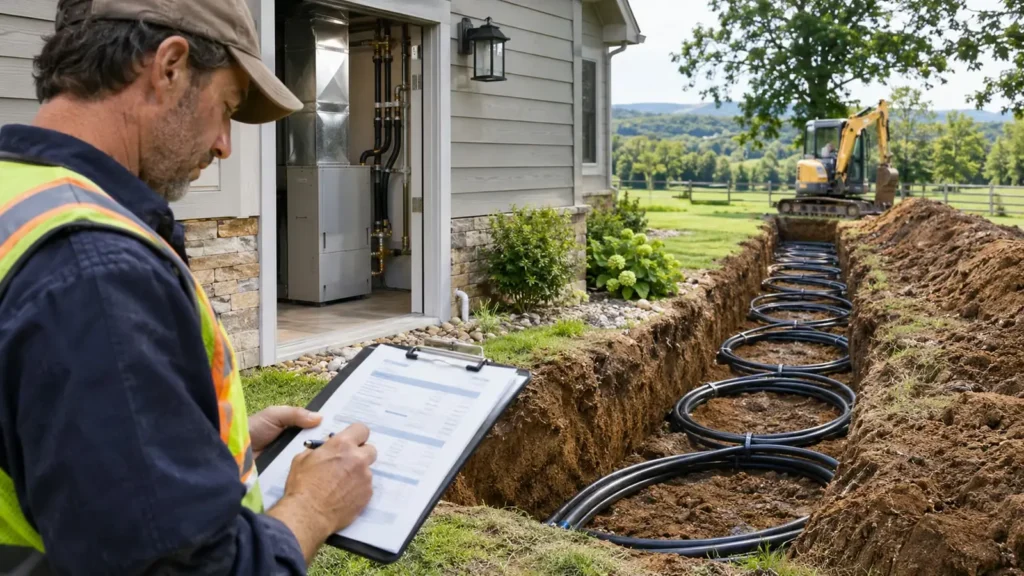
A geothermal heat pump cost is typically $15,000 to $35,000 installed, according to Fixr and HomeGuide, or roughly $4,000 to $8,000 per ton, according to PICKHVAC. Since the 30% federal tax credit ended for systems placed in service after December 31, 2025, the extra cost over an air-source heat pump now takes longer to pay back.
Below, we break down geothermal heat pump cost by size and loop type, show where the money goes and look at realistic payback periods without the federal credit. Prices were checked on November 3, 2026.
Geothermal heat pump cost by size
| System size | Installed cost (PICKHVAC, 2025) |
|---|---|
| 2 tons | $8,000–$16,000 |
| 3 tons | $12,000–$24,000 |
| 4 tons | $16,000–$32,000 |
| 5 tons | $20,000–$40,000 |
For comparison, This Old House’s 2026 survey also found average costs of $17,000 for a small or medium home and $30,000 or more for a large one. Meanwhile, EnergyRebateCalculator puts a typical 2,000 sq ft home at $20,000–$35,000 with a vertical loop and $15,000–$25,000 with a horizontal one.
Geothermal heat pump cost by loop type
In practice, the ground loop is the biggest variable, because it decides how much drilling or digging your yard needs. PICKHVAC’s 2026 guide gives these ranges for a 2–3-ton system:
| Loop type | Low | Average | High |
|---|---|---|---|
| Closed loop, horizontal (trenches) | $10,000 | $20,000 | $30,000 |
| Closed loop, vertical (bore holes) | $18,000 | $30,000 | $50,000 |
| Open loop (well-fed) | $12,000 | $25,000 | $40,000 |
- Horizontal loops are usually cheaper, but they need plenty of open land.
- Vertical loops fit small lots, but drilling raises the price. Vertical wells cost about $5–$40 per foot, according to PICKHVAC.
- Pond or lake loops can be the cheapest option if you have a suitable body of water. PICKHVAC’s 2025 guide lists $10,000–$32,000.
- Open loops use well water directly, so they depend on local water rules and supply.
Where the money goes
Unlike an air-source system, most of the geothermal heat pump cost is underground. According to PICKHVAC, loop drilling or excavation often makes up 35% to 60% of the installed price, while the heat pump unit itself is only 20% to 40% of the total. In addition, other common line items include:
- Heat pump unit only: about $3,500–$7,500 (PICKHVAC, 2025).
- Landscape restoration: $4–$12 per square foot (PICKHVAC).
- Permits: $100–$650 (PICKHVAC).
- Desuperheater for hot water: $600–$1,800 (PICKHVAC, 2026).
- New ducts or radiant distribution, if needed: $3,000–$15,000 (EnergyRebateCalculator).
Location also matters. Compared with the Midwest, PICKHVAC expects prices to run 10% to 20% higher in the Northeast and 15% to 35% higher in the West, but 5% to 10% lower in the South.
Geothermal heat pump payback without the tax credit
Without a doubt, geothermal systems are very efficient. The U.S. Department of Energy says they can reduce energy use by 30% to 60%. Even so, the payback depends on what you compare them with:
- Versus gas heat plus central AC: EnergyRebateCalculator estimates savings of $2,000–$2,300 a year.
- Versus a good air-source heat pump: savings shrink to about $500–$800 a year, by the same estimate.
As a result, the extra cost of geothermal over air-source takes a long time to recover now that the federal credit is gone. EnergyRebateCalculator estimates 8–14 years for a horizontal loop with a $6,000–$10,000 premium, but 19–30 years for a vertical loop that costs $15,000 more. Older industry figures of 5 to 10 years, cited by PICKHVAC, generally assumed the 30% federal credit.
On the plus side, the system lasts a long time. PICKHVAC puts the indoor unit at 20+ years and the ground loop at 50+ years, which can make geothermal worthwhile if you plan to stay in your home for decades.
Incentives that still apply
- Federal tax credit: ended. The IRS says the Residential Clean Energy Credit isn’t available for property placed in service after December 31, 2025.
- Federal Home Energy Rebates: available only in select states, according to the Department of Energy. Under HEEHR (formerly HEAR), a heat pump can qualify for up to $8,000 for income-eligible households, but since May 29, 2026 only when it replaces existing electric equipment.
- Utility and state programs: EnergyRebateCalculator lists utility rebates of $500–$3,000 and an enhanced NYSERDA rebate of $3,000 in New York. Check your utility before you sign.
Is a geothermal heat pump worth it?
It can be, especially if you’re replacing oil, propane or electric resistance heat, have land for a horizontal loop and plan to stay for many years. However, for most homes that already have ducts, a high-efficiency air-source heat pump now costs far less and recovers its cost faster. Compare prices in our guide to heat pump cost by home size.
Related guides: See also our guides on heat pump water heater cost and heat pump replacement cost.
Frequently asked questions
How much does a geothermal heat pump cost for a 2,000 sq ft house?
Generally, about $15,000–$25,000 with a horizontal loop or $20,000–$35,000 with a vertical loop, according to EnergyRebateCalculator.
Is there still a tax credit for geothermal heat pumps?
No federal credit remains, according to the IRS. Instead, look for state, utility and Home Energy Rebate programs.
How long does a geothermal ground loop last?
Typically 50 years or more, according to PICKHVAC and Bryant. The indoor heat pump unit, however, usually lasts 20 to 25 years.
Sources and review
Sources: PICKHVAC, geothermal heat pump cost (June 27, 2025); PICKHVAC, geothermal heat pump cost 2026 (May 21, 2026); EnergyRebateCalculator, geothermal heat pump cost and payback (updated June 21, 2026); Fixr, heat pump installation cost (updated January 22, 2026); HomeGuide, heat pump cost (2026); This Old House, heat pump cost (updated October 14, 2026); U.S. Department of Energy, Pump Up Your Savings with Heat Pumps (May 30, 2023); IRS, Residential Clean Energy Credit; U.S. Department of Energy, Home Energy Rebates Program; Bryant, geothermal heat pump installation cost. All checked on November 3, 2026.
Written by: HVAC Switch. Last updated: November 3, 2026. Read our editorial policy to learn how we research prices, or contact us if you spot an error.