
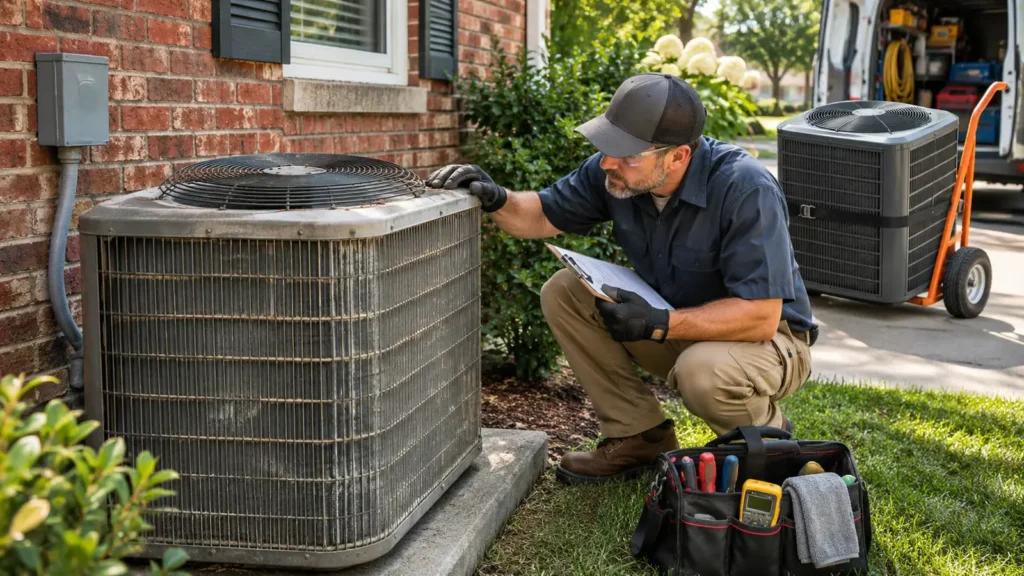
The typical AC lifespan is about 12 to 20 years for a central air conditioner: Angi puts it at 12 to 15 years, while HomeGuide says new systems last 15 to 20 years on average. Climate, installation quality and maintenance explain most of the gap, and ENERGY STAR suggests considering a replacement once your AC is more than 10 years old.
Below, you’ll find lifespan estimates by source and region, what shortens an AC’s life, the signs it’s time to replace and how to make yours last longer. Information checked on November 4, 2026.
AC lifespan by source
| Source | Central AC lifespan | Notes |
|---|---|---|
| Angi (2026 data) | 12–15 years | Modern central AC |
| HomeGuide (July 25, 2025) | 15–20 years | New systems, on average |
| DOE FEMP (Dec. 2024) | 18–25 years | Average life assumed in its cost analysis, by region |
AC lifespan by region
Climate changes how hard an AC works. For example, DOE’s federal buying guidance assumes an 18-year average life in the hot, humid Southeast, where its model runs 3,409 hours a year. In the North, by contrast, it assumes 24 years with 1,705 hours, and in the hot, dry Southwest 25 years with 1,599 hours.
| Region | Cooling hours a year (DOE model) | Average life assumed |
|---|---|---|
| Southeast | 3,409 | 18 years |
| Southwest | 1,599 | 25 years |
| North | 1,705 | 24 years |
What shortens an AC’s lifespan?
- Oversizing: an oversized system cycles too often, which ENERGY STAR says reduces comfort and shortens equipment life.
- Poor airflow: ENERGY STAR also links low airflow to lower efficiency, damp air and a shorter lifespan. In fact, airflow problems alone can cut efficiency by up to 15%.
- Wrong refrigerant charge: too much or too little refrigerant makes the system less efficient and reduces equipment life, according to ENERGY STAR.
- Dirty coils and filters: dirty coils make the system run longer, while a dirty filter can damage the equipment and lead to early failure.
- Loose electrical connections: these can cause unsafe operation and reduce the life of major components.
- Heavy use: finally, longer cooling seasons add run hours, as DOE’s regional assumptions show.
Signs your AC is near the end of its lifespan
ENERGY STAR and HomeGuide point to the same warning signs. As a result, it’s worth calling a contractor if:
- Your AC is more than 10 years old.
- It needs frequent repairs, and your energy bills keep going up.
- Some rooms stay too hot, or the house feels humid in summer.
- The system has become noisy, which ENERGY STAR says can point to undersized ducts or a problem with the indoor coil.
- A repair would cost at least 50% of a new unit, HomeGuide’s threshold for replacing instead.
- It still uses R-22, an older refrigerant that HomeGuide and This Old House both flag as a reason to replace.
How to make your AC last longer
Most of what extends an AC’s life is routine care. ENERGY STAR recommends the following:
- Schedule a professional check-up every spring, before contractors get busy.
- Inspect, clean or change the air filter once a month.
- Have the evaporator and condenser coils cleaned.
- Ask the technician to check the refrigerant level and adjust it if necessary.
- Also have electrical connections tightened and the condensate drain inspected.
Just as important, a new system should be sized and installed correctly from day one. Our guide on what size AC you need explains how a Manual J load calculation prevents oversizing.
Repair or replace an aging AC?
HomeGuide puts typical AC repairs at $150 to $650. Even so, it recommends replacement when the system is more than 10 to 12 years old or breaks down often. This Old House, meanwhile, says repairing usually wins only when the system is under 10 years old and the repair costs 30% or less of a new one.
If you’re leaning toward a new system, compare prices in our AC replacement cost guide, check whether 16 SEER2 is worth it over 14 SEER2 and see when a new coil still makes sense.
AC lifespan FAQ
Can an AC last 25 years?
Some do, especially in milder climates. For instance, DOE’s analysis assumes 24 to 25 years in the North and Southwest. Still, most sources put the typical range at 12 to 20 years.
Does a heat pump last as long as an AC?
Not always. HomeGuide gives 10 to 20 years for heat pumps versus 15 to 20 years for AC units, since a heat pump also runs during the heating season. Our guide to heat pump lifespan covers this in detail.
How long do AC coils last?
Coils typically last 10 to 15 years, according to This Old House and HomeServe.
Should I replace a 15-year-old AC that still works?
Not necessarily right away. However, ENERGY STAR suggests considering a replacement after 10 years, so it’s smart to price a new system before an emergency breakdown in the middle of summer.
Sources and review
Sources: Angi, new furnace and AC cost (2026 data); HomeGuide, AC replacement cost (July 25, 2025); HomeGuide, new HVAC system cost (August 27, 2025); DOE FEMP, purchasing energy-efficient residential central air conditioners (updated December 2024); ENERGY STAR, when is it time to replace?; ENERGY STAR, maintenance checklist; ENERGY STAR, HVAC quality installation; This Old House, evaporator coil replacement cost (April 6, 2026); HomeServe, AC coil replacement cost (September 5, 2024). All checked on November 4, 2026.
Written by: HVAC Switch. Last updated: November 4, 2026. Read our editorial policy to learn how we research prices, or contact us if you spot an error.