
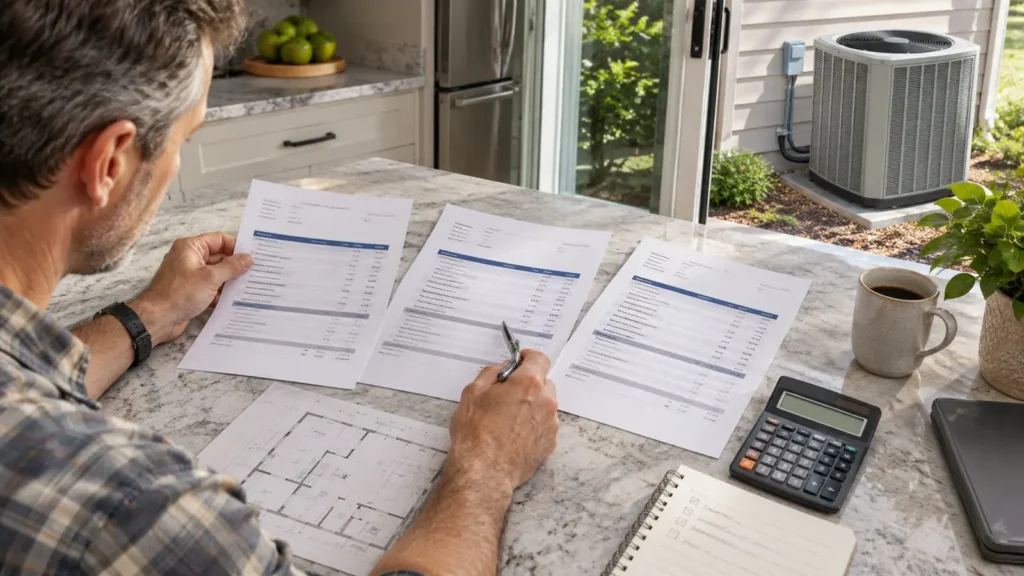
To compare HVAC quotes, line them up item by item: the exact model numbers and AHRI rating, the Manual J sizing, ductwork and refrigerant line work, permits, warranties and the payment schedule. The lowest price is only a good deal if it includes the same work, so ask every contractor the same questions in writing.
Information checked on November 4, 2026. Use the price ranges below as a reality check, not a target, since local labor rates and your home change the cost.
What a complete HVAC quote should include
| Line item | What to look for |
|---|---|
| Equipment | Brand and full model numbers for the outdoor unit, indoor coil or air handler, and furnace |
| Efficiency | SEER2, EER2 and HSPF2, plus the AHRI certificate for the matched system |
| Sizing | A Manual J load calculation, not a copy of your old system’s size |
| Ductwork | Inspection, sealing and repairs, plus a duct leakage test |
| Refrigerant lines | New lines or a written reason for reusing the old ones |
| Electrical and extras | Disconnect, wiring, thermostat, pad, condensate drain and haul-away |
| Permits and inspection | Who pulls the permit and who pays the fees |
| Warranty | Parts warranty, registration, and the contractor’s labor warranty |
| Rebates | Which rebates the contractor will apply for, and in whose name |
| Payment | Deposit, progress payments and final payment terms |
How to compare HVAC quotes with ENERGY STAR’s checklist
To start, ENERGY STAR publishes a bid comparison sheet with the questions to ask every contractor. First of all, it asks whether they’ll measure your home and calculate the correct size with Manual J. In addition, it asks whether they’ll install a properly matched indoor coil and outdoor unit, and new refrigerant lines rather than reusing old ones.
- First, will you test whether my existing ductwork can handle the system size you’re proposing?
- Also, will you check ducts for damage, seal the seams and test that leakage doesn’t exceed recommended levels?
- Then, will you confirm the refrigerant charge and airflow across the coil after installation?
- After that, will you leave the manuals and documentation, including the Manual J, the AHRI certificate and test results?
- In addition, do you offer third-party verification of the installation?
- Finally, will you tell me about local rebates I may qualify for?
ENERGY STAR’s sheet also says total duct leakage should be no more than 20%. So a quote that skips ductwork entirely may be cheaper only because it leaves out work. For more, see whether you need new ductwork and why a Manual J matters.
Fair prices to use when you compare HVAC quotes
| Project | Typical installed cost |
|---|---|
| Central AC replacement | $5,000–$12,000; about $6,000 on average for 3 tons (Fixr) |
| Gas furnace replacement | $2,800–$7,500; about $4,800 on average (Fixr) |
| AC and furnace together | $5,000–$11,000; about $8,000 on average (HomeGuide) |
| Air-source heat pump | $8,000–$15,000 (HomeGuide); Trane’s 2026 averages run $8,313–$15,608 |
However, if a quote is far outside these ranges, ask why. For example, new ductwork, a panel upgrade or a variable-speed system can raise the price legitimately. By contrast, a very low price may leave out the permit, the Manual J or the ductwork. For detail by system, see our guides to AC replacement cost, furnace replacement cost and heat pump cost.
Red flags when you compare HVAC quotes
- No permit: California’s CSLB warns against any contractor who offers a lower price to install without a permit, because a permit means the work gets inspected.
- Sizing by rule of thumb: DOE says rules of thumb too often lead to oversized systems.
- A large deposit: in California, CSLB says not to pay more than 10% down or $1,000, whichever is less. In New York City, DCWP says to pay no more than 25% upfront.
- No written contract: both CSLB and NYC DCWP say to get a written contract before work starts, and DCWP warns never to pay in cash or without a contract.
- Vague equipment: a quote that lists only a brand and tonnage, without model numbers, is hard to compare.
- Financing that hides the price: Trane notes that dealer fees and origination fees can raise the overall cost, so compare the cash price.
Check the contractor, not just the price
- First of all, verify the contractor’s license with your state board. In California, for example, that’s the CSLB.
- Then confirm workers’ compensation and general liability insurance, as CSLB recommends.
- Next, ask for references and, similarly, check complaint records.
- After that, confirm who will apply for rebates and register the equipment warranty.
- Finally, hold the final payment until the final inspection is done and you’re satisfied, as CSLB advises.
For more questions to ask, see our list of questions to ask an HVAC contractor. And if you’re financing, read our guide to HVAC financing first.
How to compare HVAC quotes: FAQ
How many HVAC quotes should I get?
NYC’s DCWP recommends written estimates from more than one licensed contractor. In practice, getting three makes it easier to spot one that’s far off.
Should I always pick the cheapest quote?
Not unless it includes the same equipment and work, because a lower total may leave things out. In particular, check the Manual J, ductwork, permit and warranty before you compare totals.
What is an AHRI certificate?
Basically, it documents that the outdoor unit and indoor coil are a rated match, according to ENERGY STAR’s bid sheet. Ask for one with every AC or heat pump quote.
Is it normal to pay a deposit?
Yes, but keep it small, since rules vary by place: California’s CSLB says no more than 10% or $1,000, whichever is less, while NYC’s DCWP says no more than 25% upfront.
Sources and review
Sources: ENERGY STAR, HVAC installation bid comparison checklist; ENERGY STAR, HVAC quality installation; California Contractors State License Board, HVAC consumer packet; NYC Department of Consumer and Worker Protection, home improvement contractor tips (June 2026); DOE, proper sizing of HVAC systems; Fixr, AC installation cost (January 28, 2026); Fixr, furnace cost (January 28, 2026); HomeGuide, new HVAC system cost (August 27, 2025); HomeGuide, heat pump cost (2026); Trane, 2026 pricing guide (modified May 26, 2026); Trane, HVAC financing FAQ (modified October 30, 2026). All checked on November 4, 2026.
Written by: HVAC Switch. Last updated: November 4, 2026. Read our editorial policy to learn how we research prices, or contact us if you spot an error.