
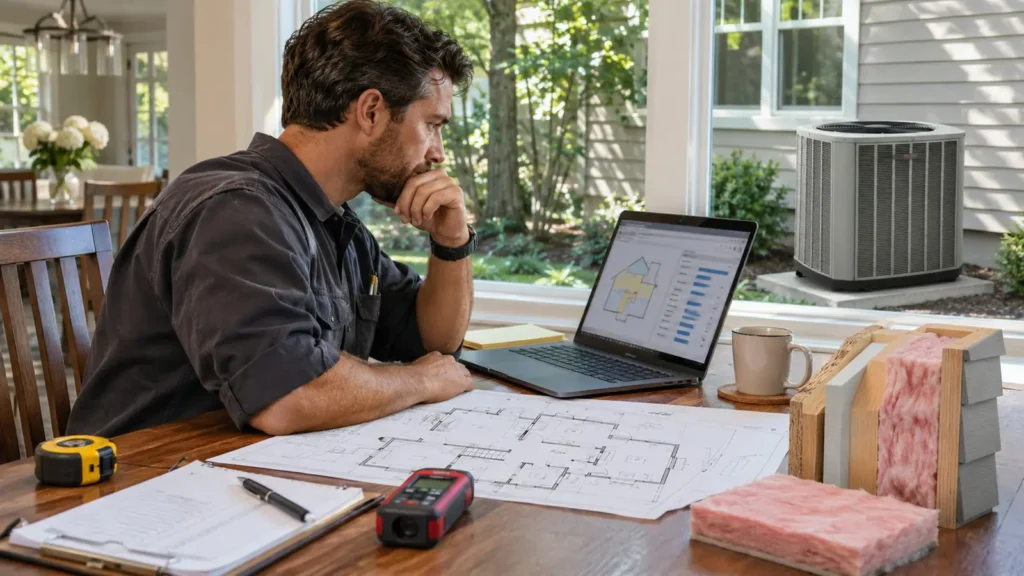
A Manual J load calculation works out how much heating and cooling your specific home needs from its climate, windows, walls, air leakage and ducts. It matters because sizing by square footage alone tends to produce oversized systems that cost more, waste energy and cycle on and off too often.
Information checked on November 4, 2026. The Air Conditioning Contractors of America (ACCA) publishes Manual J, and its 8th Edition is the current standard.
What a Manual J load calculation is
ACCA describes Manual J 8th Edition as “the national ANSI-recognized standard for producing HVAC equipment sizing loads” for single-family homes, small multi-unit buildings, condos, townhouses and manufactured homes. In addition, ACCA says a load calculation done this way “is required by national building codes and most state and local jurisdictions.”
In short, the calculation adds up heat gains and losses from each part of the house. For example, ACCA’s manual covers design conditions for your area, windows and skylights, walls and roofs, air infiltration, internal loads, duct loads and ventilation. As a result, two homes with the same square footage can need very different equipment.
Why a Manual J load calculation beats rules of thumb
According to the U.S. Department of Energy, “rules of thumb” are too often used to size comfort systems, which results in excessively oversized systems. DOE says this leads to higher cost, wasted energy and too-frequent on-and-off cycling that can hurt comfort and efficiency.
Moreover, the gap can be large. HVAC.com, for instance, cites a rule of 20 BTU per square foot, which works out to about 600 square feet per ton. By contrast, building scientist Allison Bailes reviewed 40 Manual J calculations, mostly in warm and mixed climates, and found an average of 1,431 square feet per ton, with only 8 below 1,000.
| Sizing method | Square feet per ton of cooling |
|---|---|
| Rule of thumb: 20 BTU per square foot (HVAC.com) | About 600 |
| Average of 40 Manual J calculations (ACCA blog) | 1,431 |
| Range in those 40 calculations | 624–3,325 |
In other words, a rule of thumb could have more than doubled the size of a typical system in that sample. For more examples, see our guides on what size AC you need and what size furnace you need.
What goes wrong with an oversized system
- Short cycling: an oversized furnace heats the space too quickly and satisfies the thermostat fast, Carrier says, and Trane calls oversizing the most common cause of furnace short cycling.
- Higher cost: bigger equipment costs more to buy, and DOE links oversizing to wasted energy.
- Less comfort: ENERGY STAR warns that oversizing causes cycling, less comfort and a shorter equipment life.
- Equipment that doesn’t fit efficient homes: DOE notes that loads in energy-efficient homes are often so small that they fall below manufacturers’ capacity ranges.
Also, the problem can appear later. For example, Trane says insulation upgrades can lower a home’s load enough to make a furnace that was once the right size oversized. See our guide to furnace short cycling.
Manual J, Manual S and choosing equipment
Manual J gives the loads, but it doesn’t pick the unit. Instead, the contractor then selects equipment that matches those loads, using ACCA’s Manual S. New York’s Clean Heat program, for instance, requires heat pumps to be sized with Manual S based on loads calculated with Manual J, 8th Edition.
In fact, some programs make this a condition of payment. For example, SRP in Arizona requires a Manual J for single-stage systems to qualify for its cooling rebate, and NYS Clean Heat requires the Manual J report as a PDF. See our guide to utility rebates for heat pumps.
How much does a Manual J load calculation cost?
HVAC.com puts a Manual J at $200 to $300 when contractors bill it separately. However, Fixr notes that contractors sometimes charge for it but often credit it against the installation. So ask whether your quote already includes it.
How to make sure you get a real Manual J
- First of all, ask every contractor whether they’ll do a Manual J load calculation, and get it in writing.
- Then ask for a copy of the report, with the heating and cooling loads for your home.
- Next, check that it reflects your actual home: insulation, windows and any recent upgrades.
- After that, ask how they chose the equipment size from those loads.
- Finally, be wary of any quote that simply copies the size of your old system.
ENERGY STAR’s quality installation guidelines also call for sizing with the home’s actual characteristics rather than a rule of thumb. For the rest of the checklist, see how to compare HVAC quotes and the AC installation process.
Related guides: For current prices, see our guide on heat pump cost.
Manual J load calculation: FAQ
Is a Manual J load calculation required?
ACCA says national building codes and most state and local jurisdictions require a Manual J calculation. You can also ask your local building department how it applies the rule.
Can I do a Manual J myself?
ACCA’s procedure covers many detailed inputs. So for an equipment decision, ask a contractor or an energy professional to do a full calculation.
Does a Manual J help with rebates?
Sometimes, yes. For instance, NYS Clean Heat and SRP both require one for certain incentives.
Sources and review
Sources: ACCA, Manual J residential load calculation (8th Edition); DOE Building Science Education Solution Center, proper sizing of HVAC systems; ACCA blog, Manual J load calculations vs rules of thumb (October 20, 2016); HVAC.com, AC size guide (August 1, 2023); Fixr, AC installation cost (January 28, 2026); ENERGY STAR, HVAC quality installation; Carrier, furnace short cycling (October 13, 2026); Trane, furnace short cycling (modified September 11, 2025); NYS Clean Heat Program Manual, Version 3 (September 1, 2026); SRP, air conditioner and heat pump rebates. All checked on November 4, 2026.
Written by: HVAC Switch. Last updated: November 4, 2026. Read our editorial policy to learn how we research prices, or contact us if you spot an error.