
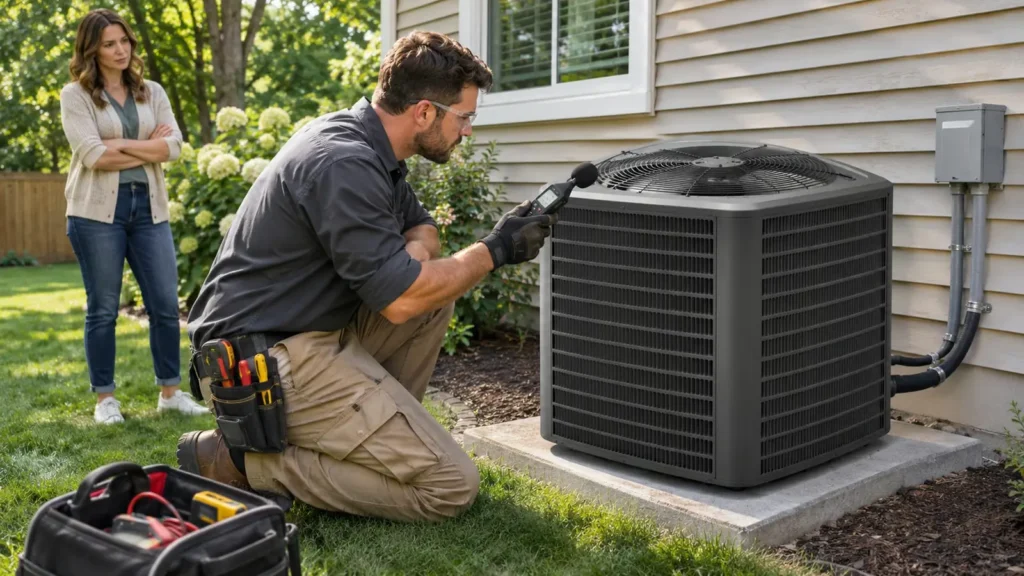
HVAC noises range from normal to urgent: a whoosh during heat pump defrost or a brief click at startup is usually fine, while banging, grinding, hissing or buzzing with a burning smell needs attention right away. Above all, if you hear hissing and smell gas, get everyone out and call 911.
Information checked on November 4, 2026. This guide covers central air conditioners, furnaces and heat pumps; when in doubt, turn the system off and call a technician.
HVAC noises at a glance
| Sound | Likely cause | What to do |
|---|---|---|
| Banging | AC: a failing compressor. Furnace: delayed ignition or a cracked heat exchanger | Stop using the system and call a pro |
| Hissing | AC: a refrigerant leak. Furnace: possibly a gas leak | Call a pro; if you smell gas, leave and call 911 |
| Buzzing | Electrical problems, a failing capacitor or loose wiring | Call a technician, sooner if you smell burning |
| Grinding | Worn motor or fan bearings, or a damaged compressor valve | Turn the unit off and call a pro |
| Squealing | A worn or slipping belt, or motor bearings | Schedule a repair before the part fails |
| Rattling | A loose panel, a loose part or debris | Turn off power and tighten panel screws, or call a pro |
| Repeated clicking | A faulty relay or contactor | Call a pro; don’t do electrical work yourself |
| Whistling | Blocked airflow from dirty filters, closed vents or duct leaks | Replace the filter and open vents |
| Whoosh during defrost | Normal heat pump defrost | Nothing |
Urgent HVAC noises: stop and call
Banging
In an AC, banging can mean a damaged piston pin, connecting rod or compressor, and Angi says to stop using the unit until it’s repaired or replaced. In a furnace, loud popping may come from delayed ignition caused by dirty burners or a faulty ignitor, while intense banging from the furnace itself can point to a cracked heat exchanger, according to ConsumerAffairs.
Therefore, shut off the furnace and call a technician if you hear loud banging. A cracked heat exchanger can leak carbon monoxide, so keep CO alarms working; see our guide to a cracked heat exchanger.
Hissing
From an AC or heat pump, hissing usually points to a refrigerant leak, and Angi says to call a pro immediately rather than try the repair. From a furnace, however, hissing can come from clogged burners, restricted airflow or a gas line leak. ConsumerAffairs is clear: if hissing comes with a gas smell, get everyone out, call 911 and then the gas company.
Buzzing with a burning smell, or arcing
Buzzing can come from failing capacitors or loose wiring, ConsumerAffairs says, and buzzing plus a burning smell means a possible fire risk. Arcing sounds are an emergency too, so shut the furnace’s emergency switch and call a pro. Meanwhile, for capacitor costs, see our AC capacitor replacement cost guide.
HVAC noises that need a repair soon
- Grinding: Angi links it to damaged blower or condenser fan bearings, a damaged blade or a compressor valve. So turn the unit off to prevent wear, and call a pro.
- Squealing or screeching: usually a worn belt or motor bearings. In addition, ConsumerAffairs says squealing from the air handler needs a professional.
- Repeated clicking: a faulty thermostat relay, an electrical problem or a damaged contactor, Angi says. Moreover, Angi warns that DIY relay work can be risky.
- Continuous thumping: Angi says brief thumping at shutdown can be normal, but continuous thumping means something isn’t working correctly.
Some of these can also signal a failing compressor. This Old House lists banging, rattling and clicking among compressor warning signs, so see our AC compressor replacement cost guide before you approve a large repair.
HVAC noises you can often fix yourself
- Rattling: often just a loose access panel. Turn off the power first, then tighten the visible panel screws, as Angi and ConsumerAffairs suggest.
- Whistling: usually blocked airflow. So replace dirty filters, open closed vents and check for obvious duct leaks.
- Thwapping: generally, something is touching the blower. Angi says it isn’t severe, but it can wear the belt and motor.
- Dripping: a clogged condensate drain, which Angi says you can often clear with compressed air or vinegar.
Normal HVAC noises
However, not every sound is a problem. For example, a heat pump makes a whoosh or swoosh when it switches into defrost, and both Lennox and Trane describe this as normal. Similarly, ConsumerAffairs says minor clicking at startup is normal, and small pops can come from ducts expanding as they warm up.
Still, a new sound that keeps getting louder deserves a look. In particular, Lennox lists grinding, squealing or banging from a heat pump as a reason to call a pro. Also, for heat pump defrost sounds, see our guide to a heat pump freezing up.
Related guides: If the repair is expensive, run the numbers in our repair or replace calculator.
HVAC noises: FAQ
Why is my AC making a loud buzzing noise?
First of all, Angi lists a refrigerant leak or freezing, a failed condenser fan and electrical problems. Then, if the buzzing keeps coming back, call a technician.
Why does my furnace bang when it starts?
Often it’s delayed ignition from dirty burners or a faulty ignitor, according to ConsumerAffairs. Because loud banging can also mean a cracked heat exchanger, shut the furnace off and call a pro.
Is a humming noise normal?
Some ACs hum during normal operation, Angi notes. However, a new hum from the outdoor unit can be a sign of a failing capacitor, as This Old House and Trane list.
How much does it cost to fix a noisy HVAC system?
It depends on the part, so get a diagnosis first. For instance, Angi puts AC blower and fan replacement at $100 to $550, while a compressor costs far more.
Sources and review
Sources: Angi, common reasons your AC is making loud noises; ConsumerAffairs, reasons your furnace is making loud noises (updated July 9, 2026); Lennox, heat pump defrost cycle (November 10, 2025); Lennox, what to do if your heat pump is frozen (February 16, 2026); Trane, what is a heat pump defrost cycle? (modified May 15, 2026); This Old House, AC compressor cost (updated August 31, 2026); This Old House, AC capacitor cost (updated April 7, 2026). All checked on November 4, 2026.
Written by: HVAC Switch. Last updated: November 4, 2026. Read our editorial policy to learn how we research prices, or contact us if you spot an error.