
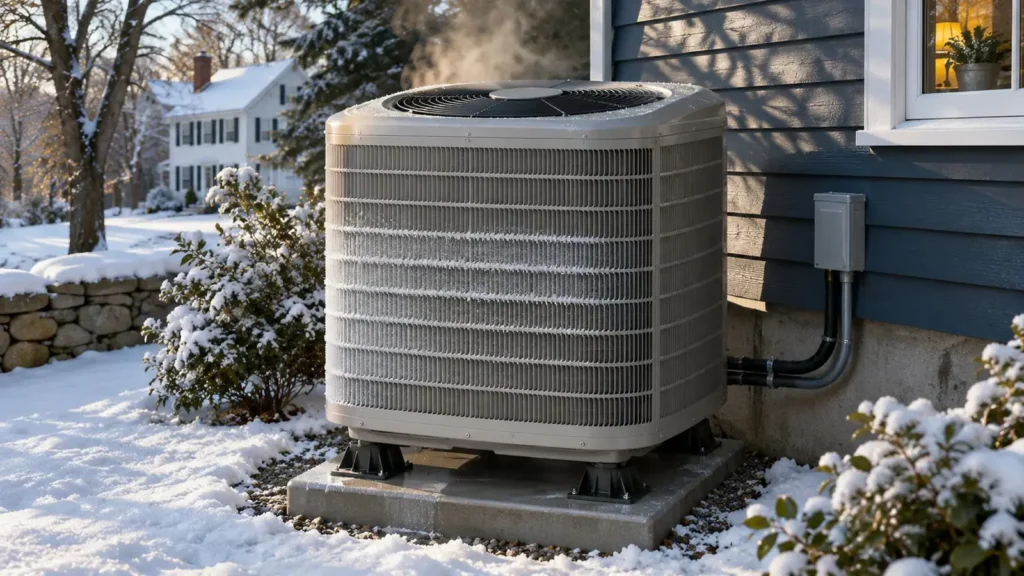
A heat pump freezing up in winter is often normal: a light layer of frost builds on the outdoor coil, and the defrost cycle melts it in a few minutes, often with a cloud of steam. It’s a problem when the whole unit turns into a block of ice, defrost runs constantly or the ice doesn’t melt within a few hours.
Information checked on November 4, 2026. Never chip ice off the coil or pour hot water on it, because both can damage the unit.
Why outdoor coils get icy in winter
In heating mode, the outdoor coil pulls heat from cold air. As a result, Trane says the coil is typically 10 to 20°F colder than the outdoor air, so moisture can freeze on it. Defrost can happen when it’s in the low 40s, but Trane says it’s more common in the 20s and 30s.
Then, to clear the frost, the reversing valve briefly switches the system to cooling mode, which sends warm refrigerant to the outdoor coil. Then it switches back to heating. For instance, Trane says its cycles usually last 3 to 5 minutes, while Lennox says defrost usually lasts 5 to 15 minutes.
When a heat pump freezing up is just normal defrost
- Steam from the outdoor unit: Lennox and Trane both say this is water vapor and it’s normal.
- A whoosh or swoosh: Lennox and Trane both list this sound as normal.
- The outdoor fan stops: Trane lists this as normal during defrost.
- “AUX” on the thermostat: backup heat may turn on so the air indoors stays warm.
- A slight dip in indoor temperature: Lennox lists this as normal. Without backup heat, Trane says you may even feel cool air for a few minutes.
However, how often defrost runs depends on the system and the weather. Lennox says most systems check for frost every 30 to 90 minutes in heating mode, and cold, damp days mean more cycles. Trane’s systems, by contrast, use demand defrost, which runs only when needed.
Signs your heat pump freezing up is a real problem
- Ice covers the whole coil or the top of the unit, and it doesn’t clear after a defrost cycle.
- Defrost runs constantly, or the cycles keep getting longer, as Trane warns.
- Also, the unit refreezes quickly after it thaws, or ice forms on only one side.
- In addition, ice appears on the refrigerant lines, or the outdoor fan won’t spin after the ice melts.
- Moreover, you hear grinding, squealing or banging, or heating gets weak with a hissing sound.
- Your electric bill jumps without explanation, which Lennox lists as a reason to call a pro.
Why a heat pump keeps freezing up: causes and repair costs
When a heat pump keeps freezing up, Lennox points to several causes. These include a failed defrost control board, timer or sensor; low refrigerant; restricted airflow from a dirty filter, snow or debris; a clogged drain pan or line; freezing rain or heavy wet snow; and faulty parts such as the reversing valve or outdoor fan motor.
| Repair | Typical cost |
|---|---|
| Control board (including defrost board) | $150–$700 |
| Reversing valve | $200–$650 |
| Outdoor fan motor | $200–$700 |
| Capacitor or contactor | $120–$400 |
| Refrigerant leak repair | $300–$1,200 |
| Compressor | $650–$2,400 |
Overall, Angi says most heat pump repairs cost $161 to $661, with an average of about $410. For a full repair-or-replace decision, see our repair or replace guide and our heat pump lifespan guide.
What to do if your heat pump is freezing up
- First of all, set the thermostat to Off, as Lennox advises, so the unit can thaw.
- Next, clear at least 2 feet of space around the outdoor unit, including snow and leaves.
- Then check the indoor air filter and replace it if it’s dirty.
- After that, wait for the ice to melt. Lennox says a unit should thaw naturally in 2 to 4 hours when it’s above freezing.
- Finally, if the ice doesn’t melt within 6 to 8 hours or refreezes quickly, call a technician.
Above all, don’t chip or break the ice, because Lennox says even a small dent can reduce efficiency. Likewise, never pour hot water on the unit, since thermal shock can crack components.
How to prevent ice buildup
- Keep it clear: first, trim plants and remove snow so air can flow around the unit.
- Change filters: Lennox recommends replacing the filter every 1 to 3 months.
- Protect only the top: Lennox says a snow guard should cover the top, never the sides.
- Book maintenance: Lennox recommends professional tune-ups twice a year, in spring and fall.
If you live where winters are harsh, also see our guides to the cold-climate heat pump and heat pump backup heat.
Related guides: If the repair is expensive, run the numbers in our repair or replace calculator. Then compare the repair with our guide on heat pump replacement cost.
Heat pump freezing up: FAQ
Is it normal to see ice on the outdoor unit?
Yes, a thin layer of frost is normal in cold, damp weather, and the defrost cycle should melt it. However, a thick block of ice that doesn’t clear isn’t normal.
How long does a heat pump defrost cycle last?
Usually just a few minutes. For example, Trane says 3 to 5 minutes for its systems, while Lennox says 5 to 15 minutes.
Why is steam coming from the outdoor unit?
In most cases, that’s the defrost cycle melting frost, so a heat pump freezing up lightly and steaming is fine. Both Lennox and Trane say the steam is water vapor and normal.
Can I keep running the system if it’s iced over?
Not if it’s iced over. Instead, Lennox recommends turning the thermostat off and letting the unit thaw. If it refreezes or doesn’t thaw, then call a technician.
Sources and review
Sources: Trane, what is a heat pump defrost cycle? (modified May 15, 2026); Lennox, understanding the heat pump defrost cycle (November 10, 2025); Lennox, what to do if your heat pump is frozen (February 16, 2026); Angi, heat pump repair cost (2026 data). All checked on November 4, 2026.
Written by: HVAC Switch. Last updated: November 4, 2026. Read our editorial policy to learn how we research prices, or contact us if you spot an error.