
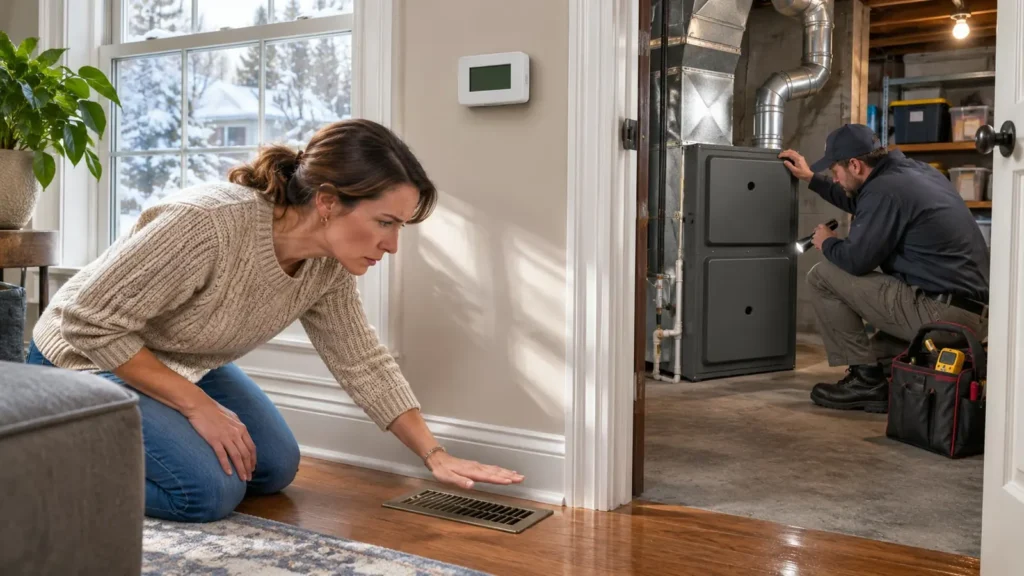
A furnace blowing cold air is most often caused by a thermostat fan set to On, a furnace that hasn’t warmed up yet or a dirty filter that made it overheat, and you can check all three yourself. If not, however, a technician may need to fix the flame sensor, ignitor, limit switch or gas supply, which usually costs $80 to $800.
Prices checked on November 4, 2026. If you smell gas, leave the home first and call your gas utility or 911 from outside; don’t try to find the leak yourself.
Quick checks when your furnace is blowing cold air
- Thermostat: first of all, set it to Heat, set the fan to Auto rather than On, and make sure the set temperature is above room temperature. Carrier lists the wrong fan setting among the most common causes.
- Give it a minute: Indeed, Carrier notes a blower delay of about 30 to 60 seconds at startup. So wait a few minutes before you assume there’s a problem.
- Air filter: next, check the filter. Carrier recommends replacing 1-inch filters every 1 to 3 months, because a clogged one can cause overheating, Carrier says.
- Vents and returns: then open supply vents and clear return grilles, since too many closed vents can also cause problems, Carrier says.
- Fuel supply: also check whether your other gas appliances work, and check the tank level if you heat with propane or oil.
- Condensate line: on a high-efficiency furnace, Lennox says to make sure the PVC drain line to the floor drain isn’t blocked.
Common causes of a furnace blowing cold air and repair costs
| Part or repair | Typical cost |
|---|---|
| Flame sensor | $80–$250 |
| Ignitor | $100–$250 |
| Thermocouple (pilot furnaces) | $100–$300 |
| Limit switch | $100–$375 |
| Gas valve | $200–$800 |
| Control board | $300–$650 |
| Draft inducer motor | $400–$1,100 |
| Blower motor | $300–$900 |
| Thermostat | $190–$480 |
| Heat exchanger | $1,000–$3,000 |
Dirty flame sensor
Carrier lists a malfunctioning flame sensor as a common cause. Specifically, if it’s coated in soot or the porcelain is cracked, it needs cleaning or replacement, according to Carrier. Lennox, however, recommends calling a dealer, and HomeGuide puts the repair at $80 to $250.
Overheating and the limit switch
Carrier also lists a malfunctioning fan limit switch, and it names clogged filters, blocked vents or returns, a failing blower motor and a dirty evaporator coil as the usual triggers. Therefore, check the filter first. Meanwhile, if the switch itself has failed, HomeGuide puts the repair at $100 to $375.
Pilot light or ignition problems
To begin with, Lennox notes that furnaces made since 2010 don’t use pilot lights. Instead, they use an electronic ignitor, which costs $100 to $250 to replace, according to HomeGuide. In an older furnace, however, a pilot that won’t stay lit may mean a dirty orifice or a faulty thermocouple, and Carrier says pilot repairs are best left to a professional.
Gas supply or gas valve
Carrier lists gas or oil supply problems as another cause. So check other gas appliances first, and contact your utility if none of them work. A failed gas valve, on the other hand, costs $200 to $800 to replace, HomeGuide says.
Leaky ducts and control board errors
Carrier also lists leaky ducts that lose warm air. To fix them, it suggests sealing visible leaks with metallic foil tape or mastic and calling a pro for hidden ducts. Similarly, a blinking light on the control board can show an error code, but Carrier says not to repair or replace the board yourself.
Safety: when to stop and call a pro
- Gas smell: leave the home and contact your gas utility or emergency services, Carrier says. Above all, don’t try to diagnose a gas leak yourself.
- Soot around the furnace: turn off the system immediately and contact a professional, according to Carrier.
- Carbon monoxide alarm: if your CO alarm sounds, the Consumer Product Safety Commission (CPSC) says to move outside to fresh air immediately and call 911 or the fire department.
- Heat exchanger concerns: HomeGuide says most technicians replace a heat exchanger instead of repairing it, because of possible carbon monoxide leaks. See our guide to a cracked heat exchanger.
In addition, CPSC recommends CO alarms on every level of the home and outside sleeping areas, and an annual professional inspection of fuel-burning heating systems. For prices, see our furnace tune-up cost guide.
Repair or replace a furnace blowing cold air?
Overall, most furnace repairs cost $100 to $600, according to HomeGuide. In addition, HomeGuide says that replacement is usually best for a furnace that needs frequent repairs or is more than 20 years old.
For example, a $250 flame sensor on a 10-year-old furnace is clearly worth fixing. By contrast, a $2,000 heat exchanger on a 22-year-old furnace is a strong case for replacement. Compare full prices in our furnace replacement cost guide and our repair or replace guide.
Related guides: If the repair is expensive, run the numbers in our repair or replace calculator. If the thermostat calls for heat and nothing happens, see our guide on what to do when the thermostat says heat is on but there’s no heat.
Furnace blowing cold air: FAQ
Why does my furnace blow cold air at first and then warm air?
That’s often normal. Carrier notes a blower delay of about 30 to 60 seconds at startup, so give the furnace a few minutes.
Why is my furnace blowing cold air after I changed the thermostat?
First of all, check the mode and fan settings. If the fan is set to On, or the mode isn’t Heat, you’ll feel unheated air. If the settings are right, however, call a technician.
Can I clean a flame sensor myself?
Yes, in some cases. Carrier says you can inspect it if you’re comfortable removing the access panel, while Lennox recommends a dealer. If in doubt, call a technician, since gas furnaces carry safety risks.
How much does it cost to fix a furnace blowing cold air?
Generally, common fixes such as a flame sensor, ignitor or limit switch usually cost $80 to $375, according to HomeGuide. However, a gas valve or inducer motor can cost up to $800 or $1,100.
Sources and review
Sources: Carrier, why is my furnace blowing cold air (October 13, 2026); Lennox, is your furnace blowing cold air? (August 23, 2024); HomeGuide, furnace repair cost; CPSC, carbon monoxide fact sheet; CPSC, winter heating safety tips (2026). All checked on November 4, 2026.
Written by: HVAC Switch. Last updated: November 4, 2026. Read our editorial policy to learn how we research prices, or contact us if you spot an error.