
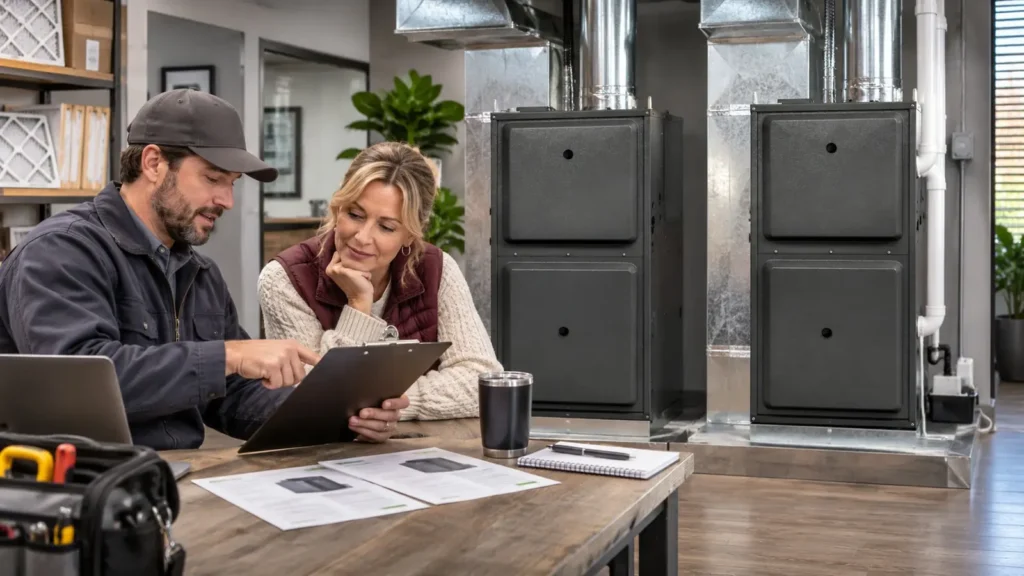
Two-stage vs single-stage furnace: a single-stage furnace always fires at 100% capacity, while a two-stage model also has a low setting of about 60% to 65% that handles most of the heating season, according to Carrier. As a result, the two-stage furnace delivers quieter, more even heat. In Trane’s 2026 lineup, its two-stage line costs only about $220 to $470 more than its single-stage line, although Carrier cites estimates of $1,000 to $2,500 more for comparable models.
Below, we compare how each type works, what you gain in comfort, what the upgrade really costs and when it’s worth it. Information checked on November 4, 2026.
Two-stage vs single-stage furnace at a glance
| Feature | Single-stage | Two-stage | Modulating |
|---|---|---|---|
| Heat output | 100% only | Low (about 60%–65%) and high (100%) | 40% to 100% in 1% steps |
| Temperature control | Largest swings | Fewer swings | Within 1 to 2 degrees |
| Noise | Loudest, with frequent cycling | Moderate to quiet | Very quiet |
| Upfront cost | Lowest | Mid-range | Highest |
Trane prices by stage
| Trane line | Stages | 80% AFUE | 96% AFUE |
|---|---|---|---|
| Choice | Single-stage | $5,093–$5,481 | $6,630–$6,946 |
| Priority | Two-stage | $5,530–$5,934 | $6,851–$7,412 |
| Premier | Two-stage, variable | $6,000–$6,386 | $7,569–$8,390 |
How each furnace type works
A single-stage furnace has a gas valve with one setting, so it runs at full capacity and then shuts off, Carrier explains. HomeGuide adds that this can create temperature swings and use more energy, which is why it calls single-stage models best for milder climates.
A two-stage furnace, by contrast, uses a two-stage gas valve. On a typical winter day it starts in low stage and switches to high only when it gets colder outside or you raise the thermostat by several degrees. In fact, Carrier says some of its two-stage models can run in low stage up to 90% of the time.
Finally, a modulating furnace adjusts its output in small steps, from 40% to 100% of capacity in Carrier’s comparison, and always pairs with a variable-speed blower.
Two-stage vs variable-speed: what’s the difference?
Basically, the terms describe different parts. According to Carrier, “modulating” or “two-stage” refers to the gas valve and how much heat the furnace produces, while “variable-speed” refers to the blower motor and how much air it moves. Therefore, a two-stage furnace may or may not have a variable-speed blower, so check the spec sheet.
Comfort benefits of a two-stage furnace
- Even heat: longer, gentler cycles mean fewer temperature swings, Carrier says.
- Quieter operation: two-stage furnaces are quieter, particularly at the lower stage.
- Better filtration: because the furnace runs longer, more air passes through the filter, although real results depend on the filter and blower.
- Less energy in mild weather: similarly, HomeGuide says two-stage furnaces reduce energy use when it’s only moderately cold.
Two-stage vs single-stage furnace: cost and savings
Upfront, however, the premium varies. Trane’s two-stage Priority line runs about $440 to $450 more than its single-stage Choice line at 80% AFUE, and about $220 to $470 more at 96% AFUE. Carrier, on the other hand, cites an outside estimate of $1,000 to $2,500 more for a comparable two-stage model.
As for energy savings, Carrier warns that real savings depend on the model, AFUE rating and climate, and that homeowners shouldn’t assume a fixed percentage. In other words, efficiency is driven mainly by AFUE, while staging is mostly a comfort upgrade. For the efficiency side, see our guide to 80% vs 96% AFUE furnaces.
When is a two-stage furnace worth it?
- Choose two-stage if you live in a cold climate with a long heating season, have rooms that heat unevenly or want quieter operation.
- Choose single-stage, on the other hand, if you live in a mild climate, need the lowest upfront price or plan to move soon.
- Consider modulating if comfort is your top priority and the budget allows; Carrier’s top modulating model reaches up to 98.5% AFUE.
Whatever you pick, size matters more than stages; see what size furnace you need. Then compare installed prices in our furnace replacement cost guide, and check how long furnaces last.
Two-stage vs single-stage furnace FAQ
Does a two-stage furnace save money?
It can, mainly in moderate weather. However, Carrier says actual savings depend on the furnace model, AFUE rating and climate, so treat comfort as the main benefit.
Is a two-stage furnace worth it in a mild climate?
Often not. HomeGuide calls single-stage furnaces best for milder climates, where the furnace runs fewer hours.
Is a two-stage furnace the same as a modulating furnace?
No. A two-stage furnace has two heat levels, while a modulating furnace adjusts gradually from about 40% to 100%, according to Carrier.
Sources and review
Sources: Carrier, modulating vs variable-speed furnaces (October 13, 2026); Carrier, what is a two-stage furnace? (October 13, 2026); Carrier, new gas furnace cost (October 13, 2026); Trane, 2026 HVAC replacement cost guide; HomeGuide, new furnace cost (December 31, 2025). All checked on November 4, 2026.
Written by: HVAC Switch. Last updated: November 4, 2026. Read our editorial policy to learn how we research prices, or contact us if you spot an error.