
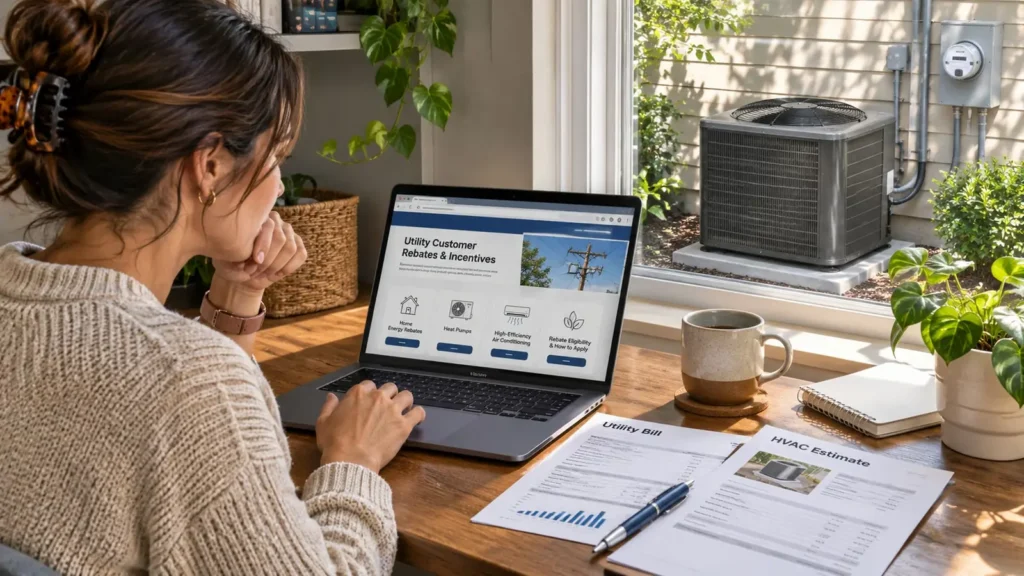
Utility rebates for heat pumps usually pay a set amount per ton or a flat sum, and in our 2026 examples they range from $75 per ton to $8,500 per home. To find yours, check your utility’s rebate page, the ENERGY STAR Rebate Finder and your city or state energy office.
Information checked on November 4, 2026. Because utility programs change every year and can run out of money, confirm the current terms before you buy.
How utility rebates for heat pumps and AC work
In most programs, the rebate depends on the system’s efficiency tier and size, and you apply after installation with a receipt. However, some programs also require a contractor from their network, a load calculation or a permit.
Unlike federal HEEHR rebates, none of the standard utility rebates in our examples has an income limit. On the other hand, each utility sets its own amounts, so two homes a few miles apart can get very different rebates.
Examples of utility rebates for heat pumps in 2026
| Program | Rebate in 2026 |
|---|---|
| Mass Save (Massachusetts utilities) | Heat pumps: $2,650 per ton, up to $8,500, for whole-home systems; $1,125 per ton, up to $8,500, for partial-home systems |
| SRP (Phoenix area) | Heat pumps and central AC rated 15.2 SEER2 or higher: $75 per ton single-stage, $150 multi-stage and $225 variable-capacity |
| Riverside Public Utilities (California) | Heat pumps rated 15.2 SEER or higher: $750 per ton; central AC: $150 per ton (15.2 to 15.9 SEER) or $250 per ton (16 SEER or higher) |
| City of Columbia Utilities (Missouri) | Heat pumps: $800 for 15.2 to 18.1 SEER2 or $1,200 for 18.2 SEER2 or higher |
| Power Ahead Colorado (Denver metro, regional program) | $1,500 for qualifying cold-climate heat pumps, which can be stacked with Xcel Energy rebates |
For example, a 3-ton variable-capacity heat pump would earn $675 from SRP. By comparison, the same 3-ton heat pump would earn $2,250 in Riverside and $7,950 as a whole-home system under Mass Save. These are our own calculations from each program’s per-ton rates.
How to find utility rebates for heat pumps in your area
- First of all, go to your electric utility’s website and look for a section called rebates, energy efficiency or savings. If a city or co-op supplies your power, check its site too.
- Then search the ENERGY STAR Rebate Finder, which lists rebates and special offers on certified products by ZIP code.
- After that, check your state energy office for the federal HEEHR and HOMES rebates. Our HEAR rebate program guide lists which states are open.
- Next, look for regional programs, such as Power Ahead Colorado, which the Denver Regional Council of Governments runs.
- Finally, ask each contractor which rebates they handle. Still, confirm every amount on the program’s own page.
Requirements that can cost you a utility rebate
- Efficiency minimums: SRP and Columbia require at least 15.2 SEER2, while Riverside lists 15.2 SEER. Also, check the rating in the AHRI directory, since Columbia warns that a manufacturer’s rating can be higher than the unit performs.
- Matched systems: Riverside requires the outdoor unit and coil to be listed together in the AHRI directory.
- Contractor rules: Mass Save requires an installer from its network, and Power Ahead Colorado requires a verified contractor. SRP, by contrast, asks for a contractor licensed in Arizona.
- Sizing: SRP requires a Manual J load calculation for single-stage systems, and Columbia can deny a rebate for an oversized unit.
- Permits and replacements: Columbia requires a final mechanical permit and pays only when you replace an existing system.
- Deadlines: Riverside wants the application within 90 days of purchase, while SRP and Columbia allow six months after installation.
- Funding: Columbia pays first-come, first-served, and Riverside says its program may be cancelled at any time.
Above all, keep the itemized receipt with the make, model numbers, serial numbers and tonnage. Riverside, for example, asks for all of these on the dated sales receipt.
Can you stack utility rebates with other incentives?
Often you can, but each program sets its own rules. For instance, the Power Ahead Colorado rebate can be combined with Xcel Energy incentives, according to program officials quoted by The Denver Gazette. By contrast, Mass Save rebates can’t be combined with other Mass Save incentives for the same equipment.
Federal rules add another limit. By law, a HEEHR rebate can’t be combined with another federal grant or rebate for the same project. For the full list of options, see our guide to heat pump rebates.
Utility rebates for high-efficiency AC
Some utilities also pay for efficient central air conditioners. SRP pays the same per-ton rates for AC as for heat pumps, and Riverside pays $150 to $250 per ton. However, compare the rebate with the extra price of the higher tier before you decide.
To see whether a higher rating pays off, read our comparison of 14 vs 16 SEER2 and our AC replacement cost guide.
Utility rebates for heat pumps: FAQ
Do I need to apply before installing?
Not always. SRP, Riverside and Columbia take applications after installation. Even so, federal HEEHR rebates must be reserved first, so check each program before work starts.
Can I get a utility rebate for a mini-split?
It depends on the program. SRP, for example, pays $225 per ton for an inverter-driven mini-split heat pump. For prices, see our mini-split cost guide.
How long does a utility rebate take?
It varies. Mass Save, for instance, tells customers to allow eight weeks for processing, and it may inspect the installation first.
What if my utility doesn’t offer a heat pump rebate?
Then look at state, city and federal programs instead. Similarly, check whether your utility offers financing, such as Mass Save’s 0% HEAT Loan, and read our guide to HVAC financing.
Sources and review
Sources: Mass Save, air-source heat pump rebates (2026); SRP, air conditioner and heat pump rebates (install by April 30, 2027); Riverside Public Utilities, heat pump and air conditioning rebates (2026); City of Columbia Utilities, air conditioner and heat pump rebates (modified March 31, 2026); The Denver Gazette, Power Ahead Colorado heat pump incentive (July 15, 2026); ENERGY STAR Rebate Finder; DOE Program Notice 26-2 (HEEHR) (effective May 29, 2026). All checked on November 4, 2026.
Written by: HVAC Switch. Last updated: November 4, 2026. Read our editorial policy to learn how we research prices, or contact us if you spot an error.