
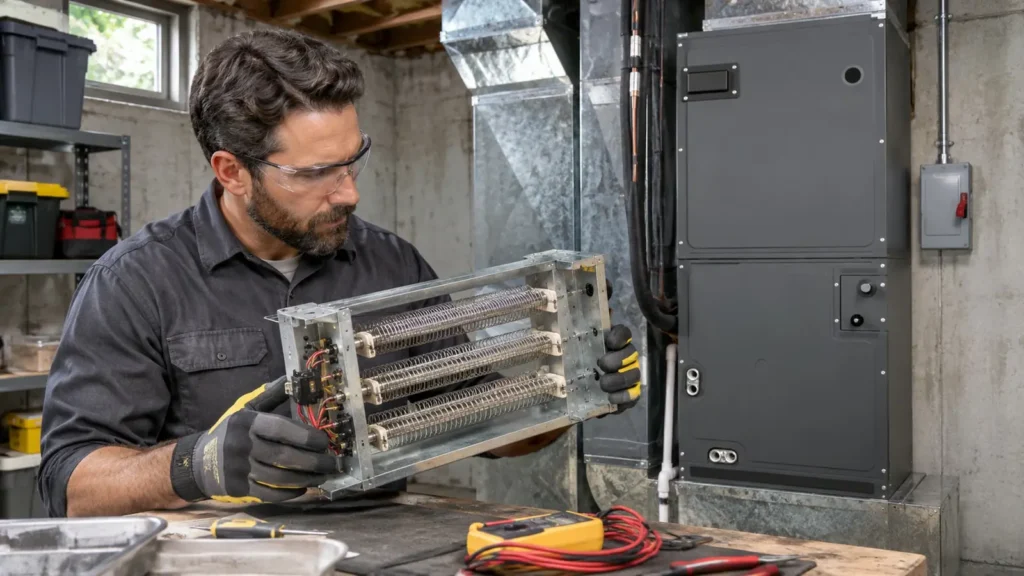
Most heat pump homes in cold or mixed climates need some form of heat pump backup heat, usually electric heat strips sized at about 5 kW for a 2-ton system, 10 kW for 3 tons and 15 kW for 4 or 5 tons, according to Alabama Power. In mild climates, or with a well-sized cold climate heat pump, backup heat may run only a few hours a year.
The catch is cost. Heat strips use roughly three to four times the energy of a heat pump for the same heat, as Alabama Power explains. Below, we explain when you need backup heat, how to size it and how to keep it from inflating your bill. Information checked on November 3, 2026.
What heat pump backup heat is
Heat strips are electric resistance coils that add heat to a heat pump, working much like a space heater, according to Alabama Power. In addition, they sit inside the indoor air handler, and the system fan blows air across them into your home, as Texas utility GVEC describes.
Because resistance heat has a COP near 1, every kWh of electricity becomes about 3,412 BTU of heat, according to PICKHVAC. A heat pump, by contrast, typically reaches a COP of 2–3 in mild cold weather, so it delivers two to three times as much heat for the same electricity.
Auxiliary heat vs emergency heat
- Auxiliary heat turns on automatically when the heat pump needs help, for example on very cold days or when you raise the thermostat by more than about 1.5 to 2 degrees, according to Alabama Power.
- Emergency heat is a manual setting. It forces the system to rely 100% on the heat strips, as GVEC explains, so you should only use it when the heat pump isn’t working properly.
When you need heat pump backup heat
First, every heat pump loses capacity as the outdoor temperature drops. At some point, called the balance point, its output no longer covers your home’s heat loss. Below that temperature, therefore, you need help from backup heat. Therefore, the colder your winters and the less efficient your home, the more backup heat you’ll use.
You’re likely to need it if:
- you live where winters regularly drop well below freezing;
- your heat pump is a standard model rather than a cold climate one;
- your home is older or poorly insulated; or
- you often set the thermostat back at night and turn it up quickly in the morning.
On the other hand, a cold climate heat pump can keep much of its capacity in subzero weather. In the DOE’s Cold Climate Heat Pump Challenge, for instance, Carrier’s test units ran at full capacity at 0°F. Learn more in our guide to cold climate heat pumps.
How to size heat pump backup heat
| Heat pump size | Typical heat strip size (Alabama Power) |
|---|---|
| 2 tons | About 5 kW |
| 3 tons | About 10 kW |
| 4–5 tons | About 15 kW |
PICKHVAC suggests a similar rule of thumb: 2–3 kW per ton in mild climates and 3–5 kW per ton in colder regions. Its table for cold climates lists 10–15 kW for a 1,200–2,000 sq ft home and 15–20 kW for 2,000–3,000 sq ft. In every case, however, a Manual J load calculation should confirm the size.
What heat strips cost to run
Meanwhile, running cost depends on the strip size and your electricity price. At the U.S. average residential price of 18.16 cents per kWh in August 2026, reported by the EIA, here’s what each size costs per hour at full power:
| Heat strip size | Heat output | Cost per hour at 18.16¢/kWh |
|---|---|---|
| 5 kW | About 17,000 BTU/h | About $0.91 |
| 10 kW | About 34,000 BTU/h | About $1.82 |
| 15 kW | About 51,000 BTU/h | About $2.72 |
| 20 kW | About 68,000 BTU/h | About $3.63 |
As a result, a few hours of strip heat on a cold morning can cost more than running the heat pump all day. Alabama Power warns that strip heat can add hundreds of dollars to your heating costs.
How to keep backup heat from running too often
- Raise the thermostat gradually. Alabama Power suggests going up one degree at a time, and GVEC recommends steps of no more than two degrees.
- Limit deep setbacks. PICKHVAC suggests setbacks of only 2–3°F.
- Use an outdoor lockout. Many systems can block auxiliary heat above a chosen outdoor temperature, such as 35–40°F, according to PICKHVAC.
- Choose a smart thermostat that stages the strips and learns recovery times, which PICKHVAC says helps avoid unnecessary aux heat.
- Avoid emergency heat unless the heat pump has failed.
Heat strips vs a furnace for backup
If you already have a gas or propane furnace, you can keep it as backup in a dual fuel system instead of adding strips. For example, EnergySage’s 2026 average for hybrid systems was $14,353 before incentives. For a full cost picture, see our heat pump cost guide.
Related guides: See also our guide on geothermal heat pump cost.
Frequently asked questions
Do I need backup heat with a cold climate heat pump?
Often yes, but you’ll use it far less. Even so, it’s mainly insurance for the coldest days or for a breakdown.
Why does my heat pump say “aux heat”?
Auxiliary heat turns on automatically when the heat pump can’t keep up, such as on a very cold day or after you raise the thermostat by more than about 2 degrees, according to Alabama Power.
Is emergency heat expensive?
Yes, because in emergency mode the system runs only on heat strips, which use roughly three to four times as much energy as the heat pump for the same heat, according to Alabama Power.
Sources and review
Sources: Alabama Power, strip heating can warm your house and empty your wallet (December 16, 2024); GVEC, heat pumps, heat strips and emergency heating (February 14, 2021); PICKHVAC, heat pump heat strips (September 16, 2025); EIA, Electric Power Monthly, Table 5.6.A (August 2026 data, preliminary); Carrier, DOE Cold Climate Heat Pump Challenge (September 12, 2024); EnergySage, air-source heat pump costs (updated March 19, 2026). All checked on November 3, 2026.
Written by: HVAC Switch. Last updated: November 3, 2026. Read our editorial policy to learn how we research prices, or contact us if you spot an error.