
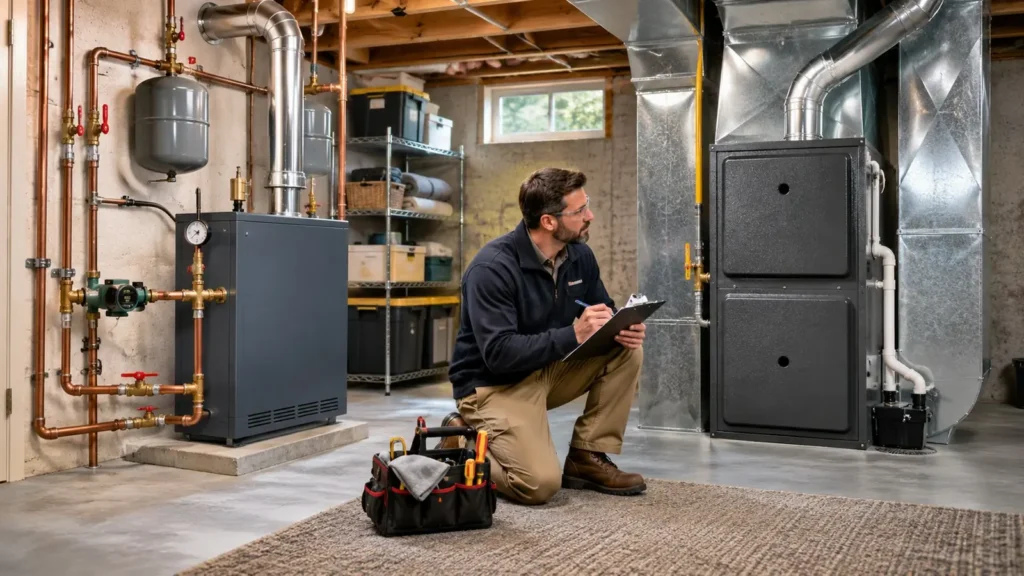
Boiler vs furnace: a boiler heats water and sends it to radiators, baseboards or radiant floors, while a furnace heats air and blows it through ducts. A new boiler typically costs $3,200 to $9,000 installed, with a $6,100 national average, according to HomeGuide, compared with about $4,800 on average for a furnace, according to Fixr. In short, boilers offer quiet, even heat without ducts, whereas furnaces cost less and can share ducts with central air.
Below, we compare costs, comfort, efficiency, lifespan and cooling options, so you can decide which heating system fits your home. Information checked on November 4, 2026.
Boiler vs furnace at a glance
| Boiler | Furnace | |
|---|---|---|
| How it heats | Hot water or steam through pipes to radiators, baseboards or floors | Warm air through ducts and vents |
| Typical installed cost | $3,200–$9,000; $6,100 average (HomeGuide) | $2,800–$7,500; $4,800 average (Fixr) |
| High-efficiency models | 90%+ AFUE; $4,000–$10,000 installed (HomeGuide) | 90%–98.5% AFUE (Carrier) |
| Lifespan | 10–20 years; 30+ for some cast-iron boilers (HomeGuide) | 15–30 years (HomeGuide) |
| Central air | Needs a separate system | Can share ducts with an AC or heat pump |
Cost: boiler vs furnace
Boilers usually cost more to replace. HomeGuide puts standard-efficiency boiler replacement at $2,200 to $7,000 and high-efficiency models at $4,000 to $10,000, with labor and fitting at $1,200 to $3,200. Furnaces, by contrast, average about $4,800 installed, according to Fixr. Interestingly, This Old House’s 2026 homeowner survey found the opposite average: $5,750 for boilers and $8,533 for gas furnaces, which shows how much local prices and job scope vary.
Switching between the two is expensive, though. Converting a boiler home to a furnace means adding ductwork, which HomeGuide prices at $2,400 to $6,600 for new ducts. As a result, most homeowners replace like with like. See our furnace replacement cost guide for full furnace prices.
Comfort and efficiency
- Even, quiet heat: boilers warm rooms through radiators or floors without blowing air, so there’s no fan noise or dust from vents.
- Faster heat: furnaces, on the other hand, warm the air quickly and can also filter it.
- No duct losses: boilers avoid the 20% to 30% air losses that ENERGY STAR attributes to typical duct systems.
- Efficiency: high-efficiency boilers are rated at 90% AFUE or more and can save 10% to 20% on energy bills, HomeGuide says; similarly, condensing furnaces reach 90% to 98.5% AFUE.
- ENERGY STAR models: an ENERGY STAR boiler is 5% more efficient than a new standard model, while an ENERGY STAR furnace is 15% more efficient than a conventional one.
Cooling: the furnace’s big advantage
A furnace shares its ducts and blower with a central AC or heat pump, so adding cooling is straightforward. A boiler home, however, has no ducts, so cooling usually means ductless mini-splits or a high-velocity system. For options and prices, see our guides to central air without ductwork and mini-split cost per zone.
Boiler vs furnace: which should you choose?
- Keep or choose a boiler if your home already has radiators, baseboards or radiant floors, and you value quiet, even heat.
- Choose a furnace instead if you have ducts, want central air through the same system or want the lowest upfront cost.
- Consider a heat pump, finally, if you want heating and cooling from one system; read heat pump vs furnace.
Related guides: See also our guides on dual fuel vs heat pump only and heat pump vs central AC.
Boiler vs furnace FAQ
Is a boiler more efficient than a furnace?
Not necessarily. Both come in high-efficiency condensing versions above 90% AFUE. However, boilers avoid duct losses, which can give them an edge in homes with leaky ducts.
How long does a boiler last compared with a furnace?
HomeGuide says a boiler lasts 10 to 20 years on average, or 30 years or more for some cast-iron models, while furnaces last 15 to 30 years.
Can I replace a boiler with a furnace?
Yes, but you’ll need ductwork, which adds $2,400 to $6,600 or more, according to HomeGuide. For that reason, it usually makes sense only if you also want central air.
Sources and review
Sources: HomeGuide, new boiler cost (December 31, 2025); HomeGuide, new HVAC system cost (August 27, 2025); Fixr, furnace replacement cost (January 28, 2026); This Old House, HVAC replacement cost (September 2, 2026); Carrier, high-efficiency gas furnaces (October 13, 2026); ENERGY STAR, when is it time to replace?; ENERGY STAR, duct sealing. All checked on November 4, 2026.
Written by: HVAC Switch. Last updated: November 4, 2026. Read our editorial policy to learn how we research prices, or contact us if you spot an error.