
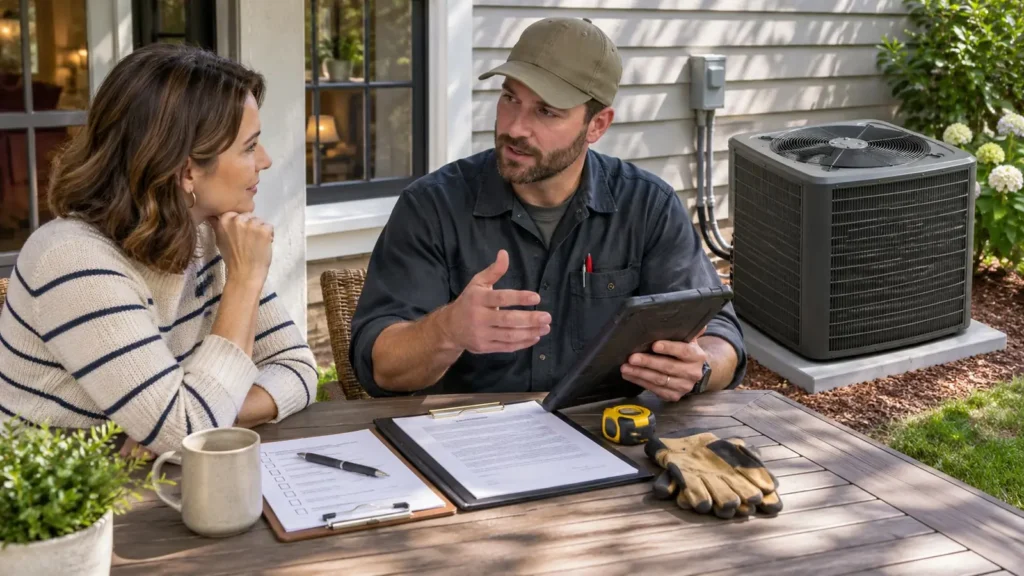
The most important questions to ask an HVAC contractor cover licensing, sizing, what the quote includes and the permit. They also cover warranties and how you’ll pay. Ask every HVAC contractor these questions in writing before you sign. Then compare the answers side by side.
Information checked on November 4, 2026. Licensing and payment rules vary by state and city, so check your local consumer agency as well.
Questions to ask an HVAC contractor about credentials
- License: first, ask whether they’re licensed and then verify it. California’s CSLB, for example, tells homeowners to check that the license is in good standing.
- Insurance: also ask for proof of workers’ compensation and general liability insurance, as CSLB recommends.
- References: next, request references, and similarly check complaint history, as NYC’s DCWP suggests.
- Quality installation: finally, ask about quality-installation programs. ENERGY STAR notes that ACCA lists accredited contractors.
Questions to ask an HVAC contractor about sizing and equipment
- Sizing: above all, ask whether they’ll do a Manual J load calculation, because ENERGY STAR’s bid checklist asks this question.
- Ductwork capacity: also ask them to test whether your ducts can handle the proposed size.
- Model numbers: then request exact models for the outdoor unit, the indoor coil or air handler and the furnace.
- Matched system: in addition, ask for the AHRI certificate. ENERGY STAR calls for a properly matched coil and outdoor unit.
- Efficiency: next, compare the SEER2, EER2 and HSPF2 ratings; see SEER2 explained.
- Refrigerant: finally, ask which refrigerant it uses, such as R-454B or R-32; see R-454B vs R-32.
If a contractor plans to keep your old indoor coil, ask why. North Carolina’s fire marshal, for example, requires a new coil when you switch to an A2L outdoor unit. For more on sizing, read why a Manual J matters.
Questions about the installation
- Refrigerant lines: first of all, ask whether they’ll install new lines or reuse the old ones.
- Ducts: also ask whether they’ll check, seal and test the ducts. ENERGY STAR says total duct leakage should be no more than 20%.
- Commissioning: then ask whether they’ll confirm the refrigerant charge and the airflow across the coil after installation.
- Crew: in addition, ask who will do the work and whether a supervisor will check it.
- Timeline: next, ask how long it will take and whether you’ll have heat or cooling in the meantime.
- Cleanup: finally, confirm that they’ll haul away the old equipment and clean up.
Carrier says an outdoor unit swap takes about 4 to 8 hours and a full system 8 to 14 hours. Jobs with new ductwork can take two to three days, HomeGuide says. See our guide to the AC installation process.
Questions about permits and inspections
- Permit: first, ask who pulls the permit and whether it’s in the price. CSLB warns against contractors who offer a lower price without one.
- Inspection: then ask when the final inspection will happen, since CSLB says to hold the final payment until it’s done.
- Written notice: also, in New York City, DCWP says contractors must list all required permits in writing before the contract.
Questions about warranties and rebates
- Registration: first, ask who registers the equipment warranty, since many brands require it within 60 to 90 days; see our HVAC warranty comparison.
- Labor warranty: also ask what labor warranty they give, since manufacturer warranties typically cover parts only, according to ConsumerAffairs.
- Rebates: then ask which rebates they’ll apply for, as ENERGY STAR’s checklist suggests. Moreover, programs such as Mass Save and NYS Clean Heat require an enrolled contractor.
- Paperwork: finally, ask for the manuals, the Manual J, the AHRI certificate and test records.
For rebate options, see our guides to heat pump rebates and utility rebates for heat pumps.
Questions about price and payment
- Contract: first of all, insist on a written, fixed-price contract, as CSLB advises. Don’t sign until you understand the terms.
- Deposit: then keep the deposit small. In California, CSLB says no more than 10% or $1,000, whichever is less. NYC’s DCWP says no more than 25% upfront.
- Schedule: next, agree on a payment schedule, because CSLB advises against paying ahead of the work.
- Financing: also ask for both the cash price and the financed price. Trane notes that dealer fees can raise the overall cost.
- Cancellation: finally, check for a 3-day right to cancel clause, which CSLB says to include.
To check whether the price is fair, compare it with our guide on how to compare HVAC quotes. Also, if you plan to borrow, read HVAC financing.
Questions to ask an HVAC contractor: FAQ
What is the most important question to ask an HVAC contractor?
Ask how they’ll size the system. DOE warns that rules of thumb too often lead to oversized systems. So a contractor who does a Manual J is a good sign.
Should I get the answers in writing?
Yes. In fact, CSLB and NYC’s DCWP both say to get a written contract. Written answers also make quotes easier to compare.
What are red flags in an HVAC contractor?
CSLB lists an unlicensed contractor, no workers’ compensation insurance, skipping the permit, poorly sealed ducts and no final inspection. Likewise, NYC’s DCWP warns against cash-only or no-contract work.
How many HVAC contractors should I ask?
NYC’s DCWP recommends written estimates from more than one licensed contractor. In practice, three gives you a useful comparison.
Sources and review
Sources: ENERGY STAR, HVAC installation bid comparison checklist; ENERGY STAR, HVAC quality installation; California Contractors State License Board, HVAC consumer packet; NYC DCWP, home improvement contractor tips (June 2026); DOE, proper sizing of HVAC systems; NC Office of State Fire Marshal, partial replacement with A2L refrigerant (June 6, 2025); Carrier, air conditioner prices (installation time) (October 27, 2026); ConsumerAffairs, HVAC warranties (updated April 29, 2026); Trane, HVAC financing FAQ (modified October 30, 2026); HomeGuide, AC replacement cost (July 25, 2025). All checked on November 4, 2026.
Written by: HVAC Switch. Last updated: November 4, 2026. Read our editorial policy to learn how we research prices, or contact us if you spot an error.