
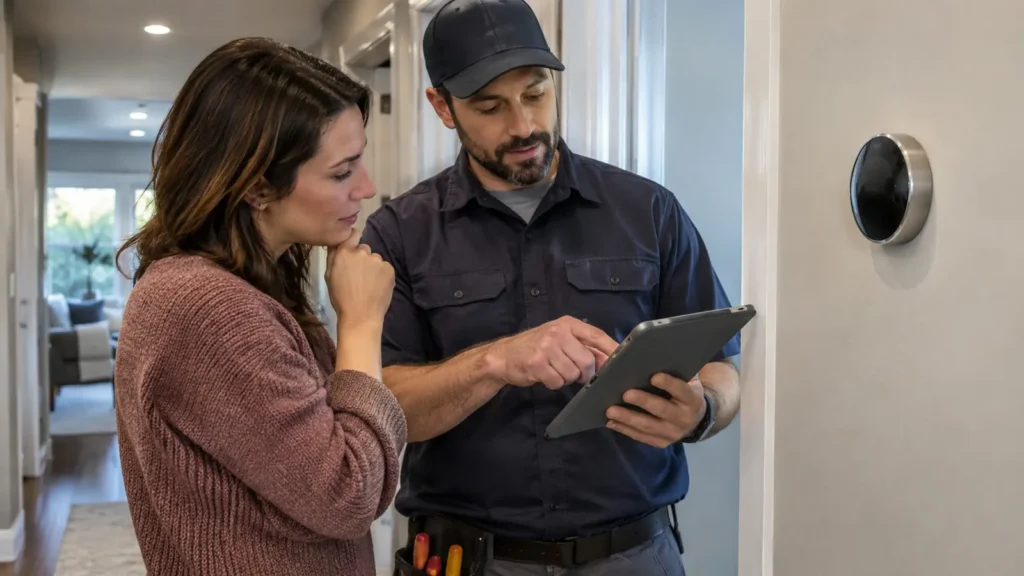
A smart thermostat works well with a heat pump if it’s heat-pump compatible and set up to limit auxiliary heat, which can cost about 2 to 5 times as much to run as the heat pump itself, according to Google Nest. However, what doesn’t work is treating it like a furnace thermostat, with deep setbacks that force the backup strips on.
Information checked on November 4, 2026. Setting names vary by brand, so check your thermostat’s heat pump guide before you change installer settings.
What makes a smart thermostat heat pump compatible
First of all, the thermostat must support heat pumps. Trane, for example, warns that a recent DIY or third-party installation may be wrong, and that heat pump owners should confirm they have a compatible heat pump thermostat.
Secondly, look for settings that control when backup heat runs. For example, Google Nest’s Heat Pump Balance and ecobee’s outdoor-temperature thresholds both do this. Also, if you’re not sure about wiring, have an HVAC technician install it.
Why auxiliary heat is the big cost
Heat pumps may have electric resistance strip heat for backup, called auxiliary or “aux” heat, the CEE guide explains. According to Google Nest, AUX heat “can cost about 2 to 5 times as much as running your heat pump.” Likewise, a heat pump owner’s guide from the Consortium for Energy Efficiency, posted by DOE, calls this mode “costly and inefficient.”
By our own calculation at the August 2026 U.S. average electricity price, resistance heat costs about $53 per million Btu, compared with roughly $18 to $24 for heat pump heating. So a thermostat that turns on aux heat too often can wipe out much of the heat pump’s savings. See our guide to a heat pump high electric bill.
Smart thermostat heat pump settings that work
Google Nest: Heat Pump Balance
To begin with, Nest’s Heat Pump Balance lets you choose how much aux heat the system uses. With Max Comfort, the default, aux heat therefore typically turns on sooner and more often. By contrast, Max Savings sets a lower lockout temperature, so aux heat turns on later and less often, and Balanced sits in between, Google says.
ecobee: outdoor temperature thresholds
Similarly, ecobee thermostats have installer thresholds for the compressor and aux heat. For instance, a support sheet from the Bonneville Power Administration recommends setting “Compressor min temperature” to disabled or 5°F or below, and “Aux heat max outdoor temperature” to 35°F or below. Still, your heat pump’s minimum operating temperature limits how low you should go, so check its manual.
Steady temperatures over deep setbacks
Above all, heat pumps are efficient with a steady thermostat setting, the CEE guide says. In particular, it advises avoiding abrupt changes of 3°F or more during unoccupied hours, and it says setbacks typically save energy only if you’re away for more than a day. So if you want a cooler night, change the setting gradually by a few degrees.
Smart thermostat heat pump mistakes to avoid
- Deep nightly setbacks: the CEE guide warns against abrupt changes of 3°F or more.
- Auto mode in winter: the CEE guide recommends Heat mode in winter and Cool mode in summer instead of Auto.
- Continuous fan: the same guide recommends Auto fan rather than continuous.
- Leaving emergency heat on: Carrier says to use emergency heat sparingly, since resistance heat alone can raise your bill significantly.
- Ignoring dual-fuel settings: if you kept a furnace, the CEE guide says to set its thermostat 2 to 4 degrees below the heat pump’s setpoint.
Also, don’t forget maintenance. A smart thermostat can’t fix a dirty filter or low refrigerant, so keep up with service; see our guide to a heat pump blowing cold air.
What a smart thermostat can save
PPL Electric, a Pennsylvania utility, says an ENERGY STAR certified smart thermostat can reduce your annual heating and cooling bill by more than 8%. However, savings depend on your habits and settings, and with a heat pump, the biggest savings come from keeping aux heat to a minimum.
Many utilities also offer rebates. For example, PPL listed a $50 or $100 rebate, and PSEG Long Island advertises smart thermostat rebates of up to $100 to $130. Then check our guide to utility rebates for heat pumps for how to find yours.
Related guides: For current prices, see our guide on heat pump cost.
Smart thermostat heat pump: FAQ
Do I need a special thermostat for a heat pump?
Yes, it must be heat-pump compatible, so check before you buy. Trane advises confirming that you have a compatible heat pump thermostat, especially after a DIY installation.
Should I turn my heat pump down at night?
Only a little, and gradually. The CEE guide advises avoiding abrupt changes of 3°F or more, because heat pumps work best with a steady setting.
What is aux heat lockout?
Basically, it’s an outdoor temperature above which the thermostat won’t use aux heat. Google Nest, for instance, adjusts this lockout automatically through Heat Pump Balance.
Can a smart thermostat lower a heat pump electric bill?
It can, mainly by limiting aux heat and also by avoiding big setbacks. For other causes of high bills, see our heat pump high electric bill guide.
Sources and review
Sources: Google Nest Help, Heat Pump Balance; Bonneville Power Administration, ecobee heat pump thermostat support sheet; Consortium for Energy Efficiency, “You installed an ASHP, now what?” (posted by DOE) (2024); Trane, thermostat troubleshooting (modified April 24, 2025); Carrier, heat pump not heating (September 15, 2026); PPL Electric, ENERGY STAR certified smart thermostat rebate (2026); PSEG Long Island, Home Comfort (2026); EIA, Electric Power Monthly, Table 5.6.A (August 2026 data, preliminary). All checked on November 4, 2026.
Written by: HVAC Switch. Last updated: November 4, 2026. Read our editorial policy to learn how we research prices, or contact us if you spot an error.