
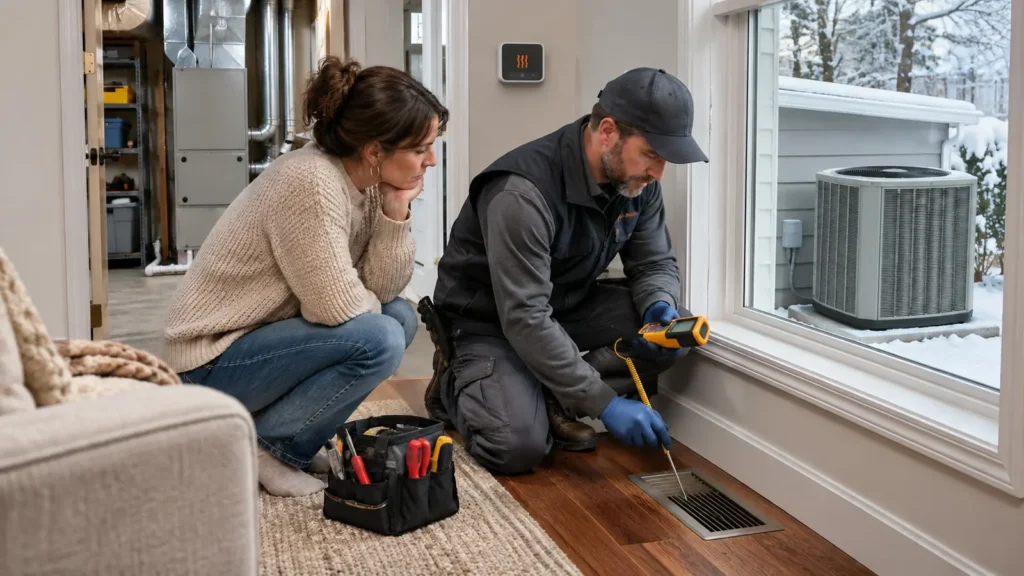
A heat pump blowing cold air in heat mode is often working normally: its air is usually 85 to 100°F, which can feel cool next to a furnace’s 120 to 140°F, and it blows cooler air for a few minutes during defrost. If the air stays cold, check the thermostat, filter and outdoor unit, then call a technician for a reversing valve or refrigerant problem.
Information checked on November 4, 2026. Never open the heat pump’s panels or touch refrigerant lines; Lennox says to go no further than resetting a breaker.
Is your heat pump blowing cold air, or just cooler air?
A heat pump delivers warm air, but not as hot as a gas furnace. According to Carrier, heat pump supply air is typically around 85 to 100°F during heating, compared with roughly 120 to 140°F from a gas furnace. Similarly, Trane says it’s usually 85 to 93°F, and building scientist Allison Bailes puts it at 90 to 110°F off the coil.
Trane explains why that can feel cool: your body is about 98.6°F, so air below that temperature feels cool on your skin. In other words, lukewarm air from the vents can be normal, as Carrier’s FAQ also notes. So the real test is whether the house reaches the temperature you set.
Common causes of a heat pump blowing cold air
| Cause | What to do |
|---|---|
| Defrost cycle | Wait; it usually ends in 5 to 15 minutes, Lennox says |
| Thermostat on Cool or fan on On | Set it to Heat and the fan to Auto |
| Dirty air filter | Replace it if you can’t see through it |
| Blocked outdoor unit | Clear snow, leaves and debris |
| Tripped breaker | Reset it once; call a pro if it trips again |
| Stuck reversing valve | Call a technician |
| Low refrigerant or a leak | Call a technician |
The defrost cycle
In cold, damp weather, however, frost builds on the outdoor coil. To melt it, the heat pump briefly runs in reverse, so it temporarily blows cooler air, Lennox explains. This usually lasts 5 to 15 minutes, while Carrier puts it at about 5 to 10 minutes. For more detail, see our guide to a heat pump freezing up.
Thermostat settings
To begin with, Carrier says thermostat settings are among the most common causes. First of all, make sure the mode is Heat, not Cool, and that the fan isn’t set to On or constant fan. Lennox also suggests raising the setpoint at least 5 degrees to see if the heat pump responds. If the thermostat reads more than 2 to 3°F away from the actual temperature, Carrier recommends having it checked.
Airflow problems
A clogged filter restricts airflow, so Carrier recommends checking it every 60 to 90 days, while Trane says to change it every 1 to 3 months. Outdoors, meanwhile, Carrier advises at least 24 inches of clear space around the unit. In addition, leaky ducts can lose about 20% to 30% of the air in a typical home, according to Carrier.
A stuck reversing valve
The reversing valve switches the heat pump between heating and cooling. If your system cooled fine last season but won’t heat now, the valve may be stuck or may have failed, Trane says. Therefore, this needs a professional repair, and Angi puts a reversing valve at $200 to $650.
Low refrigerant
Signs of a leak include hissing, pooling liquid or a frozen indoor coil, according to Trane, which says to call for service right away. Meanwhile, Lennox calls refrigerant work “a job for a licensed technician.” Angi lists leak repairs at $300 to $1,200.
Quick checks for a heat pump blowing cold air
- First of all, wait 15 minutes in case the heat pump is defrosting.
- Then set the thermostat to Heat, the fan to Auto, and raise the setpoint by 5 degrees.
- Next, replace the air filter if it’s dirty.
- After that, check the breakers, the outdoor disconnect and the indoor air handler switch.
- Also, clear snow, ice and debris from around the outdoor unit, keeping about 2 feet of space.
- Finally, if the air is still cold after these checks, call a technician.
If the outdoor unit isn’t working, Carrier says you can switch to emergency heat. However, use it sparingly, because relying only on electric resistance heat can significantly raise your bill. See our guide to heat pump backup heat for details.
When a heat pump blowing cold air needs a technician
- First, the air stays cold even after you’ve done the checks above.
- Also, heavy ice remains on the outdoor unit after a defrost cycle.
- In addition, you hear grinding, squealing or banging, or you smell burning.
- Similarly, the system short cycles or shows an error code.
- Finally, your electric bill jumps suddenly, which Lennox lists as a warning sign.
For repair-or-replace advice on an older system, see our heat pump lifespan guide. And if your bills are the main worry, read why your electric bill is so high with a heat pump.
Related guides: If the repair is expensive, run the numbers in our repair or replace calculator. Then compare the repair with our guide on heat pump replacement cost.
Heat pump blowing cold air: FAQ
What temperature should air from a heat pump be?
Generally, 85 to 100°F, according to Carrier. Trane gives 85 to 93°F, so air that feels lukewarm can still be normal.
Why does my heat pump blow cold air for a few minutes?
Most likely, it’s defrosting. Indeed, Lennox says defrost temporarily blows cooler air, usually for 5 to 15 minutes.
Should I use emergency heat if my heat pump blows cold air?
Only if the outdoor unit isn’t working, and only until it’s repaired. Carrier warns that electric resistance heat alone can raise your bill significantly.
Is a heat pump blowing cold air normal in very cold weather?
Its air is always cooler than a furnace’s, so it can feel cool in any weather. For example, Allison Bailes measured 105°F from his own heat pump at 32°F outdoors. If the house can’t keep up, a cold-climate model or backup heat may help; see our cold-climate heat pump guide.
Sources and review
Sources: Carrier, heat pump not heating (September 15, 2026); Trane, heat pump not heating (modified July 17, 2025); Lennox, heat pump heat feel cool? (February 17, 2026); Energy Vanguard (Allison Bailes), is heat pump supply air too cold? (May 6, 2024); Angi, heat pump repair cost (2026 data). All checked on November 4, 2026.
Written by: HVAC Switch. Last updated: November 4, 2026. Read our editorial policy to learn how we research prices, or contact us if you spot an error.