
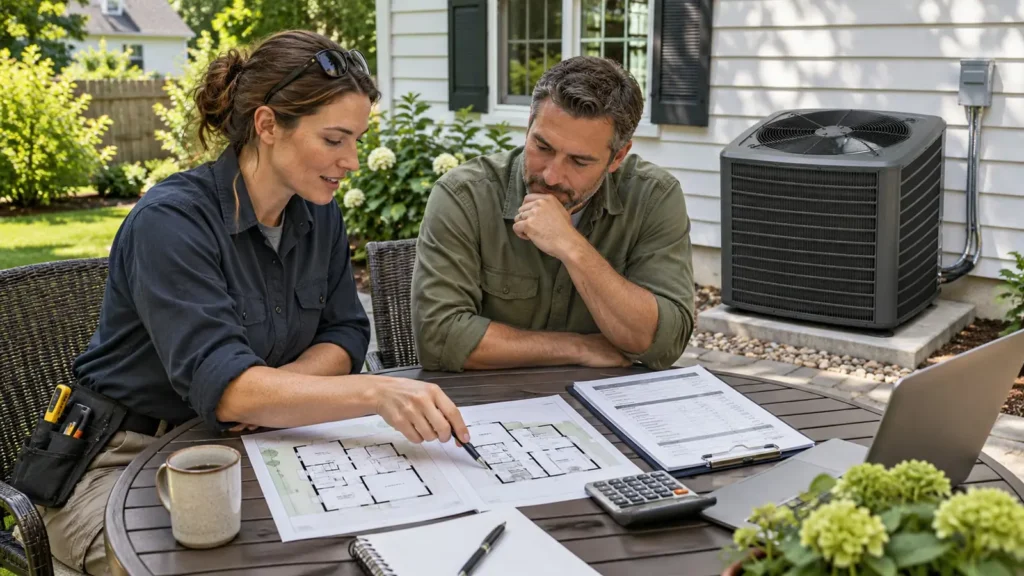
A ducted air-source heat pump typically costs $5,000 to $15,000 installed, according to Fixr’s 2026 data. Average heat pump cost figures from the major cost guides range from about $5,800 to $9,000, while EnergySage’s 2026 data puts the average ducted system near $14,500 before incentives.
Your own price depends mostly on the size of your home, the condition of your ducts and electrical panel, the efficiency you choose and your climate. Below, we compare heat pump cost data from four sources by home size and system type. We also explain what pushes the price up and which incentives are still available now that the federal tax credit has ended. All prices were checked on November 3, 2026.
Heat pump cost by home size
In general, larger homes need more heating and cooling capacity, which is measured in tons. One ton equals 12,000 BTU per hour, so a 3-ton heat pump is a 36,000 BTU unit. Because contractors price equipment largely by capacity, home size is the quickest way to estimate your budget.
| Home size | Typical capacity | Fixr (2026) | HomeGuide (2026) | EnergySage per-ton estimate |
|---|---|---|---|---|
| 1,000 sq ft | 2 tons | $5,000–$8,000 | $3,000–$5,500 | about $7,600 |
| 1,500 sq ft | 2.5–3 tons | $6,700–$14,000 | $3,200–$6,500 | $9,500–$11,400 |
| 2,000 sq ft | 3–4 tons | $8,000–$20,000 | $3,500–$8,500 | $11,400–$15,200 |
| 2,500 sq ft | 3.5–5 tons | $9,500–$22,000 | $3,800–$10,000 | $13,300–$19,000 |
| 3,000 sq ft | 4–6 tons | $15,000–$25,000 | $4,000–$10,000 | $15,200–$22,700 |
How to read this table:
- Home sizes, tonnage and the Fixr column come from Fixr’s cost guide (updated January 22, 2026).
- HomeGuide prices by tonnage, so we used its rows for the same capacity range. HomeGuide’s table stops at 5 tons.
- The “EnergySage per-ton estimate” column is our own calculation. We multiplied the tonnage by EnergySage’s average of $3,790 per ton for ducted systems (updated March 19, 2026) and rounded to the nearest $100.
- Each source collects and reports prices in its own way, so the ranges don’t line up exactly. That’s why we show all of them.
Still, treat the capacity column as a starting point only. EnergySage’s rule of thumb is about 1 ton per 600 square feet, yet insulation, windows, air leaks and climate can change the answer a lot. For that reason, a good contractor sizes the system with a room-by-room load calculation. In the U.S., the industry standard for that calculation is ACCA Manual J.
Heat pump cost by system type
The type of system matters as much as its size. For example, a ductless mini-split for one room costs a fraction of a whole-home geothermal system.
| System type | Typical installed cost | Best for |
|---|---|---|
| Ducted air-source (central) | $5,000–$15,000 (Fixr); $6,500–$12,000 (Modernize); $14,529 average (EnergySage) | Homes with ductwork in good condition |
| Ductless mini-split, single zone | $2,000–$6,000 (Modernize); $1,200–$4,000 (HomeGuide) | One room, an addition or a garage conversion |
| Ductless mini-split, multi-zone | $8,000–$15,000 (Modernize) | Whole homes without ducts |
| Hybrid or dual fuel (heat pump plus furnace) | $14,353 average (EnergySage) | Cold climates where you want a furnace as backup |
| Geothermal (ground-source) | $15,000–$35,000 (Fixr and HomeGuide) | Long-term owners with enough land for the ground loop |
Ductless systems look cheap for a single room. However, the price climbs quickly with each indoor unit you add. EnergySage’s 2026 average for ductless systems was $25,957 before incentives, well above its average for ducted ones.
What drives heat pump cost up or down
In fact, two quotes for the same house can differ by thousands of dollars. In most cases, the gap comes down to these seven factors.
1. Capacity
Each extra ton adds equipment and labor. EnergySage’s 2026 averages are $3,790 per ton for ducted systems and $9,163 per ton for ductless ones. That’s why correct sizing matters as much as the brand you pick.
2. Efficiency rating
Higher cooling (SEER2) and heating (HSPF) ratings mean lower energy bills but a higher upfront price. According to Fixr, typical installed prices by efficiency tier are:
- 14–15 SEER2 / 7–8 HSPF: $5,000–$12,000
- 16–17 SEER2 / 8–9 HSPF: $7,000–$15,000
- 18–19 SEER2 / 9–10 HSPF: $10,000–$18,000
- 20+ SEER2 / 10+ HSPF: $15,000–$25,000
3. Ductwork
If your ducts are sealed, correctly sized and in good shape, the new heat pump can usually reuse them. Modernize puts a furnace-to-heat-pump conversion with existing ducts at $7,500–$15,000. On the other hand, new ductwork adds $2,400–$6,600, according to HomeGuide.
4. Electrical upgrades
A heat pump runs on electricity, so your panel needs enough capacity. As EnergySage notes, homes with a 100-amp panel may need an upgrade. Modernize suggests budgeting an extra $1,500–$5,000 for panel upgrades, new ducts or other significant repairs.
5. The indoor unit
Some installations also need a new indoor unit, called an air handler. Modernize prices an outdoor unit plus a new air handler at $8,000–$15,000. HomeGuide lists a new air handler alone at $2,000–$3,500.
6. Climate
In cold regions, you may need a cold-climate model that keeps heating efficiently in freezing weather. EnergySage notes that these models tend to carry a premium. Some homes also add electric backup heat or keep a furnace in a dual fuel setup.
7. Labor, permits and removal
First, labor usually runs $75–$125 per hour, according to Fixr. Next, permits cost $50–$300 (Fixr) or $250–$400 (HomeGuide), depending on your city. Finally, removing the old equipment adds $500–$1,000 if it isn’t already included in your quote, according to HomeGuide.
Tax credits and rebates that lower heat pump cost in 2026
Meanwhile, incentives changed a lot in 2026. Here’s what still applies and what doesn’t.
- The federal heat pump tax credit has ended. The Energy Efficient Home Improvement Credit (Section 25C) covered 30% of the cost, up to $2,000 a year. According to the IRS, you can only claim it for improvements made through December 31, 2025. As a result, a heat pump installed in 2026 doesn’t qualify.
- The geothermal credit has ended too. The IRS says the Residential Clean Energy Credit isn’t available for property placed in service after December 31, 2025.
- Federal Home Energy Rebates depend on your state. Under the HEEHR program (formerly HEAR), a heat pump for space heating and cooling can earn up to $8,000, and a household can receive up to $14,000 in total. Households below 80% of the area median income can have up to 100% of the cost covered, while those between 80% and 150% can get up to 50%. However, since May 29, 2026, new HEEHR reservations cover only upgrades from existing electric equipment, not replacements of gas, oil or propane systems. The program is also open only in some states, so see our heat pump rebates guide before you sign a contract.
- Utility and local rebates are still worth checking. Enter your ZIP code in the ENERGY STAR rebate finder to see utility, state and local offers in your area.
How to get an accurate heat pump cost for your home
Online ranges help you set a budget, but only an in-home visit gives you a real number. To compare quotes fairly, follow these steps:
- Get at least three written quotes from licensed contractors.
- Ask each contractor how they sized the system and whether they did a Manual J load calculation.
- Make sure every quote lists the exact outdoor and indoor model numbers, plus their SEER2 and HSPF2 ratings.
- Check what’s included: removal of the old unit, permits, electrical work, duct changes, the thermostat and warranty registration.
- Confirm any rebate rules before you sign, since some programs set conditions on the equipment or the installer.
Related guides: Before you collect quotes, also read our guide on Manual J load calculations. You can also get a personalized estimate with our HVAC replacement cost calculator.
More in this section:
- Heat pump replacement cost
- Cold-climate heat pumps
- Heat pump size for a 2,000 sq ft house
- Ducted vs ductless heat pumps
- Mini-split cost per zone
- How long heat pumps last
- Heat pump pros and cons
- Heat pump electricity use
- Heat pump backup heat strips
- Geothermal heat pump cost
- Heat pump water heater cost
Frequently asked questions
Can I still get the federal tax credit for a heat pump in 2026?
No. The 30% credit of up to $2,000 only applied to improvements made through December 31, 2025, according to the IRS and ENERGY STAR. State and utility rebates may still be available, though.
What size heat pump does a 2,000 sq ft house need?
Usually 3 to 4 tons, according to Fixr. EnergySage’s rule of thumb of 1 ton per 600 square feet gives about 3.3 tons. Still, only a load calculation for your specific home can confirm the right size.
Is it cheaper to switch from a furnace if I already have ducts?
Yes, usually. Reusing ducts that are in good condition avoids one of the biggest extra costs. Modernize prices this kind of conversion at $7,500–$15,000.
Will I need a new electrical panel?
Possibly. Homes with a 100-amp panel may need an upgrade, according to EnergySage. Where HEEHR programs (formerly HEAR) are open, they can cover up to $4,000 of a panel upgrade for eligible households.
Is a ductless mini-split cheaper than a central heat pump?
For one room, yes. A single-zone mini-split typically costs $2,000–$6,000 installed, according to Modernize. For a whole home, though, a multi-zone ductless system often costs as much as a central heat pump or more.
Sources and review
Sources: Fixr, heat pump installation cost (updated January 22, 2026); HomeGuide, heat pump cost (2026); Modernize, heat pump installation cost guide (updated August 12, 2026); EnergySage, air-source heat pump costs (updated March 19, 2026); IRS, Energy Efficient Home Improvement Credit; IRS, Residential Clean Energy Credit; ENERGY STAR, air-source heat pump tax credit; U.S. Department of Energy, Home Energy Rebates Program; DOE Program Notice 26-2 (HEEHR) (effective May 29, 2026); Minnesota Department of Commerce, HEAR; Rewiring America, HEAR summary; ACCA technical manuals. All checked on November 3, 2026.
Written by: HVAC Switch. Last updated: November 3, 2026. Read our editorial policy to learn how we research prices, or contact us if you spot an error.