
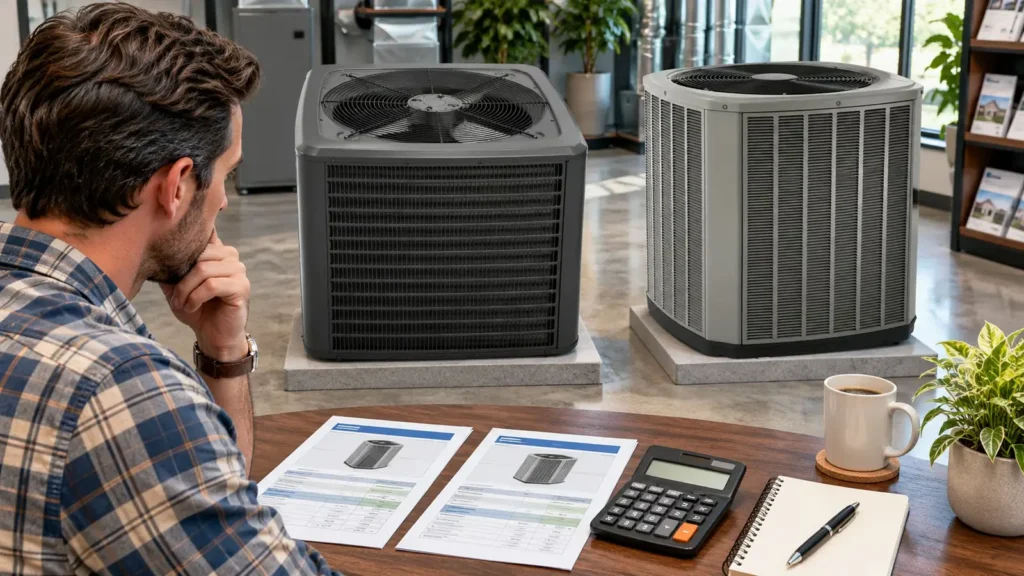
14 vs 16 SEER2: a 16 SEER2 central AC uses 12.5% less electricity than a 14 SEER2 model. For a typical 3-ton system, that saves about $100 a year in the North and about $166 a year in the Southeast, compared with the 14.3 SEER2 minimum there, at today’s average power price. Since the higher-efficiency unit usually costs about $800 to $1,300 more installed, it pays back in roughly 5 to 8 years in the Southeast but takes 8 to 13 years in the North.
Below, we first show the math by region, then explain the federal minimums that limit your choice and list the cases where the upgrade pays off. Information checked on November 4, 2026.
14 vs 16 SEER2 at a glance
| 14 SEER2 | 16 SEER2 | |
|---|---|---|
| Electricity use | Baseline | 12.5% less |
| Typical installed price tier | $6,700–$9,300 (14.0–14.7 SEER2 tier) | $7,500–$10,600 (15.0–17.2 SEER2 tier) |
| Allowed in the North | Yes (minimum 13.4 SEER2) | Yes |
| Allowed in the Southeast and Southwest (under 45,000 Btu/h) | No (minimum 14.3 SEER2) | Yes |
| ENERGY STAR threshold (15.2 SEER2) | Below it | Above it |
14 vs 16 SEER2 savings: the math by region
To estimate savings, we used DOE’s own assumptions from its federal buying guidance: a 3-ton (36,000 Btu/h) central AC running the equivalent of 3,409 hours a year in the Southeast, 1,599 in the Southwest and 1,705 in the North. We then priced electricity at 18.16 cents per kWh, the U.S. residential average that EIA reported for August 2026.
| Region | Baseline model | Baseline yearly cost | 16 SEER2 yearly cost | Yearly savings | Simple payback |
|---|---|---|---|---|---|
| Southeast | 14.3 SEER2 | $1,559 | $1,393 | $166 | 4.8–7.9 years |
| Southwest | 14.3 SEER2 | $731 | $653 | $78 | 10.3–16.7 years |
| North | 14 SEER2 | $796 | $697 | $100 | 8.0–13.1 years |
In other words, the upgrade pays for itself well within the system’s life in the Southeast. In the North and Southwest, by contrast, payback is slower. Even so, DOE’s guidance assumes a 24-year life in the North and 25 years in the Southwest, so the extra cost can still be recovered over time. Keep in mind that these are simple, undiscounted figures.
Federal minimums limit your options in the South
First, where you live decides whether a 14 SEER2 AC is even an option. According to AHRI, split central ACs in the North must reach at least 13.4 SEER2. In the Southeast and Southwest, however, the minimum is 14.3 SEER2 for systems under 45,000 Btu/h and 13.8 SEER2 for larger ones, and the rule applies by installation date. As a result, southern buyers are really comparing about 14.3 versus 16 SEER2.
DOE’s federal guidance lists the Southeast as Alabama, Arkansas, Delaware, Florida, Georgia, Hawaii, Kentucky, Louisiana, Maryland, Mississippi, North Carolina, Oklahoma, South Carolina, Tennessee, Texas, Virginia and the District of Columbia, plus Puerto Rico and the U.S. territories. Meanwhile, the Southwest covers Arizona, California, Nevada and New Mexico.
When is 16 SEER2 worth it over 14 SEER2?
- You live in a hot climate with a long cooling season, so the AC runs many hours a year.
- Your electricity rate is above the national average, which increases the yearly savings.
- Also, you plan to stay in the home long enough to recover the extra cost.
- Local utility rebates shrink the price gap; for this reason, check the ENERGY STAR rebate finder before you buy.
- The higher-SEER2 model also has a two-stage or variable-speed compressor, which removes more humidity, according to Carrier.
On the other hand, 14 SEER2 often makes sense in the North if you run the AC for only a few months a year, plan to move soon or need the lowest upfront price. Similarly, This Old House calls 16 to 17 SEER2 the sweet spot for most homes and says most efficiency upgrades pay back in seven to 12 years.
Installation matters as much as the rating
After all, a high rating only counts if the system is installed well. ENERGY STAR says right-sizing, correct airflow, the proper refrigerant charge and sealed ducts all affect real-world performance. Likewise, DOE’s federal guidance notes that oversizing, improper charging and leaky ducts cut efficiency and shorten equipment life.
So start with the right size; our guide on what size AC you need explains how. Then compare installed prices in our AC replacement cost guide.
Related guides: See also our guide on how long a central AC lasts.
14 vs 16 SEER2 FAQ
Is 16 SEER2 the same as 16 SEER?
No. SEER2 uses a newer test procedure that took effect on January 1, 2023, so the numbers run lower than old SEER ratings. For example, AHRI says 13.4 SEER2 is equivalent to 14 SEER and 14.3 SEER2 to 15 SEER.
How much more does a 16 SEER2 AC cost?
Based on HomeGuide’s installed price tiers, expect roughly $800 to $1,300 more than a 14 SEER2 system. Still, brand, size and compressor type also move the price.
Does a 16 SEER2 AC qualify for a tax credit?
Not in 2026. The IRS says the Energy Efficient Home Improvement Credit applies only to improvements made through December 31, 2025.
Can I install a 14 SEER2 AC in Texas or Florida?
Not a split system under 45,000 Btu/h. Both states are in the Southeast region, where the minimum is 14.3 SEER2, according to AHRI and DOE’s regional list.
Sources and review
Sources: DOE FEMP, purchasing energy-efficient residential central air conditioners (updated December 2024); EIA, Electric Power Monthly, Table 5.6.A (August 2026 data, preliminary); HomeGuide, AC replacement cost (July 25, 2025); AHRI, 2023 energy efficiency standards; ENERGY STAR, HVAC quality installation; This Old House, HVAC replacement cost (September 2, 2026); Carrier, single-stage vs two-stage vs variable-speed (October 27, 2026); IRS, Energy Efficient Home Improvement Credit. All checked on November 4, 2026.
Written by: HVAC Switch. Last updated: November 4, 2026. Read our editorial policy to learn how we research prices, or contact us if you spot an error.