
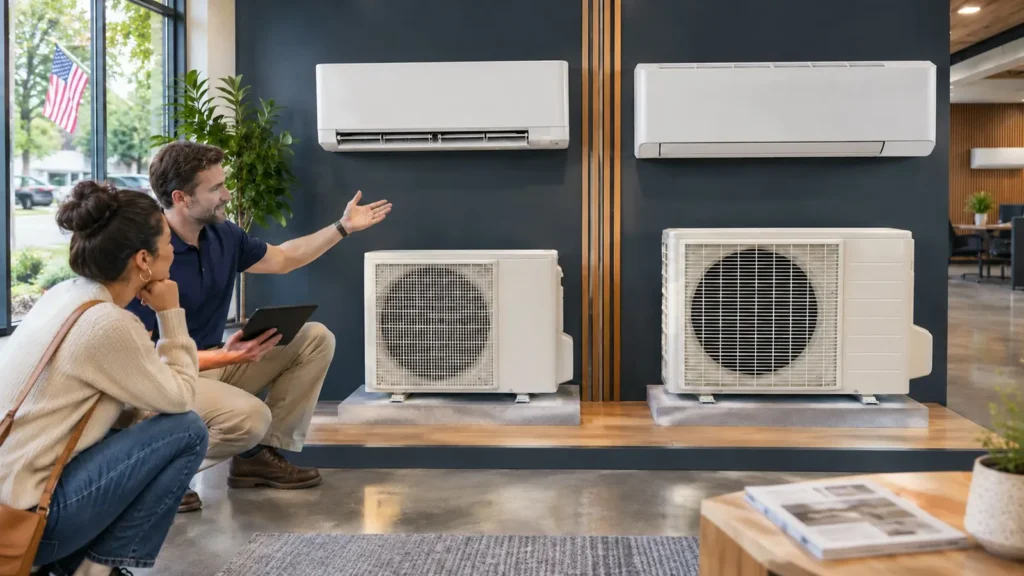
Mitsubishi vs Daikin mini-splits: both are leading ductless brands with strong cold-weather performance and 12-year parts warranties when you meet the registration rules. Mitsubishi’s Hyper-Heating (H2i) systems deliver 100% of rated capacity down to 5°F, and H2i plus models down to −5°F, while Daikin says its Aurora heat pumps keep 100% heating performance to 0°F; both brands list operation down to −13°F. The biggest practical difference is the warranty fine print: Mitsubishi’s best terms require a Diamond Contractor or Ductless Pro installer, whereas Daikin’s require online registration within 60 days.
Below, we compare cold-climate performance, efficiency, warranties and installer networks, so you can choose the right ductless system. Specs and terms checked on November 4, 2026.
Mitsubishi vs Daikin at a glance
| Mitsubishi Electric | Daikin | |
|---|---|---|
| Cold-climate line | Hyper-Heating (H2i) and H2i plus | Aurora |
| Full heating capacity | 100% at 5°F (H2i); 100% at −5°F (H2i plus) | 100% heating performance to 0°F |
| Lowest operating temperature | −13°F | −13°F |
| Efficiency (example) | Varies by model | Aurora wall-mount: up to 21 SEER2, 10.5 HSPF2 |
| Best warranty | 12 years parts and compressor (Diamond Contractor or Ductless Pro, registered within 90 days) | 12 years parts (registered within 60 days) |
Cold-climate performance
To begin with, both brands target cold regions. Mitsubishi says its Hyper-Heating systems perform at 100% of rated capacity at outdoor temperatures as low as 5°F, with guaranteed operation down to −13°F; its H2i plus models raise full capacity to −5°F. Daikin, meanwhile, says its Aurora wall-mount keeps 100% heating performance to 0°F and runs continuously as low as −13°F.
In other words, Mitsubishi’s H2i plus models hold full capacity at a lower temperature on paper. Still, both are designed for cold climates, so proper sizing matters more than a few degrees on a spec sheet. For more, see our guide to cold climate heat pumps.
Efficiency and refrigerant
For example, Daikin lists its Aurora wall-mount at up to 21 SEER2 and 10.5 HSPF2, using R-32 refrigerant. Mitsubishi, on the other hand, rates efficiency by model and indoor-outdoor combination; for example, it says its Deluxe wall-mounted FS system with H2i plus is ENERGY STAR certified in all combinations. So compare the exact SEER2 and HSPF2 for the models in each quote.
Warranty: Mitsubishi vs Daikin
- Mitsubishi: 12 years on parts and the compressor, as long as a Diamond Contractor or Ductless Pro installs the system in a single-family home, you register within 90 days and you’re the original owner living in the home. However, an older 2024 Mitsubishi page listed much shorter terms, 1 year on parts and 7 years on the compressor, for other licensed contractors.
- Daikin: 12 years on parts if you register online within 60 days of installation; in Quebec, the term is 6 years.
As a result, with Mitsubishi the installer you choose directly affects your warranty. With Daikin, by contrast, the key step is registering on time.
Cost
Unfortunately, we didn’t find a reliable, current brand-by-brand price comparison for these two mini-split brands. In general, however, HomeGuide puts a single-zone ductless system at $1,200 to $4,000, and Bryant’s 2026 guide estimates $2,000 to $7,000 per zone installed. Our mini-split cost per zone guide has the full breakdown.
Mitsubishi vs Daikin: which should you choose?
- Choose Mitsubishi if a Diamond Contractor is available nearby and you want full capacity at the lowest temperatures with H2i plus.
- Choose Daikin instead if your preferred installer isn’t a Mitsubishi Diamond Contractor and you want a 12-year parts warranty through simple online registration.
- In both cases, get a Manual J load calculation and compare the exact model numbers and ratings.
For more comparisons, see mini-split vs central air and our guide to the best HVAC brands.
Related guides: See also our guides on Carrier heat pump prices and Trane heat pump prices.
Mitsubishi vs Daikin FAQ
Which mini-split works better in extreme cold?
On paper, Mitsubishi’s H2i plus models hold 100% capacity to −5°F, while Daikin’s Aurora holds 100% heating performance to 0°F. Both, however, list operation down to −13°F.
Do I need a special installer for a Mitsubishi warranty?
For the 12-year terms, yes, because Mitsubishi requires a Diamond Contractor or Ductless Pro installation and registration within 90 days.
Does Daikin require registration?
Yes. In fact, Daikin says you must register online within 60 days of installation to get the 12-year parts warranty.
Sources and review
Sources: Mitsubishi Electric Trane HVAC US, heat pumps in extreme cold climates (October 19, 2026); Mitsubishi Electric Trane HVAC US, Deluxe wall-mounted system with H2i plus (March 8, 2021); Mitsubishi Electric Trane HVAC US, Diamond Contractors (October 19, 2026); Mitsubishi Electric Trane HVAC US, register your product; Mitsubishi Electric Trane HVAC US, HVAC system costs (July 18, 2024); Daikin, Aurora R-32 wall-mounted heat pumps; Daikin, standard warranty information; HomeGuide, heat pump cost (2026); Bryant, mini split cost (2026). All checked on November 4, 2026.
Written by: HVAC Switch. Last updated: November 4, 2026. Read our editorial policy to learn how we research prices, or contact us if you spot an error.