
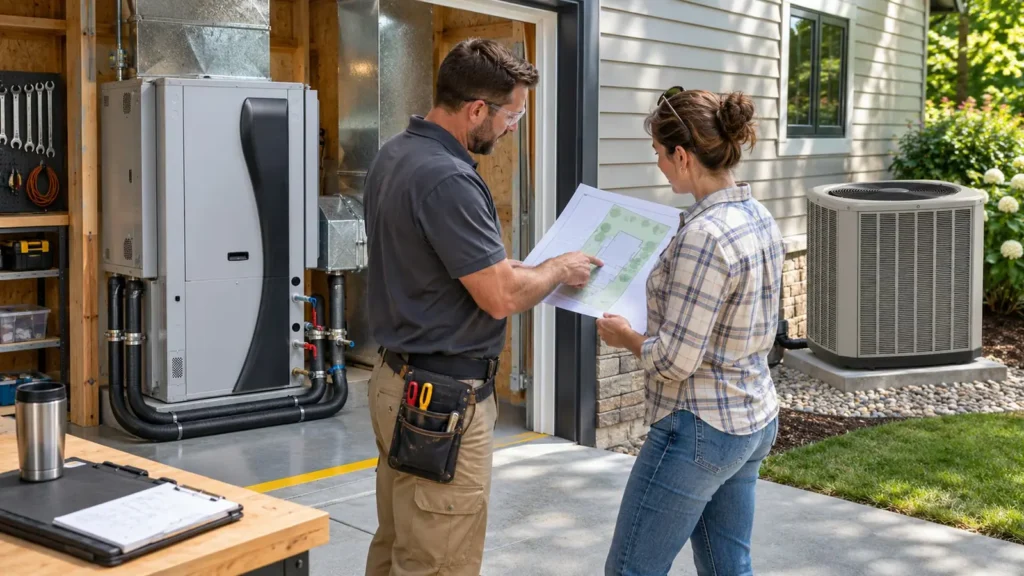
Geothermal vs air-source heat pump: a geothermal (ground-source) system typically costs $15,000 to $35,000 installed, about two to three times as much as an air-source heat pump at roughly $8,000 to $15,000. In return, it’s more efficient, but EnergyRebateCalculator estimates the extra savings over a good air-source heat pump at only about $500 to $800 a year. As a result, with the 30% federal tax credit gone since the end of 2025, geothermal’s extra cost can take 12 to 40 years to pay back.
Below, we compare upfront costs, efficiency, running costs, payback and site requirements, so you can see which system makes sense for your property. Information checked on November 4, 2026.
Geothermal vs air-source heat pump at a glance
| Geothermal heat pump | Air-source heat pump | |
|---|---|---|
| Typical installed cost | $15,000–$35,000 (Fixr, HomeGuide) | $8,000–$15,000 (HomeGuide) |
| Where heat comes from | Ground loops buried in your yard | Outdoor air |
| Efficiency | Highest; DOE says geothermal can cut energy use 30% to 60% | High, but drops in very cold air |
| Space needed | Yard for trenches, wells or a pond | Room for an outdoor unit |
| Federal tax credit in 2026 | None; the 30% credit ended after 2025 | None; the credit ended after 2025 |
Upfront cost: geothermal vs air-source heat pump
Most of geothermal’s cost is underground. In fact, PICKHVAC says drilling or excavating the ground loop often makes up 35% to 60% of the installed price, while the heat pump itself is only 20% to 40%. As a result, a vertical closed loop averages about $30,000 and a horizontal loop about $20,000 in PICKHVAC’s 2025 figures, and This Old House’s 2026 survey found averages of $17,000 for small and medium homes and $30,000 or more for large ones.
Air-source systems, by contrast, need only an outdoor unit and refrigerant lines. HomeGuide lists $8,000 to $15,000 installed, EnergySage’s 2026 average for a ducted system is $14,529, and Trane’s 2026 national averages range from $8,313 to $15,608 depending on the line. For details, see our geothermal heat pump cost guide and our heat pump cost guide.
Efficiency and running costs
Geothermal systems tap the ground’s steady temperature instead of outdoor air, so their efficiency holds up on the coldest days. According to ENERGY STAR, certified geothermal heat pumps use 61% less energy than a standard model and save nearly $830 a year. An air-source heat pump, on the other hand, loses efficiency as outdoor temperatures fall; for example, ENERGY STAR’s cold-climate certification only requires a COP of 1.75 at 5°F.
However, the gap narrows when you compare geothermal with a good air-source heat pump instead of with older equipment. EnergyRebateCalculator estimates that geothermal saves $2,000 to $2,300 a year versus gas heat plus central AC, but only about $500 to $800 a year versus a good air-source heat pump.
Payback: is geothermal worth the extra cost?
| Extra cost of geothermal | Payback at $500 a year | Payback at $800 a year |
|---|---|---|
| $10,000 | 20 years | 12.5 years |
| $15,000 | 30 years | 18.8 years |
| $20,000 | 40 years | 25 years |
In other words, geothermal mostly makes financial sense when the extra cost is small, for example on a large lot where horizontal trenches are cheap, or when local rebates cover part of the loop. Before 2026, the 30% Residential Clean Energy Credit also helped; however, the IRS says it isn’t available for property placed in service after December 31, 2025.
Which should you choose?
- Choose geothermal if you have land for the loop, plan to stay in the home for decades, face a very cold climate or can get strong local rebates.
- Choose air-source instead if you want the lower upfront price, have a small lot or may move within 10 to 15 years.
- Consider a cold-climate air-source model, finally, if you want good winter performance without drilling; our cold climate heat pump guide explains what to look for.
Either way, size the system with a Manual J load calculation, and see our heat pump vs furnace comparison if you’re still weighing gas heat.
Related guides: See also our guides on whether to repair or replace your HVAC and boiler vs furnace. Both systems also replace central air, so compare them with our guide on central AC replacement cost.
Geothermal vs air-source heat pump FAQ
Is geothermal more efficient than an air-source heat pump?
Yes, especially in cold weather, because the ground stays at a steadier temperature than outdoor air. Still, the dollar savings over a good air-source heat pump are modest, about $500 to $800 a year by one estimate.
Is there still a tax credit for geothermal?
Not federally. The IRS says the Residential Clean Energy Credit isn’t available for property placed in service after December 31, 2025. Some states and utilities, however, still offer rebates.
Can I add geothermal to an existing home?
Yes, if there’s room for the loop. Vertical wells fit small lots but cost more to drill, while horizontal trenches need more land.
Sources and review
Sources: Fixr, heat pump installation cost (January 22, 2026); HomeGuide, heat pump cost (2026); PICKHVAC, geothermal heat pump cost (June 27, 2025); This Old House, heat pump cost (October 14, 2026); EnergySage, heat pump costs (March 19, 2026); Trane, 2026 HVAC replacement cost guide; EnergyRebateCalculator, geothermal heat pump cost and payback (June 21, 2026); U.S. Department of Energy, Pump Up Your Savings with Heat Pumps (May 30, 2023); ENERGY STAR, geothermal heat pumps; ENERGY STAR, central AC and heat pump specification, version 6.2; IRS, Residential Clean Energy Credit. All checked on November 4, 2026.
Written by: HVAC Switch. Last updated: November 4, 2026. Read our editorial policy to learn how we research prices, or contact us if you spot an error.