
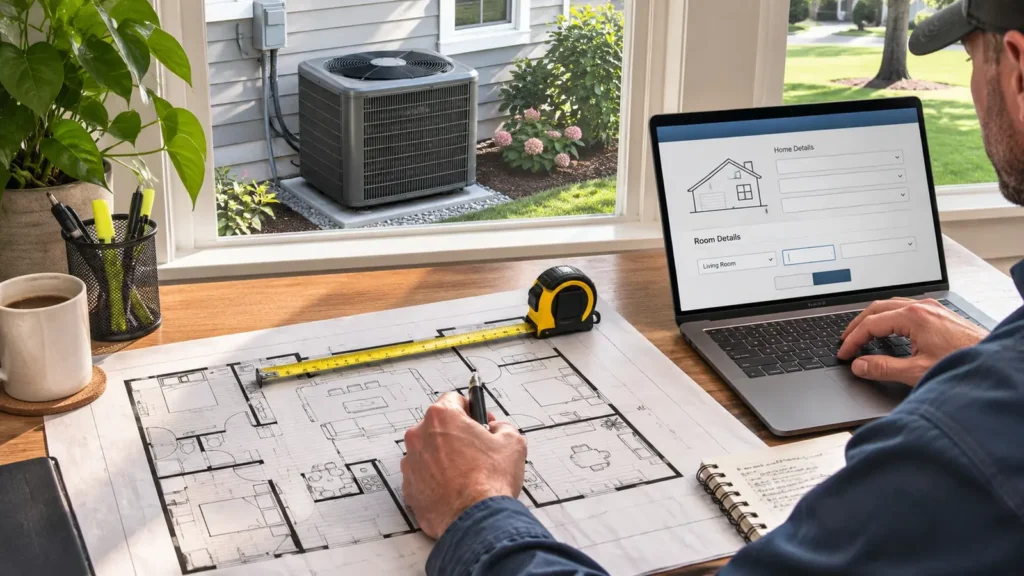
Use this AC size calculator to estimate how many tons, and how many BTU per hour, of cooling your home needs. It works for central air conditioners and for heat pumps, since a heat pump’s cooling capacity is rated in tons and BTU too.
Table checked on November 4, 2026. Still, treat the result as a starting point, because a Manual J load calculation from your contractor should set the final size.
AC and heat pump size calculator
How the AC size calculator works
First, the calculator looks up your square footage in the tonnage table from the SupplyHouse blog. In addition, that table assumes a moderate climate, 8-foot ceilings, average insulation and standard windows.
| Area (sq ft) | Starting size | Cooling output |
|---|---|---|
| 600–900 | 1.5 tons | 18,000 BTU/h |
| 900–1,200 | 2 tons | 24,000 BTU/h |
| 1,200–1,500 | 2.5 tons | 30,000 BTU/h |
| 1,500–1,800 | 3 tons | 36,000 BTU/h |
| 1,800–2,100 | 3.5 tons | 42,000 BTU/h |
| 2,100–2,400 | 4 tons | 48,000 BTU/h |
| 2,400–3,000 | 5 tons | 60,000 BTU/h |
Next, it adjusts that starting size in the direction SupplyHouse describes. A hot climate, an older or poorly insulated home, or strong sun pushes the size up. On the other hand, a cool climate, a newer well-insulated home, or shade pushes it down.
However, SupplyHouse gives the direction of each adjustment, not an exact amount. So the calculator moves the size by one half-ton step, the same step the table uses, and only once. If factors point both ways, they cancel each other out.
For example, SupplyHouse puts a 1,500-square-foot home at about 2.5 tons in a moderate climate. Likewise, it suggests about 3 tons in a hot, humid climate or an old, poorly insulated house. Meanwhile, a new, well-insulated home in a cool climate may need only 2 tons.
Finally, the calculator adds about 10% for each foot of ceiling height above 8 feet. That’s the rough rule SupplyHouse gives for taller rooms.
Why the AC size calculator is only a starting point
Square-foot tables are, after all, rules of thumb. The Department of Energy warns that rules of thumb tend to oversize equipment. As a result, you pay more up front, waste energy and get a system that cycles on and off more often. Instead, DOE recommends sizing with ACCA Manual J, 8th edition.
Real cooling loads also vary widely. In a 2016 post on the ACCA blog, Allison Bailes reviewed 40 Manual J calculations, mostly in hot and mixed climates. The average came to 1,431 square feet per ton, with a range from 624 to 3,325. In fact, only 8 of the 40 homes needed more than one ton per 1,000 square feet.
That’s why the calculator also shows what the 1,431 sq ft per ton average would mean for your home. When the two numbers are far apart, that gap is a good reason to ask for a load calculation before you buy. Also, our Manual J load calculation guide explains what a proper one includes.
Similarly, ENERGY STAR’s quality installation guidance says contractors should size the system for your home’s actual features, not a rule of thumb. Otherwise, an oversized system cycles more, feels less comfortable and may wear out sooner.
Using the AC size calculator for a heat pump
In summer, a heat pump cools your home the same way a central air conditioner does. Therefore, the cooling size from this calculator is a fair starting point for a heat pump as well.
But a heat pump also has to heat your home. DOE notes that cooling loads usually exceed heating loads in the United States, although that isn’t true everywhere. So if you live where winters are cold, also check how much heat a unit delivers at low outdoor temperatures. Our cold-climate heat pump guide covers that, and our heat pump size for 2,000 sq ft page walks through a full example.
AC size calculator FAQ
How many BTU is one ton of cooling?
One ton of cooling equals 12,000 BTU per hour. For example, a 3-ton system delivers about 36,000 BTU/h.
Is a bigger air conditioner better?
No. Both DOE and ENERGY STAR warn that an oversized system cycles on and off more, uses more energy and costs more to buy. For more detail, read our guide on what size AC you need.
What if my home is over 3,000 square feet?
The SupplyHouse table stops at 5 tons for 2,400 to 3,000 square feet. Larger homes may need more than one system or zoning, so ask a contractor for a Manual J load calculation.
What should I do once I know the size?
Next, estimate the price with our HVAC replacement cost calculator. Then compare quotes, and ask each contractor how they sized the system.
Sources and review
Sources: SupplyHouse, What Size AC Unit Do I Need? Tonnage guide; ACCA blog, Manual J load calculations versus rules of thumb (October 20, 2016); DOE Building Science Education, proper sizing of HVAC systems; ENERGY STAR, HVAC quality installation. All checked on November 4, 2026.
Written by: HVAC Switch. Last updated: November 4, 2026. Read our editorial policy to learn how we research prices, or contact us if you spot an error.