
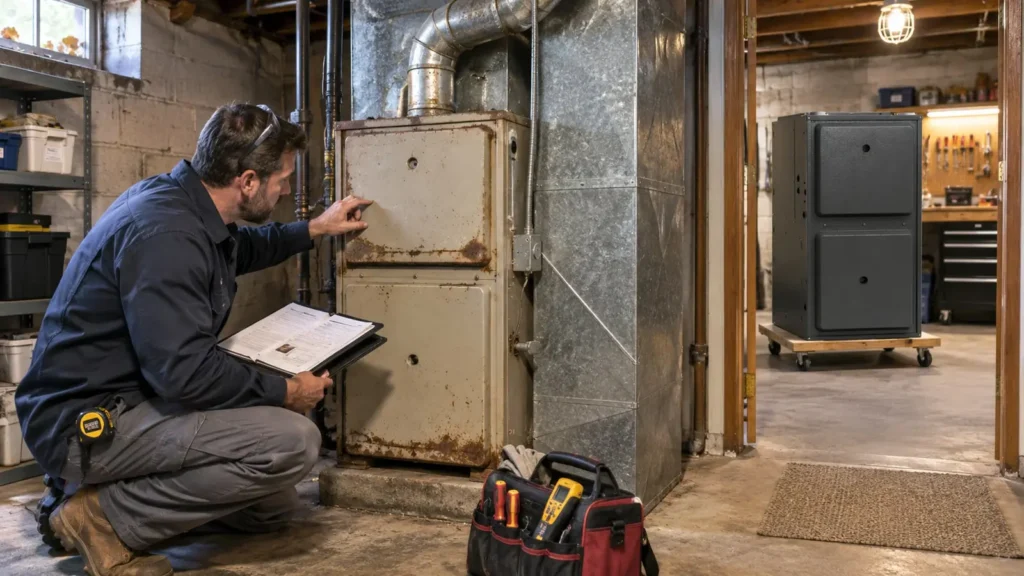
The typical furnace lifespan is about 15 to 20 years, according to Angi, while HomeGuide gives a wider range of 15 to 30 years. Because of that, ENERGY STAR suggests considering a replacement once a furnace is more than 15 years old, especially if it needs frequent repairs or your heating bills keep rising.
Below, we compare lifespan estimates, explain what wears a furnace out, list the warning signs that it’s time to replace and share the maintenance steps that help it last. Information checked on November 4, 2026.
Furnace lifespan at a glance
| Source | Furnace lifespan | Notes |
|---|---|---|
| Angi (2026 data) | 15–20 years | Modern furnace; “up to three decades” in its FAQ |
| HomeGuide (Aug. 27, 2025) | 15–30 years | Depends on brand and usage |
| ENERGY STAR | Replace after 15+ years | Consider an ENERGY STAR model, about 15% more efficient |
In other words, a furnace can run well past 20 years, but efficiency and safety matter more than age alone. For example, Carrier notes that older systems may operate at just 56% to 70% AFUE, while new models reach 80% to 98.5%.
What shortens furnace lifespan?
- Wrong size: an oversized furnace cycles on and off rapidly, which can lead to premature breakdowns, while an undersized one works overtime and wears out sooner, Fixr says.
- Dirty filters: a dirty filter can increase energy costs and damage the equipment, leading to early failure, according to ENERGY STAR.
- Skipped maintenance: likewise, loose electrical connections and parts that lack lubrication reduce the life of major components.
- Heavy use: furnaces in cold climates simply run more hours each winter.
- Poor installation: finally, leaky ducts and bad airflow make the system work harder.
Signs your furnace is near the end of its lifespan
HomeGuide recommends replacing a furnace that is more than 15 years old and needs frequent fixing, or when a repair would cost more than half the price of a new unit. In addition, watch for these warning signs:
- Energy bills keep going up.
- Rooms heat unevenly.
- The furnace cycles on and off often or makes loud noises.
- Dust or soot builds up around the furnace or registers.
- A gas furnace burns with a yellow flame instead of a blue one.
- Fuel lines rust, or a technician finds a crack in the combustion chamber or heat exchanger.
If you ever smell gas, leave the house right away and call your gas utility or 911 from outside.
Furnace safety: don’t skip carbon monoxide alarms
Fuel-burning heating systems can produce carbon monoxide (CO), an odorless, colorless and deadly gas, the Consumer Product Safety Commission (CPSC) warns. For this reason, CPSC recommends CO alarms on every level of the home and outside sleeping areas. It also advises testing them every month and replacing the batteries at least once a year, unless they have sealed 10-year batteries.
If a CO alarm sounds, CPSC says to move outside to fresh air immediately and call 911 or the fire department. Then, don’t go back inside until emergency responders say it’s safe.
How to make your furnace last longer
Routine care is the best way to extend furnace lifespan. ENERGY STAR and CPSC recommend the following:
- Have a professional inspect and service the heating system every year, ideally in the fall before contractors get busy.
- Ask the technician to check gas connections, gas pressure, burner combustion and the heat exchanger.
- Also have electrical connections tightened and moving parts lubricated.
- Inspect, clean or change the air filter once a month during heating season.
- Keep the condensate drain clear if you have a high-efficiency furnace.
As for cost, HomeGuide puts an annual furnace tune-up at $70 to $200 or more. Moreover, many manufacturers require this maintenance to keep the warranty valid.
Late in a furnace lifespan: repair or replace?
If your furnace is under 15 years old and the repair is modest, repairing usually makes sense. By contrast, if it’s older and the repair approaches half the price of a new unit, HomeGuide’s guidance points to replacement. Fixr, meanwhile, puts the average furnace replacement at about $4,800.
For a full price breakdown, see our furnace replacement cost guide. Then read about 80% vs 96% AFUE furnaces and what size furnace you need. If your AC is aging too, see whether to replace both at once.
Furnace lifespan FAQ
Can a furnace last 30 years?
Some do. In fact, HomeGuide’s range goes up to 30 years and Angi mentions furnaces lasting up to three decades. Still, a 30-year-old furnace is far less efficient than a new one, so an inspection is worth it.
Do high-efficiency furnaces last as long?
We found no reliable data showing a different lifespan. However, condensing furnaces have extra parts, such as a second heat exchanger and a condensate drain, that need regular checks.
How long does a furnace last compared with an AC?
Angi puts a furnace at 15 to 20 years and a central AC at 12 to 15 years. As a result, the AC often fails first; see our guide to AC lifespan.
Sources and review
Sources: Angi, new furnace and AC cost (2026 data); HomeGuide, new HVAC system cost (August 27, 2025); HomeGuide, new furnace cost (December 31, 2025); ENERGY STAR, when is it time to replace?; ENERGY STAR, maintenance checklist; Carrier, high-efficiency gas furnaces (October 13, 2026); Fixr, furnace replacement cost (January 28, 2026); CPSC, CO alarms; CPSC, winter heating safety tips (January 23, 2026); CPSC, carbon monoxide fact sheet. All checked on November 4, 2026.
Written by: HVAC Switch. Last updated: November 4, 2026. Read our editorial policy to learn how we research prices, or contact us if you spot an error.