
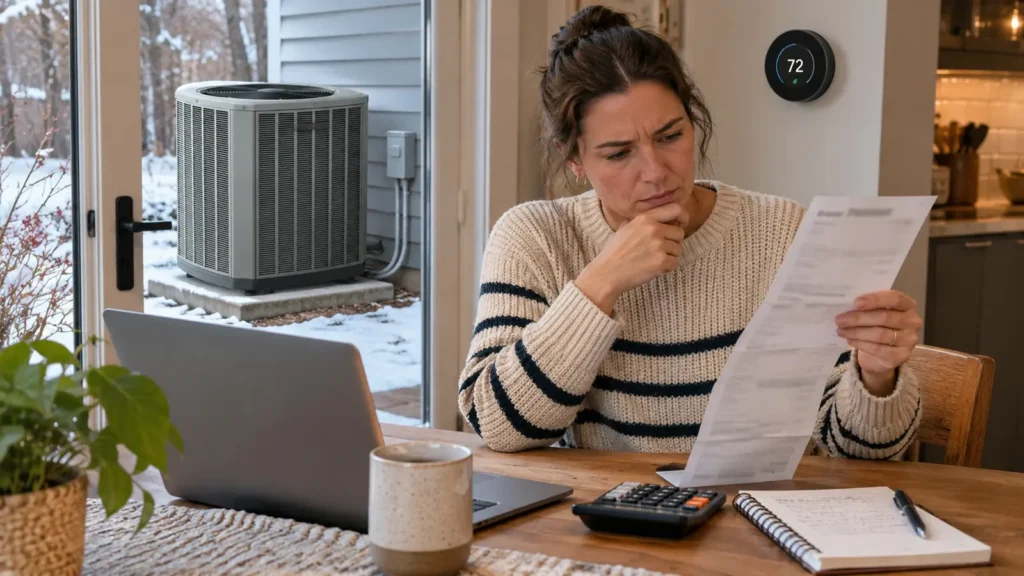
A heat pump high electric bill usually comes from backup electric heat running more than it should, a thermostat setback, colder weather or a maintenance problem such as a dirty filter or low refrigerant. Higher rates matter too: EIA expects homes that heat with electricity to spend about 4% more this winter.
Information checked on November 4, 2026. A sudden jump in kilowatt-hours, not just dollars, is the clearest sign that something is wrong.
Is a heat pump high electric bill normal in winter?
A heat pump runs on electricity, so heating costs show up on your electric bill. As a result, winter bills rise even when everything works. For example, EIA’s Winter Fuels Outlook expects homes that heat with electricity to spend about $1,196 on average from November to March, about 4% more than last winter.
| Region | Expected winter spending, electric heat |
|---|---|
| Northeast | $1,637 |
| Midwest | $1,380 |
| South | $1,079 |
| West | $1,151 |
| U.S. average | $1,196 |
However, a sudden spike is different. According to a heat pump owner’s guide from the Consortium for Energy Efficiency, posted by the U.S. Department of Energy, the most common sign a heat pump isn’t working properly is “a sudden increase in electricity consumption (kWh).” So if you have a heat pump high electric bill, compare your kWh with the same month last year, not just the total.
Common causes of a heat pump high electric bill
Backup electric heat running too often
To begin with, many heat pumps have auxiliary heat, which is electric resistance strip heat. The CEE guide calls this mode “costly and inefficient” and says to consult an HVAC expert if you see frequent use. Similarly, Carrier says to use emergency heat sparingly, because relying only on resistance heat can significantly raise your bill.
| Heat source | Cost per million Btu of heat |
|---|---|
| Electric resistance (aux or emergency heat) | $53.22 |
| Basic heat pump (HSPF2 7.5, about COP 2.2) | $24.21 |
| Efficient heat pump (about COP 3.0) | $17.74 |
In other words, every hour of backup heat costs roughly two to three times as much as the same heat from the heat pump. That’s why a stuck or overused aux heat strip is a common reason for a heat pump high electric bill.
Thermostat setbacks and settings
Above all, heat pumps are efficient with a steady thermostat setting, the CEE guide says. In particular, it advises avoiding abrupt changes of 3°F or more during unoccupied hours. It adds that setbacks typically save energy only if you’re away for more than a day.
Mode settings matter too. For example, the guide recommends Heat mode in winter rather than Auto, and the fan on Auto rather than continuous. Also, if you kept an old furnace as backup, set its thermostat 2 to 4 degrees below the heat pump’s setpoint.
Dirty filters and poor airflow
According to DOE, heat pump efficiency and performance deteriorate if airflow is much less than 350 cubic feet per minute per ton. Therefore, change ducted filters about every 90 days and ductless filters at least monthly, as the CEE guide recommends. Also, clean supply registers and return grilles once a year.
Wrong refrigerant charge
DOE says that too much or too little refrigerant reduces heat pump performance and efficiency, and that systems should be leak-checked at every service call. So if you suspect a leak, see our guide to AC refrigerant leak cost.
Defrost problems
Auxiliary heat may turn on during defrost, the CEE guide notes. Because of that, DOE recommends a heat pump with demand-defrost control, which minimizes defrost cycles and supplementary energy use. DOE also says high winds can cause defrost problems, so shelter the outdoor unit if you can. See our guide to a heat pump freezing up.
Leaky ducts
Finally, Carrier says leaky ducts can lose about 20% to 30% of the air in a typical home. Accordingly, the CEE guide lists sealing duct leaks as part of regular service.
How to fix a heat pump high electric bill
- First of all, pick a comfortable temperature and leave it there, instead of large setbacks.
- Then check how often “Aux” or “Emergency heat” appears on your thermostat.
- Next, replace the filter on schedule and keep vents and returns clear.
- After that, keep at least 2 feet of space around the outdoor unit and clear snow.
- Also, book service every one to two years, as the CEE guide suggests, including a refrigerant and duct check.
- Finally, compare your kWh use with last year’s bills to spot a sudden jump.
If your heat pump is old or undersized, an upgrade may help. For instance, DOE advises choosing the highest HSPF feasible in colder climates. For more, see our guides to heat pump electricity usage, the cold-climate heat pump and heat pump backup heat.
When a heat pump high electric bill needs a technician
Call a pro if your kWh use jumps suddenly, if the thermostat shows auxiliary heat most of the time or if the outdoor unit stays iced over. Lennox also lists sudden bill spikes as a reason to call. Meanwhile, if the heat pump blows cool air, read our guide to a heat pump blowing cold air.
Related guides: If the repair is expensive, run the numbers in our repair or replace calculator. Then compare the repair with our guide on heat pump replacement cost. Also, check that your thermostat suits a heat pump with our guide on smart thermostats for heat pumps.
Heat pump high electric bill: FAQ
Is it normal for my electric bill to go up in winter with a heat pump?
Yes, some increase is normal, since the heat pump now does your heating with electricity. However, a sudden jump in kWh compared with last year usually signals a problem.
Should I turn my heat pump down at night?
Only a little, and gradually, if at all. The CEE guide suggests changing the setting by a few degrees in the evening and morning, and avoiding abrupt changes of 3°F or more.
Does emergency heat use more electricity?
Yes. Emergency heat runs only electric resistance, which costs about $53 per million Btu at average U.S. rates, compared with about $18 to $24 for heat pump heating, by our calculation.
Is a heat pump cheaper to run than a furnace?
It depends on your fuel prices and climate, so check the numbers for your region. See our heat pump vs furnace comparison for regional operating costs.
Sources and review
Sources: Consortium for Energy Efficiency, “You installed an ASHP, now what?” (posted by DOE) (2024); DOE Energy Saver, air-source heat pumps; EIA, Winter Fuels Outlook 2026–27 (October 6, 2026); EIA, Electric Power Monthly, Table 5.6.A (August 2026 data, preliminary); EIA, British thermal units; Carrier, heat pump not heating (September 15, 2026); Lennox, heat pump heat feel cool? (February 17, 2026). All checked on November 4, 2026.
Written by: HVAC Switch. Last updated: November 4, 2026. Read our editorial policy to learn how we research prices, or contact us if you spot an error.