
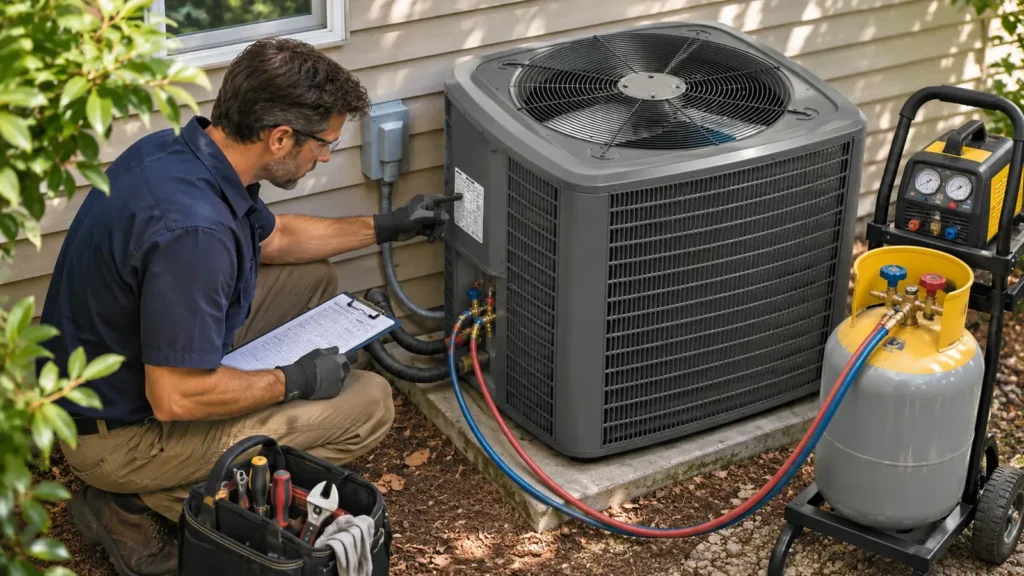
The R-410A phase out means new home AC and heat pump systems now use lower-GWP refrigerants such as R-454B and R-32, while R-410A supply is shrinking under a federal phasedown. If your AC uses R-410A, you can keep using and repairing it; federally, contractors can even install leftover pre-2025 R-410A split systems, although New York still bans that.
Information checked on November 4, 2026. Refrigerant rules changed several times in 2025 and 2026, so confirm current state rules with your contractor.
R-410A phase out: the timeline
| Date | What happened |
|---|---|
| 2024–2028 | The AIM Act requires a 40% cut in HFC production and consumption, according to CRS |
| January 1, 2025 | New residential AC and heat pump systems must use refrigerants with a GWP below 700, ACCA says |
| January 1, 2026 | The original deadline to install pre-2025 R-410A split systems |
| May 2026 | EPA’s final rule lifts that installation deadline nationwide, except where state rules apply |
| 2029–2033 | The HFC cut deepens to 70% |
| 2036 onward | The cut reaches 85% |
What EPA changed in May 2026
On May 21, 2026, EPA issued a final rule that “formally lifts the January 1, 2026, prohibition on the installation” of residential and light commercial R-410A AC and heat pump equipment made or imported before January 1, 2025, according to ACCA. The Federal Register published the rule on May 26, 2026, and ACCA says it took effect 60 days after publication.
In practice, this applies to pre-2025 split systems, not packaged units, Goodin Company explains. Packaged systems still follow a sell-through deadline based on their manufacturing date. Meanwhile, contractors can install leftover R-410A split systems until inventory runs out.
However, the rule doesn’t change the overall R-410A phase out under the AIM Act. ACCA warns that more demand for a limited HFC supply is “anticipated to significantly increase refrigerant prices.”
New York is different
However, New York didn’t get the same relief. According to ACCA, the January 1, 2026 installation deadline remains in effect there under state regulation Part 494. In addition, Copeland’s Jennifer Butsch, writing in ACHR News, says New York treats replacing an outdoor condensing unit as a new installation, which requires a complete system replacement with a lower-GWP refrigerant.
So if you live in New York, the R-410A phase out moves faster: plan on a full A2L system when your R-410A outdoor unit fails. For incentives, see our guide to heat pump rebates in New York.
What the R-410A phase out means for your AC
- You can keep using it. First, Copeland, writing for ACCA, says existing R-410A equipment “will still need to be serviced for many years.”
- Repairs are still possible. Copeland also says its R-410A compressors will remain available to repair existing systems.
- Refrigerant may cost more. ACCA expects higher HFC refrigerant prices, so a leak repair and recharge could get pricier.
- You can’t mix refrigerants. Technicians can’t charge an R-410A system with an A2L refrigerant, or the other way around, according to the same ACCA article.
For current repair prices, see our guides to AC refrigerant leak cost and AC compressor replacement cost.
Repair or replace an AC during the R-410A phase out?
To begin with, age and repair cost matter most. For instance, This Old House suggests repairing an AC under 10 years old when the repair costs less than $1,000, and replacing it when the repair is more than half the price of a new unit. Copeland adds that refrigerant cost and efficiency belong in the decision too.
Also, if you replace the system, plan to replace the indoor coil as well. North Carolina’s fire marshal says you must replace an existing R-410A indoor coil when you switch to an A2L outdoor unit. As a result, a full replacement usually costs more than swapping only the outdoor unit; see our AC replacement cost guide.
Should you buy a leftover R-410A system during the phase out?
It may cost less upfront, but weigh the trade-offs. On one hand, the federal rule allows the installation outside New York. On the other hand, ACCA expects R-410A prices to rise, and future repairs will rely on a shrinking supply. So ask for quotes on both an R-410A system and an A2L system, and compare the total cost.
For more on the new refrigerants, read R-454B vs R-32, and to compare bids, see how to compare HVAC quotes.
R-410A phase out: FAQ
Is R-410A banned?
No. Existing systems can still run, and technicians can still service them. New systems manufactured since January 1, 2025 must use refrigerants with a GWP below 700, but contractors can still install leftover pre-2025 split systems outside New York.
Can I still get R-410A refrigerant for repairs?
Yes. The AIM Act keeps cutting production, though, so ACCA expects prices to rise.
What replaced R-410A?
New systems use lower-GWP refrigerants such as R-454B and R-32, both classed as A2L. For comparison, Carrier says R-454B has a GWP of 466.
Do I have to replace my R-410A AC?
No. Copeland says existing R-410A equipment will still need servicing for many years, throughout its useful life. Even in New York, the state rule doesn’t require replacing existing equipment early, ACHR News reports.
Sources and review
Sources: ACCA, EPA lifts R-410A installation deadline (May 22, 2026); Federal Register, EPA final rule (FR Doc. 2026-10387) (May 26, 2026); Goodin Company, EPA changes to the Technology Transitions rule (August 5, 2026); Congressional Research Service, hydrofluorocarbon phasedown (IF11779) (June 30, 2026); ACHR News, New York’s HFC phasedown (March 1, 2025); ACCA blog (Copeland), repair or replace and the shift to A2L refrigerants (modified August 5, 2025); NC Office of State Fire Marshal, partial replacement with A2L refrigerant (June 6, 2025); Carrier, R-22 refrigerant (GWP figures) (October 8, 2026); This Old House, AC compressor cost (updated August 31, 2026). All checked on November 4, 2026.
Written by: HVAC Switch. Last updated: November 4, 2026. Read our editorial policy to learn how we research prices, or contact us if you spot an error.